Top 15 College Pitchers in the 2026 MLB Draft
Credit: MLB
We are currently only a few hours away from the MLB draft, and there's a lot to watch for in what might be the most confusing draft landscape in the last few years. Will the preseason favorite Roch Cholowsky go #1, or will the Chicago White Sox switch it up and take Grady Emerson? If the White Sox do take Cholowsky, will the Rays go with one of the obvious candidates in Vahn Lackey and Grady Emerson, or will they get creative and cut a deal with Tyler Bell? Will the Georgia Tech all-time leading home run leader go within the top 5 picks? Where will we see Justin Lebron go? How many prep players will go in the first four rounds? Will Brody Bumila end up going to the University of Texas, or will an MLB org still bank on his upside despite his recent UCL injury?
These are all valid questions that look to have completely unpredictable answers at the moment, but among all the potential trends and developments that could arise on draft day, the thing I will be watching for the most is how many College Starting Pitchers go within the first two rounds.
While still strong in its own regard, this year's class of NCAA pitching talent is almost certainly weaker than other classes in recent memory. The depth is comparable to some of them certainly, but there’s a little bit of a lack in true top-of-the-draft talent as we had with Kade Anderson, Jamie Arnold and Liam Doyle last year, Chase Burns and Hagen Smith in 2024, and Paul Skenes and Chase Dollander in 2023.
In my mind, however, this lack of any likely T10 picks besides one player might be a blessing in disguise as it allows the talent of some of the starters that fall in the pick 20–50 range to really shine. There are around 15 guys in this year’s class that really stand out to me as fitting of Round 2 or higher-level selections, and I’ll be personally giving my rankings as well as including writeups on each of the players.
#15: RHP Jack Radel (Notre Dame)
There’s a lot of things to like about the profile of the Fighting Irish ace, but his most noticeable trait is his imposing stature on the dirt. At 6 '5 250 lbs, Jack Radel has a huge frame built to handle a starter’s workload, and he pairs it with pristine release traits. Radel averages >7 feet of extension at release, and as a result, is able to lower his release height to ≈6.1 feet despite his higher arm angle. Radel’s fastball averages 94.2 MPH with great carry and run at 19.6 IVB and 7.6 HB. Radel commands the pitch exceptionally well. He zones it more than 60% of the time, and he can hone it in on the outside part of the plate vs right handed batters exceptionally well. The heater will likely see some whiff regression from the 24.5% rate it’s at currently as Radel moves over to the MLB ball, but his feel for the offering leaves me confident it will still be an above-average pitch at the next level.
Despite sitting in the low 80s, Radel’s slider has been a legitimate weapon. The pitch has a quality gyro shape at 0.5 IVB and -3.6 HB and is able to play above its velocity due to how it’s consistently located well. Opposing batters chased the offering nearly 47% of the time and whiffed against it 43.7% of the time. He will have to rely on finesse and his feel for the offering as he is only able to get a 20.7% Zone Whiff Rate, but he’s shown that it can be a strong enough secondary to support his fastball. Radel also utilizes an intriguing high 80s cutter with a higher vert shape at ≈10 IVB, but it showed pretty poor results this year.
Radel throws his fastball and slider 73.2% of the time. Although he would likely benefit from a wider arsenal, neither his upper 80s changeup nnor his his low 80s curveball have demonstrated the shapes or results to where I think they can be a significant part of his arsenal currently.
Radel certainly has a “What you see is what you get” profile. He’s likely maxed out physically, and he doesn’t spin the ball well enough to dream of getting him to a truly elite breaking ball, but with his release traits, command and solid fastball-slider combo, it's hard to see him not being a Major League mainstay in a back-of-the-rotation role in the future.
#14: LHP Wes Mendes (Florida State)
If you’re a fan of quality left-handed changeups, then Wes Mendes is the player for you! Ignoring my horrible attempt at the slogan, Mendes has an absolutely devastating offspeed. The changeup sits in the low 80s with ≈11 inches of vertical separation from his fastball as well as huge sinking movement at -18.3 HB. Mendes only uses the offering 1/4 of the time vs righties, likely because his command of it can be rough, but it held an absurd 54.5% Whiff Rate and 42.9% Zone Whiff Rate against them.
The arsenal around Wes’s changeup is a little less defined. His fastball sits in the low 90s with solid movement at ≈18 IVB and ≈-9 HB and has generated good amounts of chase and whiff, but I’m a little worried about how the offering will perform with a shape regression at its current velocity.
Mendes doesn’t spin the ball exceptionally well, but despite it, he’s been able to find his way around another 3 compelling secondaries in his Cutter, Slider, and Curveball. The mid 80s cutter doesn’t really project as a whiff pitch due to its more traditional movement, but when paired with his changeup, it gives Mendes another option to keep right-handed batters off their game and suppress damage. The Slider sits in the low 80s with depth at -1.5 IVB, and I could see it becoming a real weapon if Mendes sees a velo boost in his career. His Curveball sits at 77 MPH, but has reached 79 multiple times and peaked as high as 80. It gets incredible depth at -13.9 IVB. Like his slider, it’s seen solid results already and is a pitch I could see becoming an easy + offering if it were to gain a little bump in velo.
Mendes has grabbed 96 on a few occasions, and I could definitely see there being a little more projection to come from his 6'1 195 lb frame. A real 5-pitch arsenal with quality command can be hard to come by, and with Mendes having a true out pitch already to go along with it, there is certainly a lot to like with him.
#13: LHP Cole Carlon (Arizona State)
Cole Carlon starts the run of 3 pitchers I would classify it as a weird evaluation. His most noticeable trait is the absolute catapult height he throws the ball from; Carlon’s 6.5' release height would be within the T10 highest marks among Major League starters. Despite its relatively uninspiring shape in a vacuum, his 86.6 MPH slider was one of the best pitches in all of college baseball, holding a 40.6% Chase Rate, a Whiff Rate of 57.2%, and a 39.3% Zone Whiff Rate. The quality of Carlon’s slider is going to be a huge hinge for how valuable a player he can become, considering he uses it over 50% of the time, and while I’m not quite certain it will perform like the ++ pitch it has given that it doesn’t have any true outlier shapes or create any outlier angles, its still easily a + offering.
Carlon throws his 4—seam hard, averaging 95.9 MPH on the offering — but as a tradeoff for his release height, it’s played more like an average-ish offering with a Whiff Rate of 20.7% and Hard Hit Rate of 44.6%. I’d like to see if he could toy with sinker and possibly even adapt it as his primary fastball given how well it would play off his release.
His Changeup and Curveball round out his arsenal, and although he only turns to them at a combined 8.6% rate, his changeup shows true promise. The mid 80’s offspeed gets roughly 12 MPH and 11 inches of IVB in separation from his heater. It’s seen gaudy whiff rates, but Carlon’s feel of the pitch is still pretty poor.
Considering his command is pretty spotty, there’s huge relief risk in Carlon’s profile, but he possesses mammoth upside if he can make some necessary adjustments to his arsenal.
#12: RHP Joey Volchko (Georgia)
If I had to choose one player in the entire draft class who is hardest to capture in one little blurb, it would almost certainly be Joey Volchko. While he made headlines for his 15-strikeout CG vs Texas, the RHP turned in an equally impressive season when he posted a 3.68 ERA over 95.1 innings with 119 strikeouts.
Because he’s an extreme low-slot supinator, Volchko is unable to get any effective form of ride on his fastball. In his Freshman season, the pitch got 13.2 IVB on average, significantly limiting its ability to generate whiffs despite his premium velocity. Since then, he abandoned the idea of throwing a traditional fastball shape and leaned into his natural bias for cutting the ball. Volchko’s “fastball” is now essentially a 95 MPH Cutter at 6 IVB and -1.3 HB, and it's been a revelation. The pitch naturally performs better vs Left Handed Batters, but it has been able to hold its own vs righties as both a whiff pitch and a damage suppressor as well.
The fastball, or Cutter more accurately, is an above-average pitch, but the real dividends of Volchko’s supination bias are in the gains found in his breaking balls. He has incredible spin capacity for both his Slider and Curveball, with the former getting north of 2900 RPM on average. Volchko goes to the 87.8 MPH bender more often than his primary fastball vs Right Handed Hitters, and for good reason. At its high velocity, the pitch gets wicked sweeping movement and misses bats at a 41.8% rate against them. Volchko uses his Curveball far less than either of his slider or fastball, but it might be the most metrically appealing pitch in his arsenal. It gets huge depth at -13.5 IVB while staying firmly in the mid 80s. Volchko uses it almost completely against lefties, but it’s turned in Whiff rates above 40% with both handedness of the hitter.
There have been attempts by Volchko to throw three more pitches in a sinker, a slower cutter, and a changeup, but none have performed all that well, and he’s struggled to get quality shapes on the sinker and changeup. He will also show issues with command and maintaining a consistent release point. Given these traits, Joey Volchko has his fair share of reliever risk, but if he puts it all together, he could end up being a dependable mid-rotation guy.
#11: RHP Ben Blair (Liberty)
You are not going to find a funkier delivery in the 2026 draft class than you will from Ben Blair. While the general unorthodox movement traits he has when throwing the ball might draw most of the attention, Blair pairs them with incredible release traits. The right-hander gets >6.5 feet of extension down the mound, firing from an incredibly low 4.9' release height.
Blair relies on the fastball a lot. He’s turning to the pitch around 60% of the time, although it's for good reason. Because of Blair's velocity, extension, and low release, his heater comes in incredibly flat to opposing batters, holding a general VAA of -4.4 and -3.8 VAA at the top of the zone. Blair commands the pitch well enough to the point where it’s able to play in most parts of the zone, but it gets most of its swing and miss at the top rails. In the upper third, Blair’s heater holds a whiff rate north of 30%.
Given his release height, Blair gets an outlier amount of vertical break on his Cutter. The league-induced vertical break on Cutters in MLB this year is roughly 8 inches. The number steadily decreases as release height lowers, averaging just 7 inches for release heights lower than 5 feet. Ben Blair is able to get 11.2 IVB on his with above average horizontal movement at -1.5 HB. The pitch does sit in the low 80’s, but it’s still able to miss bats at a 29.5% rate within the strike zone. Blair will also mix in an above-average sweeping slider with -12.1 HB at 83 MPH that misses some bats, and occasionally mix in a mid-80s changeup that will almost certainly be a point of development for whatever organization selects him.
There could possibly be some concerns with the odd delivery traits and how they relate to health, but I think his athleticism should allow him to continue throwing the way he does as long as he is able to maintain a consistent release point and continue showcasing his great command. Overall, Ben Blair offers a package of really fun traits that are bound to be a divisive topic depending on what organization you're asking, but I think he has a really realistic chance to become an impact starter at the next level if he can clean some things up.
#10: LHP Mason Edwards (USC)
Mason Edwards is coming off a truly remarkable year for the Trojans. The left-hander posted a 2.07 ERA through 95.2 innings while leading all of Division 1 baseball with 169 strikeouts. This kind of dominance usually translates to prospects who would fall within the T10 picks, but Mason Edwards is a little weirder.
Edwards fires from a high 3/4 slot, getting average extension down the mound. His most notable quirk is that he relies on his fastball and curveball roughly 92% of the time! This type of heavy pitch reliance can be fine if the pitcher is throwing two offerings that are completely overpowering — see Chase Burns — but I wouldn’t really describe this as being the case with Edwards.
His fastball sits in the low 90s with around 20.8 IVB and -7.8 HB. While this high-vert fastball shape usually translates into + offerings, coming off Edward’s 6.5-foot release height, it's a little less effective. The offering was still solid by all means as it posted a 19.8% Zone Whiff Rate, but it's probably closer to a below-average offering at the next level than it is a real + pitch.
The Curveball was Edward’s money-maker this year. It sits in the low 80s with impressive depth and sweep at -10.3 IVB and 10.6 HB. Edwards had no problem getting strikes with the pitch; Batters chased it at a 33.6% clip and whiffed at it over 60% of the time. It’s an easy + pitch with the deception he can create, but he does not have any outlier command over it, and I’m cautious of the idea of curveballs being a starter’s primary strike breaker without it.
Edwards will mix in his Changeup to right-handers, but it’s still only at a rate of ≈11%. The low 80s cambio posted some pretty gaudy results despite its more average vertical separation from the fastball, running a Whiff Rate of 58.6% and Zone Whiff Rate of 45.7%. I’d imagine whatever organization selects him will attempt to push the usage up significantly.
With Edward’s deception and arsenal of 3 above-average pitches, I still think he has a pretty solid floor with some minimal usage tweaks, but it comes with some more limited upside.
#9: RHP Tegan Kuhns (Tennessee)
The Vols did a great job developing pitching talent for the MLB Draft last year — sending 5 arms within the first 3 rounds — and Tegan Kuhns looks to be the next Tennessee starter who will hear his name selected early.
Kuhns operates with unbelievable athleticism on the mound. He utilizes a leg kick that almost reaches his chin, which would often throw off a lot of analysts, but he does not struggle at all when it comes to maintaining a consistent release point. He throws from a higher arm angle on average, but gets enough extension to lower his vertical release point to ≈5.4 feet.
When it comes to raw pitch mix, there are a lot of similarities between Kuhn’s and his fellow UT grad Liam Doyle. Kuhn’s fastball sits at 94.1 MPH with hellacious riding life at 19.3 IVB and 10.6 HB. This kind of shape coming out of Kuhn’s low release generates an extremely flat VAA of -4.3° and -3.5° in the upper third of the strike zone. Kuhn doesn't locate his fastball in the upper part of the strike zone as much as you would like given how well it plays there, but it’s still easily a + pitch supported by the 29% Whiff Rate it generated this year.
Unfortunately, the similarities between Doyle and Kuhns don’t stop at having overpowering 4 seams, as Kuhns shares the same limited arsenal and fastball reliance concerns. Kuhn's main secondary offering comes in the form of a 76.9 MPH Curveball with average depth. I’ve already expressed my concerns with starters relying on Curveballs as their main secondary offering when it came to Mason Edwards, but it's even more glaring for Kuhns considering that his is at best a below-average pitch.
His slider sits in the low 80s with a pretty solid gyro shape at -1.6 IVB and -1.7 HB, but it’s struggled to miss bats at its lower velocity despite Kuhn's feel for it being pretty solid. Against left-handers, Kuhn’s will mix in a changeup that sits at 83 MPH and has missed bats at a decent mark, but with poorer command.
Kuhns’s strike feel helps ease some of his reliever risk concerns, but they’ll continue to surround his profile as long as he is using his fastball at a 56% rate. I still think there is some projection to come from his lankier frame that could push his two breakers closer to 50 or 55 grade territory, but if there’s not, an MLB org will definitely have its work cut out for them in making Kuhns reach his ceiling of a front rotation arm.
#8: RHP Cameron Flukey (Coastal Carolina)
Cameron Flukey came into the year as arguably the top pitching prospect in the 2026 class. The RHP held a 3.19 ERA through 101.2 innings with 118 strikeouts while repeatedly touching the upper 90s on his fastball, but like every draft prospect he had some questions to answer coming off his sophomore season, and he unfortunately was not able to address all of them as he was limited to 24 innings in his Junior season due to a stress fracture in his rib.
Flukey’s fastball, by all means, should be an elite pitch. It sits around 96 MPH with great vertical movement at north of 19 IVB, and Flukey gets above average extension down the mound at ≈6.5 feet. Through his 2025 and short 2026 campaigns, however, one thing has remained constant for Flukey: his heater has never been able to miss bats effectively. It only posted a Whiff rate of 20.1% in his Sophomore year, and 19.7% this year. Flukey zones his fastball at a really high rate of 59.2%, but he leaves it down the middle quite often. Combine this with him giving hitters the ability to sit on the pitch by throwing it more than half of the time, and you have a recipe for poor fastball results. It would be a lot easier to bank on this issue being fixed if he had a deep mix or a few really good secondaries to support him, but this isn’t really the case.
Flukey is another pitcher who has a Curveball as his most used secondary. It’s gotten good results with a 40% Whiff Rate, but similarly to Tegan Kuhns and Mason Edwards, he doesn’t have outlier command, and it’s not exactly an overpowering pitch as it sits at 77 MPH. His Slider has a firm gyro shape, but it's on the slower side by quite a bit as it sits in the low 80s. He’s attempted to throw a changeup, and it gets good separation in both velocity and vertical movement from his fastball, but his feel for the pitch is rough at the moment.
The name of the game with Flukey is projection. He’s already hit 98 multiple times, and he’ll likely sit in the 97–98 range as he fills out his frame. Velocity gains could help strengthen his secondaries, but even if you assume they go up 2 or 3 MPH, they are still likely 50-grade pitches at best, and it will take a good amount of arsenal refinement and likely new pitch additions to help Flukey reach his ceiling.
#7: RHP Logan Reddemann (UCLA)
Logan Reddemann may not have the eye-opening pitches or traits of some of the starters on this list, but he undeniably gets the job done. The RHP had a really impressive year for the Bruins before having his season ended by arm fatigue in April, posting a 2.87 ERA through 59.2 innings.
Reddemann gets average extension and pitches from a stock release height of roughly 5.8 feet. His fastball sits at 95.1 MPH with above-average life at 17.2 IVB and 10 HB. Given his more standard release height, the pitch will probably be below average on paper when it loses some shape with the MLB ball, but Reddemann has a great feel for locating it at the top of the zone that should help it play up consistently, although he will likely need to cut its usage down from over 50%.
His changeup is a really polarizing offering. The pitch has a copycat shape from his fastball with only ≈4 inches of vertical separation from his fastball. This would usually be a deathblow to the hope of starters wishing to toss an effective offspeed, but Reddemann’s gets whiffs at a 42.3% clip. I still think it will be a below-average offering at the next level, but it's interesting to see how well it's performed when he’s pouring it in for strikes, and I could be wrong considering how weird changeup results can be.
Reddemann will add in both a high 80s slider with solid gyro shape and a low 80s curveball with average depth. Neither pitch will light up stuff models, but it's hard to doubt the impressive amount of whiffs that he’s generated with both of them.
There’s not much upside with Logan Reddemann considering his lack of truly outlier traits or high-octane offerings, but with his consistent feel for landing strikes and sequencing well, he has a pretty safe floor of a backend arm.
#6: RHP Gabe Gaeckle (Arkansas)
Coming off a solid sophomore season in which he posted a 4.42 ERA through 71.1 innings with 92 strikeouts, Gabe Gaeckle was a popular candidate to have a breakout year that would boost his draft stock. Gaeckle’s junior year was a letdown on this front. While he did improve some of his results, his time between the bullpen and rotation was rocky and nowhere near the level of performance that his stuff would indicate. Despite this, the traits of a front rotation starter are still present in him.
Despite his short 6 '0 stature, Gaeckle can generate great extension due to his freakish athleticism. As a result, he’s able to get his release height down to a low 5.2 feet despite firing from an average arm angle. Coming out of this slot, Gaeckle's fastball is a legitimate invisaball. The mid-90s heater gets great vertical life at 17.2 IVB and 8.3 HB with outlier VAA. Unsurprisingly, the pitch gets a lot of chase and plays really well at the top of the zone, and I’d like to see Gaeckle get it up there more in the future.
What makes Gaeckle really appealing is the fact that he isn’t overly reliant on his FB, with a usage rate of just 38.6%, and he pairs it with 3 solidly shaped secondaries. Gaeckle’s most used of the three is a mid-80s slider with solid depth and 8 inches of sweep. His Curveball sits at 81.7 MPH and generates some good bite at -10 IVB. When he’s at his best and locating it down to hitters, it will give them nightmares, but his command struggles limit its effectiveness frequently. Gaeckle throws his changeup a little too hard at 88.5 MPH on average, but it gets an impressive 12 inches of vertical separation from his heater, and he should be able to mold it into a quality offering given time, given his feel for killing spin on it.
The only thing holding Gaeckle back from stardom is his own command. The risk is certainly real, but his stuff is just a touch below true ace level. If he is able to improve his pitch location capacity, even just a little, I think he could be a front rotation arm.
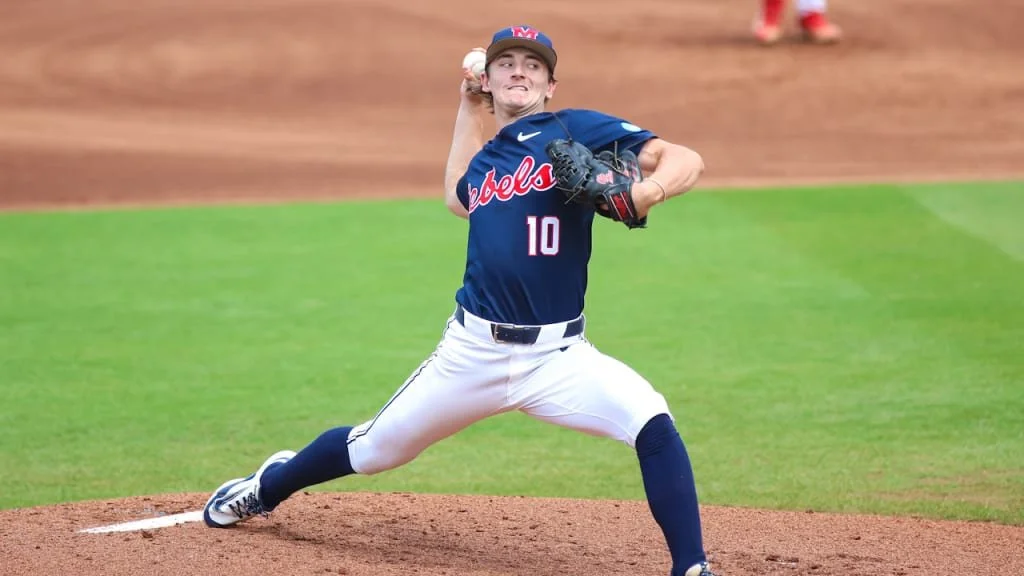
#5: RHP Taylor Rabe (Ole Miss)
Coming into the year, Taylor Rabe was largely an afterthought in the Ole Miss rotation, but he’s done nothing but skyrocket his draft stock since going into the starting role.
Rabe is another guy in this class who extends pretty well down the mound. He throws from a higher three-quarter slot with a release height of around 6.2 feet and generates great velocity from it. His primary 4-seam fastball comes in at 96.1 MPH on average — topping out at 99 — and has shown the ability to miss bats despite its lackluster shape at 15.4 IVB and 10.7 HB.
While he doesn’t have much of a capacity for spin at all, Rabe has a pair of really interesting breaking pitches in his short cutter and depthy slider. The cutter sits in the upper 80s and is definitely closer to a slider shape at 3.9 IVB. Rabe uses the pitch almost equally against left and right-handed batters, and it has seen great results against both. The Slider is used less frequently, but it sits in the mid 80s with an impressive Slurve-like shape, and has generated great results as well when used.
His arsenal is rounded out by a 95.8 MPH Sinker that generates plenty of groundballs. Rabe has tried incorporating an upper 80s changeup in his arsenal vs lefties. The pitch has a solid foundation shape-wise, but his feel for the offering will need some work.
Rabe’s floor is one of, if not the, highest in the entire pitching class. He has four above-average offerings, and he racks up plenty of strikes with all of them. His ceiling is absolutely nothing to scoff at either, considering that you can likely project him to grow into a tick or two more of velocity as he fills out his frame.
#4: LHP Hunter Dietz (Arkansas)
If there’s one odd trend I’m noticing with this year's pitching class, it's that there are a plethora of left-handers throwing from incredibly tall release heights, and Hunter Dietz is among them.
Coming in at 6'6 235 lbs, Dietz operates with a 3/4 delivery that results in a 6.8-foot release height that may as well be as close to the moon as it is the MLB average of 5.7. He’ll sit at 95.1 MPH on his heater, but has run it up to 97 on numerous occasions, topping out at 98. The velocity and outlier release height helped the heater play up for him in college, but it will likely drop to a below-average outing when he transfers over to the Major Leagues, given the pitch’s poor life at 16.8 IVB. Similar to Cole Carlon, I’d like to see Dietz toy around with a sinker given how well it would play with the steeper angles Dietz creates.
Dietz’s most used secondary is his mid-80s gyro slider that gets some solid depth. The pitch is solid from a raw shape perspective, but the extremely steep approach angles that come from his incredibly high release allow the offering to play up significantly. Hitters swung and missed at the offering over 50% of the time, and it wasn’t just great execution, as it recorded a 37.9% Zone Whiff Rate as well. It’s a truly overpowering pitch that should transfer over well to MLB as Dietz has no problem landing it for strikes.
Although he’s mainly a two-pitch guy at the moment, Dietz’s curveball shows big promise. The offering sits around 80 MPH, but with incredible depth at -14.6 IVB. To put that into perspective, the average MLB curveball gets 4 inches less of total movement. Tack on the steep VAA benefits that come from his release, and Dietz easily has another + offering in his arsenal. With a 55.2% Whiff Rate, the pitch performed impeccably well in its limited usage, and whatever team selects the Arkansas Ace will likely want to bring its usage up.
One thing I think could be a huge breakthrough for Dietz against RHB is his developing a dependable changeup. If he’s able to get to a changeup with good separation from his heater, it would be a monster pitch to deal with from his release. He attempted to throw a couple this year, but it had a pretty poor copycat shape, and to say he didn’t turn to it much would be putting it lightly.
Despite throwing plenty of strikes, Dietz has some pretty sizable risk given that he’ll likely need to supplant his 4-seam usage, but with the quality of his breakers and his outlier release traits, I think there could be a future for him as a front rotation starter if all goes right.
#3: RHP Liam Peterson (Florida)
If you want a prototypical power stuff pitcher, then Liam Peterson is almost certainly your guy. Peterson had a disappointing Junior season considering some of his lofty expectations to be a contender for the best pitcher in the class, but he still has all of the elite traits that give him tremendous upside.
Peterson gets roughly average extension, but is able to generate exceptional velocity from his high 3/4 slot. His fastball sits at 96.3 MPH, touching 99 on numerous occasions. The 20.7 inches of vertical break seems extraordinary on the surface, but it looks far flatter to hitters coming out of his 6.7-foot release height. As a result of this, the offering has struggled to induce whiffs, but at the very least, it should be able to ward off damage given how quickly it comes up on hitters.
The real meat of Peterson’s arsenal comes in his 3 secondaries. He turns to his slider 41.7% of the time vs righties, and given how well it's performed, don’t look for it to drop anytime soon. Peterson’s slider gets roughly 2800 RPM on average at 86.4 MPH, and it has a wicked two-plane shape with 4.8 inches of sweep. It’s easily a + offering without context, but when you factor in the steep angles it creates for batters off Peterson’s release and Peterson’s good feel for locating it, the pitch is up there for the best individual breaker in the entire class. Unsurprisingly, hitters were lost against the pitch, as it held a 38.6% Zone Whiff Rate on the year.
Peterson’s changeup developed into his main lefty neutralizer pitch this year, and it saw impeccable results with a 52% Zone Whiff Rate. The offering averages 85.8 MPH with closer-to-average vertical separation from the heater, but it's another offering that plays up tremendously due to the unusual angles Peterson creates, giving him another + or potentially ++ offering in his arsenal. He’ll mix in a low-80s curveball occasionally, and it's been able to generate whiffs at around a 35% rate, giving him a well-rounded arsenal.
Peterson has seen some heavy struggles when it comes to command, but he’s been able to hold his Walk Rate to 10.2%, which is encouraging to see. His stuff is Major-League-ready enough to be in a bullpen tomorrow, and as long as he can hold out his control over command profile, he has a long career ahead of him as a mid-rotation arm with the chance to become much more.
#2: RHP Cade Townsend (Ole Miss)
One of the more interesting trends in modern pitching development has been the continued emphasis placed on pitch mix expansion. One of my favorite Baseball content creators Lance Brozdowski did a video on this topic about a year back, (Link:What is “Pitch Decay”?) and he noted that a large part of this is due to the concept of “Pitch Decay” or hitters gaining familiarity with a pitchers arsenal as they face them multiple times in a game and thus performing better the more times they’ve gone against the pitcher as a result. When pitchers have a smaller arsenal, it's easier for hitters to adjust and vice versa, and there’s nobody in this draft class who makes it more difficult for batters to adjust than Cade Townsend with his 5-pitch arsenal.
Standing at 6 '1, Townsend gets below average extension down the mound, but he shows some athleticism in his delivery and holds his release point very well. His primary 4-seam clocks in at 95.5 MPH with impressive ride at 19.5 IVB, but it doesn’t generate a great amount of whiffs due to his unpredictable feel for it. Townsend has kept this fastball usage at an incredibly low 27.8%, leaving room for him to give hitters a feel for his entire arsenal.
In fact, Townsend's fastball isn’t even his second most-used pitch against right-handed batters in particular, with his slider being his go-to pitch at 32.3% usage. The pitch sits at 85.6 MPH on average with 9.4 inches of sweep, and has been his primary swing-and-miss pitch with a 46.4% whiff rate. Townsend doesn’t zone it much, but has no trouble producing strikes with it as it generates tons of chase away from right-handers.
Townsend’s cutter is his third most-used offering, and surprisingly the second most-used vs RHB. It sits in the mid-high 80s to mid 90s with a sharp 3.2 inches of cut. What makes the pitch so intriguing is the split profile it has versus different-handed batters. Using the pitch so often vs Right Handers is a really odd trait, but it’s hard to doubt it being successful when it holds a 34.4% Zone Whiff Rate against them. The pitch has seen poor results when used against left-handers, as they hit it harder than would be desired, but it’s still a + offering. Townsend pairs his odd cutter with an extreme north-to-south curveball that might be the most interesting piece of his entire arsenal. Townsend throws his curve hard — averaging ≈83 MPH on the offering and peaking at 85 MPH and it gets unbelievable depth at -14.5 IVB. He struggles to land the pitch for strikes, but if he can clean up his command, the offering has all the marks of one of the top breakers in the game.
Development and further implementation of Townsend’s splitter will likely be a focal point going forward in his career, but upper 80s offspeed has both impressive results and shape for being a pitch he only truly started using this year.
Townsend slashed his Walk Rate to 7.0% this year. With above-average strike-throwing capacity and an arsenal of 5 above-average offerings, it’s hard not to see an easy mid-rotation starter in him at the moment. If he continues sharpening his command and tinkering with his arsenal, I could see him becoming a dependable #2 starter at the next level.
#1: RHP Jackson Flora (UCSB)
Unsurprisingly, Jackson Flora, my preseason SP1, comes in as my personal top pitcher in the draft. Flora put together a legendary season where he posted a 1.24 ERA over 102 IP on his way to winning the 2026 NCAA D1 National Pitcher of the Year. While I do think he’s a little more raw than people will give him credit for, Flora has all the traits you want to see from a top-level pitching prospect.
At 6 '5 205 LB, Flora has the prototypical starter's frame that scouts rave about, with room to grow into even more velocity. Flora uses his longer frame well, getting premium extension down the mound. His fastball sits at 96.1 MPH right now, but considering he’s touched as high as 100 and still has room to grow, it's not hard to see him being a guy who can potentially sit in the 97–98 range in the future. His release point can tend to waver at times, leading to his pitches having a pretty broad range of movement, but at the moment, he gets some solid carry on his heater at 17.5 IVB with a little cutting action. The pitch performed relatively well with a 24.9% Whiff Rate, and it’s a pretty easy + pitch, but I don’t think it’s quite worthy of the ++ mark some evaluators have given it.
A natural supinator, Flora can get to some nutty shapes on his pair of breaking balls. He’ll throw a more traditional low 80s sweeper that gets a crazy amount of movement, but I think the more promising offering is his slider. It sits at 85 MPH, but with a combination of lift and sweep at 5.3 IVB and -11.2 HB that I’ve quite frankly never seen before. If I had to find a comp for it, I think the closest pitch in terms of release and shape similarities would be a right-handed version of the slider that Aroldis Chapman throws. The pitch generated a 40.4% Whiff Rate on the year, but I think this could shoot up the ranks of all sliders if Flora can locate it in more competitive spots in the future, because metrically it might be an outlier pitch.
In his sophomore season, Flora only had his 2 breakers and fastball in his arsenal, so developing a changeup to deal with LHB was a priority going into his draft year. It’s safe to say the new kick change he displayed did not disappoint. Flora holds the pitch in the 1400 RPM region, and at its best, it generates a devastating amount of drop while hovering in the mid 80s. Against left-handed hitters, the offering held an absurd 41.5% Zone Whiff Rate in particular. While the results have been great, Flora's feel for the offering is pretty jagged at the moment. His command of the offering has not been good, and its shape varies tremendously from pitch to pitch, but the makings of another + offering are there.
With Flora’s zone feel and walk rate lagging a little behind some of the other pitching prospects in the class, as well as his struggles with landing consistent shapes on his pitches, I think he’s slightly closer to a blank canvas than he is a true Major League starter at the moment, but next to the canvas is a color palette of front-of-the-rotation traits. He could be a true ace at the next level, and I’m really excited to see how he’ll grow in the organization that selects him.
Conclusion
In the interest of fun and also to give a little quick wrap-up, I figured that I would include a little superlatives list with what I consider the best individual traits among guys on my list. Here they are below.
Best fastball: Tegan Kuhns (Runner-up: Gabe Gaeckle)
Best cutter: Joey Volchko (Runner-up: Cade Townsend)
Best changeup: Wes Mendes (Runner-up: Liam Peterson)
Best slider: Liam Peterson (Runner-up: Cole Carlon)
Best curveball: Hunter Dietz (Runner-up: Cade Townsend)
Best command: Taylor Rabe (Runner-up: Jack Radel)
Best release traits: Ben Blair (Runner-up: Jack Radel)