
Final 2026 Cardinals Mock Draft
Credit: UAA/John Paternoster)
We are just a few hours away from Day 1 of the 2026 MLB Draft. This has the potential to be a franchise-altering draft for the Cardinals, who are positioned to make six selections within the first 86 picks. Armed with the most Day 1 selections and the sixth-largest bonus pool, they have plenty of flexibility throughout the draft.
I’m excited to see how everything unfolds. In this article, I’m making one final attempt to project the Cardinals’ first six selections of the draft.
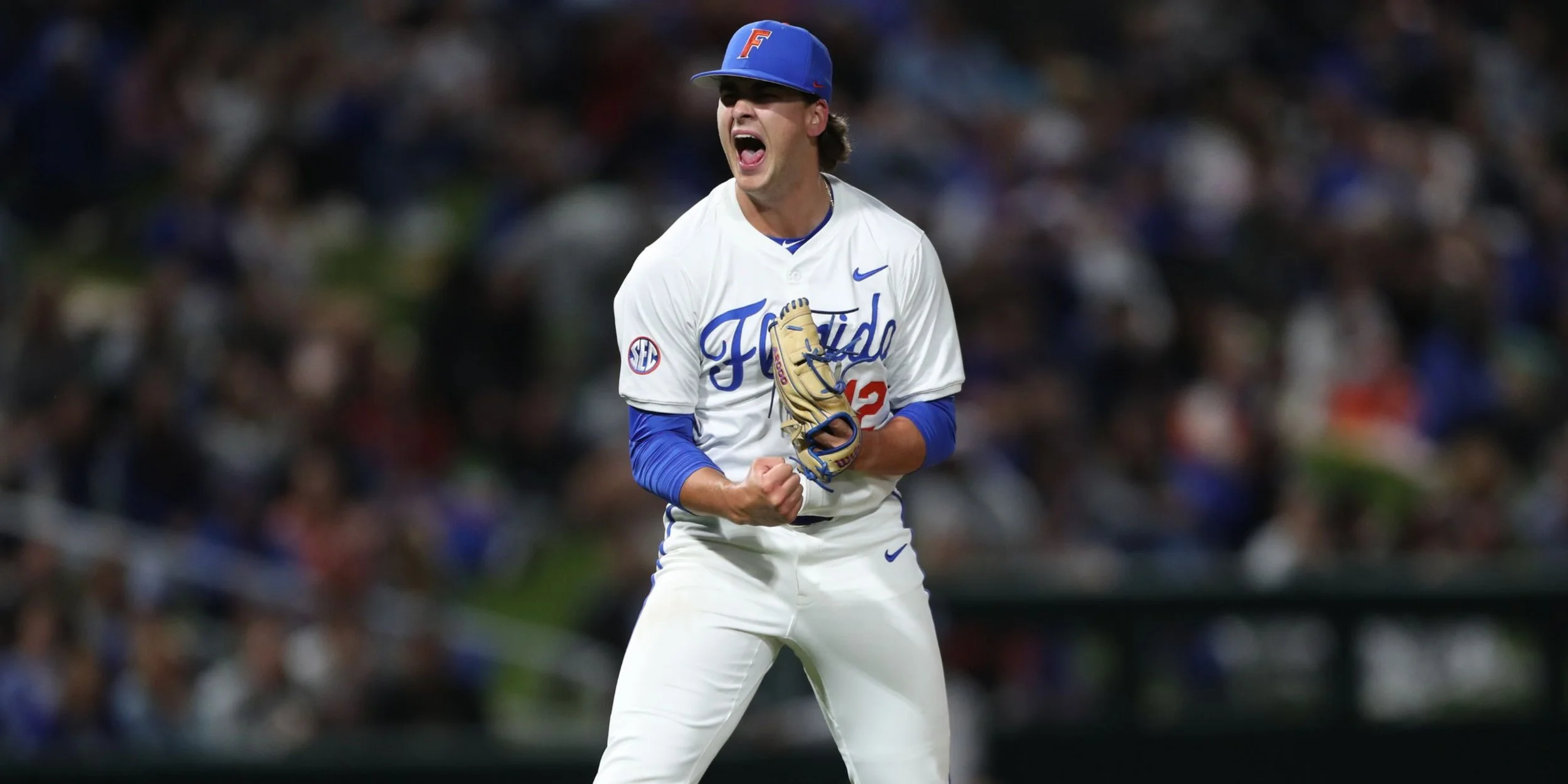
No. 13 (Round 1): RHP Liam Peterson
I expect the Cardinals to target a college player with this pick, and I ultimately landed on Florida right-handed pitcher Liam Peterson.
Peterson possesses some of the loudest stuff in the entire class, headlined by a dynamic two-pitch combination that plays exceptionally well from a steep release point. His fastball averages 96.4 mph with 20.5 inches of induced vertical break from an over-the-top, 6.7-foot vertical release.
Peterson’s calling card is an 86 mph gyro slider that averages more than 2,800 rpm. Hitters produced a 50.5% whiff rate against the pitch in 2026. He also features an 80 mph curveball and a mid-80s changeup with 15 inches of arm-side movement, both of which have flashed as potential weapons.
The biggest concern with Peterson is the inconsistency in his mechanics and command. The Cardinals swung for the fences on a pitcher with ace-level upside last year, and it would not surprise me if they took a similar approach again.
No. 32 (Competitive Balance Round A): SS Taj Marchand
Although I have the Cardinals selecting a pitcher in the first round, I expect them to put a greater emphasis on position players throughout Day 1. That starts here with South Carolina prep shortstop Taj Marchand.
Marchand has an explosive swing that ranked in the 96th percentile in bat speed during the 2025 High School Circuit. It is a powerful, whippy swing that will likely need to be refined in pro baseball, but he has consistently shown a strong feel for making contact.
Marchand is an aggressive hitter, and there are legitimate questions about his swing decisions. He ranked in the fourth percentile in chase rate on the circuit. He will likely enter professional baseball as a shortstop, but I believe he ultimately settles at second or third base, where his athleticism may fit best.
Still, this selection would primarily be a bet on the bat, and Marchand possesses some of the highest offensive upside in the class.
No. 50 (Round 2): SS Tyson LeBlanc
One player I expect to be selected much higher than his current projections suggest is Kansas shortstop Tyson LeBlanc.
LeBlanc enjoyed a breakout 2026 season at Kansas after transferring from LSU Eunice. He went from being a junior-college standout to one of the best players in the Big 12, hitting 25 home runs and posting a 1.131 OPS.
The underlying data is every bit as impressive as the production, and there is not much to criticize within his offensive profile. In fact, his offensive metrics are remarkably similar to those of projected first overall pick Roch Cholowsky.
Cholowsky and LeBlanc are the only college hitters who meet all of the following benchmarks:
Max EV: Above 110 mph
Z-Swing%: Above 65%
Chase%: Below 25%
Whiff%: Below 18%
Ground-ball%: Below 35%
Hard-hit%: Above 48%
Although LeBlanc is also a shortstop, he does not project to provide the same level of defensive value as Cholowsky. Even so, I do not believe his name is being discussed enough. I expect him to be selected somewhere in this range, and he would be an excellent fit for the Cardinals at this spot.
No. 68 (Competitive Balance Round B): OF Carter Beck
One of the top mid-major data standouts in the class, Carter Beck does just about everything well.
Only two hitters in college baseball this season ranked in the 94th percentile or better in average exit velocity, 90th-percentile exit velocity, and in-zone contact rate: Caden Ferraro and Beck. His combination of bat-to-ball ability and raw power is among the best in the class.
Had Beck produced these numbers while playing for a Power Four program, I have little doubt that he would be a first-round pick. His level of competition creates some uncertainty about how the profile will translate against more advanced pitching, but at this point in the draft, the potential reward outweighs the risk.
It is also encouraging that Beck has more than held his own when facing premium velocity and breaking pitches. He is a talented defender as well and projects to remain in center field long term.
No. 72 (Competitive Balance Round B): SS Carson Kerce
I included Carson Kerce in my first mock draft, and he returns as the only player from that version to appear in my final projection.
Kerce put everything together during his junior season for the Yellow Jackets, slashing .384/.473/.679 while setting the program’s single-season record with 29 doubles. He is an above-average bat-to-ball hitter with an excellent feel for finding the gaps, where he does most of his damage.
Kerce consistently produced hard contact this season, recording a 59.7% hard-hit rate on batted balls of at least 95 mph. He also posted an impressive 106 mph 90th-percentile exit velocity.
Defensively, Kerce projects as a versatile player who has spent time at shortstop, second base, third base, and left field during his college career. I see some similarities between Kerce and Cardinals utilityman Thomas Saggese, with Kerce displaying a more advanced approach at the plate.
No. 86 (Round 3): OF Peyton Bonds
Peyton Bonds is a physical specimen, listed at 6-foot-5 and 230 pounds, with impressive athleticism for his size.
The nephew of Barry Bonds, Peyton recorded exit velocities as high as 120.7 mph this season. He also displays impressive bat-to-ball ability for a player with that level of raw power, keeping his whiff rate below 20%.
There are legitimate questions about his swing decisions, as he posted a 38.5% chase rate. His launch-angle profile also needs improvement. Despite the elite top-end exit velocities, he does not currently elevate the ball consistently enough to fully maximize his power.
That said, this selection would be a bet on his physical tools and the belief that pro development can help refine the weaker areas of his game. Bonds is also a rangy center fielder who projects to remain up the middle.
There is sky-high upside here, and in the third round, it would make sense for the Cardinals to take that chance
