6 Players the Cardinals Should Target With Their Competitive Balance Round A Pick
Credit: MLB.com
As we make it closer to the Pick #13 article, we come to the penultimate article in this series as we preview the Competitive Balance Round-A pick #32. Competitive Balance Round picks are only given to teams that are in the bottom 10 in league market size or revenue, and are given out based on factors such as revenue, winning percentage, and market score, per MLB.com. The last time the Cardinals had a pick in this round was 2018, when they selected pitcher Griffin Roberts with the 43rd pick. They had two picks in 2016 in this round, selecting Dylan Carlson and Dakota Hudson back-to-back at pick #33 and #34. You know the drill, let’s get into 6 players we like in this range of the draft.
Tyler’s Picks
OF Chase Brunson (TCU)
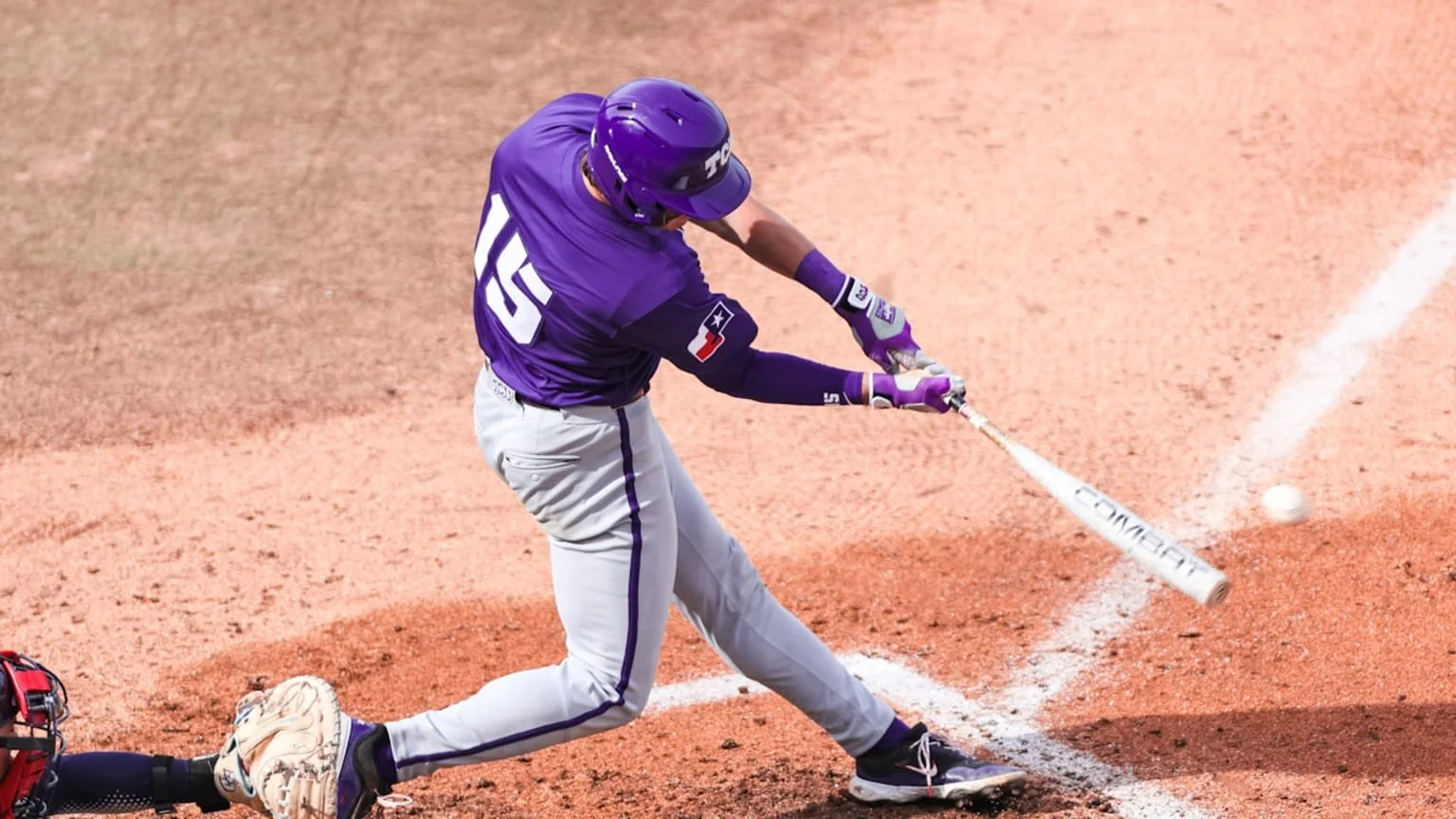
While Brunson was a bit overshadowed by fellow top OF prospect Sawyer Strosnider at TCU, Brunson is likely the more well-rounded player at this current point and projects as one of the higher-floor prospects in this range of the draft. Brunson slashed .304/.462/.556 for a 131 WRC+ with 10 homers and 11 doubles in 51 games for the Horned Frogs. Brunson also showed off a very solid 18.7% strikeout rate to a 14.7% walk rate.
Starting from a slightly open stance, Brunson starts with his hands in front of his back shoulder and the bat at a 45-degree angle. He then uses a shin-high front leg lift as his timing mechanism. He doesn’t bring his hands up, more often opting to drop them to chest level, which allows his swing to stay more level and short. It’s a beautiful swing that allows him to make good enough contact (89% in-zone contact), while his out-of-zone contact is around average at 57.1%.
On the power side, Brunson can more than hold his own with a 90.9 mph average exit velocity, with his 90th EV being 107.8 mph and a max of 111.6 mph. He also hits the ball hard to the pull side consistently with a 42% hard-hit pulled%, which ranked amongst the 73rd percentile in college baseball. He combines these impressive power numbers with a more passive approach (54.7% zone swing) while having both solid chase (22%) and whiff (21.2%) numbers, both of which rank in the 59th percentile or higher. The one concern with Brunson’s hitting profile is that, with the flatter swing, he can get a little ground ball-heavy at times, and he only ran a 19.8% line drive rate, which ranked in the 31st percentile. Besides those slight concerns, Brunson combines power with solid contact rates in the zone and the ability to limit the chase enough to do damage consistently, a very well-rounded offensive profile.
Brunson is a solid defender in center field who should stick there in pro ball. While he doesn’t have the top-end speed of some of the top defenders in this class, he gets solid jumps and uses his instincts to track down balls in the gap, while his arm profiles to be slightly above average in center and more average if he has to move to a corner spot. Brunson is a solid baserunner, stealing 13 bases this season.
Overall, Chase Brunson is a very solid baseball player with a high floor and not many flaws that you can point out in his current game. Standing at 6’3, 200 pounds, there might be a bit more projection in his profile, but most scouts would agree that he might not have the upside of others at this pick. Still, his all-around skillset would make him a very intriguing pick at this spot.
SS/C Cole Prosek (Magnolia Heights HS, MS)
Cole Prosek is arguably the best pure high school hitter in this draft class; his smooth left-handed swing has had him performing well above his peers on the high school circuit for years, and his ability to find the barrel consistently has impressed scouts. He won MVP honors at the Perfect Game All-American Classic at Petco Park last July.
Standing at 6’1, 195 pounds, Prosek uses his body well to stay on time and generate power in his swing. His hands start near his head with his bat hovering over his back shoulder, and he then strides, only picking his foot up a couple of inches off the ground. This allows him to have good adjustability and stay on time. He then uses his quick hands, which whip through the zone, creating solid bat speed and plenty of power. The thing that impressed me the most when watching Prosek’s film is how well he can adjust his hands almost mid-swing to find the barrel and make solid contact.
Prosek dominated Mississippi high school baseball, slashing .595/.685/1.214 with 18 homers and 78 hits in 131 at-bats. He also hit 18 homers to only 13 strikeouts and 31 walks. He also pitched to a 3.16 ERA on the mound with stuff getting into the low 90s, but his future is certainly in the batter’s box. He won every major player of the year award this season in the state of Mississippi, including MaxPreps Player of the Year, Mississippi Gatorade Player of the Year, and PBR Mississippi Player of the Year.
Defensively, Prosek certainly doesn’t have the range or speed of some of his fellow shortstops in this class, and a move to 3B is likely early on in pro ball, I’d assume, where his arm will be above average. While he should play a good 3B, he has mixed in some catcher during this high school season, and the arm strength should be good enough if a team wants to try him behind the plate. Though, being newer to the position means a lot of work will be needed with actions and movement behind the dish, making 3B a more realistic option in my view.
Prosek will be an older high schooler, already being 19 on draft day, but his skillset and consistent loud production on the high school circuit and big events will likely have him going in the first round or very early second round of the draft
RHP Tegan Kuhns (Tennessee)
Note: before I start this write up, after Jackson Flora the mix of college pitchers and where they might go from about picks 15-40 is very much up in the air to this point Tegan Kuhns could very well go 10 picks before #32 or he could go 10 picks after, same goes with arms like Mason Edwards, Cade Townsend, Taylor Rabe, and Liam Peterson. One of these arms will likely be available at 32, but it’s anyone’s guess which one it will be. It’s also why you only see one pitcher in this entire article. Now onto Kuhns.
The Cardinals are no strangers to recent Tennessee arms, picking both Liam Doyle and Tanner Franklin in last year's draft. Kuhns is just the next Volunteer arm in line to be drafted in the early rounds of the draft. Starting the season as the Friday night starter, Kuhns posted a 3.56 ERA in 81 innings, striking out 106 batters while walking only 16 batters. One thing that impressed me with Kuhns is that his production stayed consistent during conference play, posting a 3.52 ERA across 10 starts. His 4.7% walk rate ranked 2nd amongst SEC pitchers while his K-BB% of 26.3% ranked 7th.
One thing that made me skeptical of Kuhns ability early on was the fact that he has a lot of moving parts in his delivery, and with long legs I was concerned that he was going to have some control and body sync issues throughout the season, and while that did show a little bit early in the season, he quelled most of my concerns on that front especially through SEC play. In the windup, he starts with a step back of his plant leg to create some momentum before swinging it through to a very high leg kick, which reaches his upper chest area. He uses the height of the leg kick to generate momentum down the mound, allowing him to get to a lower 5.5 ft release height. With runners on, he opts to ditch the step back, and he instead goes straight into the leg kick, making the delivery look much more streamlined.
Similar to Liam Doyle, Kuhns’ profile is centered around an electric outlier fastball. He throws the pitch at an average of 94 mph from a 5.5 ft release height where he gets 19 inches of IVB, this creates an elite -3.5 VAA in the upper third on the zone, this allowed the pitch to get a 29% whiff rate along with a 32.5% chase rate, also similar to Doyle, he uses the pitch a lot at a 56.1% usage clip. Kuhn’s most used secondary is his curveball (23% usage), which sat in the high 70s this past season with 10 inches of drop. The pitch got a solid 36.5% whiff rate while also producing a good 26.8% chase rate. He also mixed in a low 80s gyro slider, which got a 28.8% whiff rate, and a changeup, which he used 10% of the time, producing a 35.2% whiff rate, though the pitch needs some work metrically to keep anywhere near that in pro ball. Kuhns zones his fastball, curveball, and slider all above 63%, making me pretty confident he’ll be able to throw strikes in pro ball.
While I was skeptical of Tegan Kuhns' profile coming into and during the early part of the season, he rounded into form nicely late during the season, and he looks the part of a first round pick. Some teams may pass on him earlier in the first round, mainly due to some skepticism about his ability to get on the side of the ball to create new pitches, making him have some reliever risk with a more limited arsenal.
Aidan’s Picks
OF Zion Rose (Louisville)
Rose entered the 2026 season with lofty expectations after a strong 2025 campaign, but an injury just before Opening Day forced him to miss time early in the year. Once he returned, however, it was as if he had never been sidelined. Rose picked up right where he left off, producing at a high level over 36 games and finishing the season with an outstanding .417/.491/.646 slash line. There’s a lot to like in his profile, but he does come with some work needed.
Rose sets up at the plate with noticeable hand and bat twitch, creating rhythm before the pitch. He incorporates a pronounced leg kick into his load for timing while doing an excellent job of keeping his weight back, allowing him to maximize his lower-half usage and generate high exit velocities. Once he begins his swing, his body remains quiet and controlled, letting his quick hands and above-average bat speed do the work. The result is a compact, efficient swing capable of producing both consistent contact and quality impact.
Rose has been more of a hit-over-power bat throughout his college career, though he flashed more game power in 2025 by hitting 13 home runs. The underlying data suggests there is raw power in the profile. He posted a 104.6 mph 90th percentile exit velocity and reached a max exit velocity of 110.1 mph, demonstrating the strength to impact the baseball. The biggest reason the home run totals haven't been higher is his batted-ball profile. Rose puts the ball on the ground too often and doesn't consistently get the ball in the air to his pull side when he does lift the ball. Even so, he has the raw strength to drive the ball from foul pole to foul pole, leaving room for more game power if he begins to optimize his launch angles and pull the ball in the air more. Where Rose truly stands out is his elite bat-to-ball ability. He rarely swings and misses, striking out in just 8.6% of his plate appearances while walking at a 10.9% clip. His advanced contact skills give him a high offensive floor, and when paired with his underlying power metrics, there's room for additional game power to emerge.
Rose also brings above-average speed to the table. He possesses natural baserunning instincts, allowing him to impact the game beyond the batter's box, and projects as a player capable of stealing 20 or more bases annually. His combination of contact ability, developing power, and speed gives him the profile of a dynamic offensive contributor.
Defensively, Rose projects best in left field at the professional level. Although he possesses above-average speed, his defensive instincts and routes are still developing, limiting his effectiveness in center field at this stage. His arm grades out around average, making right field a less-than-ideal fit. There is, however, some positional versatility in his profile. If he continues to improve his reads and overall defensive instincts, he has the athleticism to earn opportunities in center field down the road.
There is plenty to like about Rose's profile, especially if a club believes there is still room for development. While he comes with some legitimate concerns, most of them are tied to areas that can improve through professional instruction and experience. The offensive foundation is strong, and if he can unlock more of his raw power while continuing to refine his defensive game, he has the upside to become an everyday contributor. At the same time, the developmental risk creates a wider range of outcomes, giving him both an intriguing ceiling and a relatively low floor.
SS Rocco Maniscalco (Oxford HS, AL)
Maniscalco is one of the youngest draft-eligible prospects in this year's class, having turned just 17 years old on May 1. Entering the MLB Draft Combine, there were questions surrounding the impact potential of his bat. However, he answered many of those concerns by producing multiple exit velocities north of 108 mph, showcasing more raw power than previously believed. When you pair that emerging offensive upside with his advanced defensive abilities, it's easy to see why Maniscalco has become one of the more intriguing prep prospects in the draft.
Rocco features a quiet setup from both sides of the plate, utilizing a small leg kick to help with his timing. His swing differs slightly depending on which side he's hitting from. From the left side, he works with a steeper bat path that helps create more loft and allows him to elevate the baseball consistently. From the right side, his swing is flatter through the zone and doesn't produce the same amount of lift. Overall, his left-handed swing is noticeably smoother and more fluid, giving him a more polished offensive look from that side of the plate, though it’ll be interesting to see what he does from the right side.
Rocco's approach at the plate can be inconsistent, as his swing decisions tend to fluctuate between being overly aggressive and not aggressive enough. While he has the tools to develop an above-average hit tool, improving his contact ability will be a key part of his offensive development. The power upside is more intriguing from the left side, especially after the exit velocities he produced at the MLB Draft Combine, which highlighted more raw pop than many expected. From the right side, however, there are still questions about how much impact he'll produce, making the left-handed swing the more advanced and projectable side of his offensive profile.
Defensively, Rocco projects as a plus defender with the tools to make an impact at a premium position. He pairs plus arm strength with exceptional range, allowing him to cover plenty of ground. His footwork is clean, his hands are smooth and reliable, and he consistently makes quick, efficient transfers from glove to hand. The defensive profile is one of the strongest parts of his game and gives him a high floor as a prospect.
Rocco is one of the more intriguing high school prospects in this year's draft because he combines athleticism, defensive ability, and offensive upside. While he isn't as polished as many of the college bats in the class, his long-term ceiling is considerably higher. There is developmental risk in the profile, but if he reaches his potential, he has the tools to become an impact player on both sides of the ball.
OF Logan Hughes (Texas Tech)
After a breakout 2025 season, Texas Tech entered 2026 expecting Hughes to be one of the anchors of its lineup, and he exceeded those expectations. Over 55 games, Hughes slashed .375/.510/.735, continuing to establish himself as one of the premier hitters in college baseball. The biggest step forward came in his approach at the plate, as he nearly doubled his walk rate from 10.6% to 19.1% while maintaining his power production and keeping his strikeout rate in check. His improved plate discipline elevated an already impressive offensive profile and made him an even more complete hitter.
Hughes sets up with a pronounced bat waggle, moving the barrel from behind his back ear to out in front of his body. He incorporates a small leg kick into his load while doing an excellent job of sitting on his back leg, allowing him to generate power through his lower half. Hughes pairs that strong foundation with above-average bat speed and an uphill swing path designed to produce loft and drive the ball with authority.
Like his Texas Tech teammate Caden Ferraro, Hughes possesses tremendous offensive upside. He finished among the Big 12 leaders in numerous offensive categories, including batting average, slugging percentage, on-base percentage, RBIs, and walks. Much of that production stems from his disciplined approach and impressive combination of raw and game power. Hughes launched 18 home runs in 2026 while posting a walk rate north of 19% and striking out in just 12.8% of his plate appearances. He rarely expands the strike zone and consistently works quality at-bats, though there is still some swing-and-miss in his game, particularly against pitches in the strike zone. The underlying power metrics are equally impressive. Hughes recorded a 107.7 mph 90th percentile exit velocity and a 113.4 mph max exit velocity, giving him the raw power to project as a 20-plus home run hitter at the next level. If he can consistently tap into more pull-side loft, there is even more game power to unlock. Even now, he has the strength to leave the yard to the opposite field, a testament to his overall power profile.
While Hughes' offensive profile carries significant upside, there is considerably less value in the rest of his game. He is a below-average runner, limiting him to a corner outfield role at the professional level, with left field appearing to be his best defensive fit. His arm also grades below average, further reinforcing that projection. Defensively, Hughes remains a work in progress, showing inconsistent reads and overall reliability in the outfield. Because of those limitations, there is a realistic chance he eventually transitions into a full-time designated hitter or, potentially, first base, although his smaller frame is not ideal for the position.
Overall, Hughes' value is driven almost entirely by his bat, and it's a profile that offers considerable offensive upside. If his approach, contact ability, and power continue to translate at the professional level, he has the potential to develop into an impact middle-of-the-order hitter. While his defensive limitations and lack of speed narrow his overall profile, the offensive production is more than enough to make him an intriguing draft prospect.