6 Players the Cardinals Should Target With Their 2nd Round Pick
Credit: USA Baseball
With the draft two weeks away, you guys know the drill. Let’s get into 6 players that Aidan and I are intrigued in for Pick 50 during the upcoming draft.
Tyler’s Picks
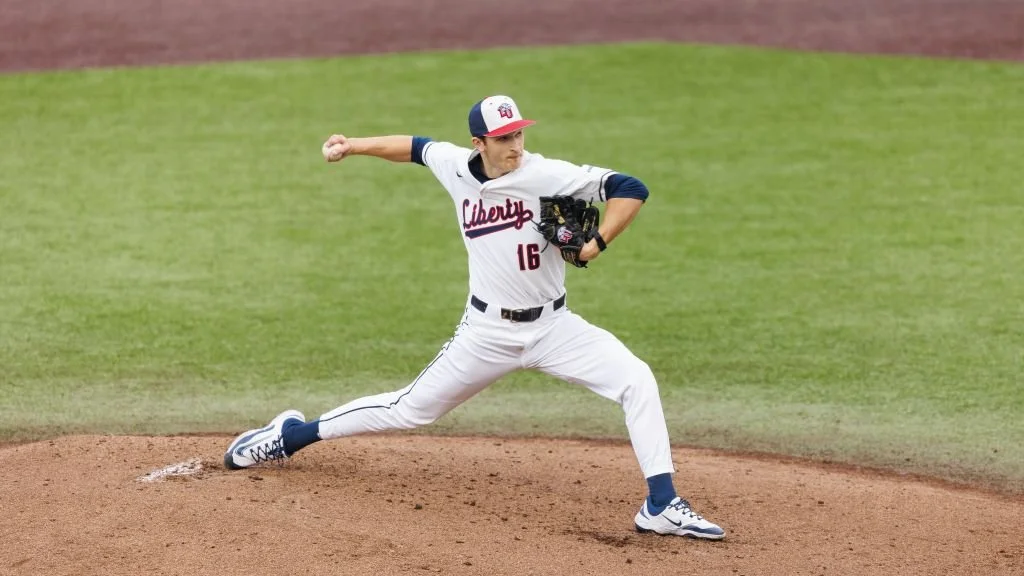
RHP Ben Blair (Liberty)
One of the best mid-major pitchers in the country, Ben Blair put his name on the map due to a mix of unique release traits combined with excellent command. Blair posted a 3.53 across 94.1 innings with 113 strikeouts to a miniscule 17 walks, which comes out to a 24.6% K-BB%. Blair posted double-digit strikeout games against both Hofstra and Harvard early in the season on his way to Conference USA Pitcher of the Year and D1 Baseball All-American Third Team.
Blair’s main trait that will intrigue teams entering the draft is his unique delivery that allows him to achieve one of the lowest release heights in all of college baseball at around a 4.9 vertical release. Blair has a quick pitching action, starting his hands at his chest before raising them to face level. He then employs a waist-high leg raise before a rapid extension of the leg and launch down the mound. This rapid launch down the mound allows Blair to create an elite ~6.7 ft of extension on his fastball from his 6’3 frame. Blair features a low arm slot, which is especially hard for righties to pick up, and adds to an already deceiving delivery.
Blair features a 4-pitch mix, including a 4-seam fastball, sinker, cutter, and slider. The fastball averaged 94.6 mph with 10 inches of IVB from a 4.9 ft vertical release. This allows the pitch to get an elite vertical approach angle of 3.6 in the upper third of the zone, which has allowed the pitch to perform especially well, producing a 23.4% whiff rate with a 29.5% chase rate. The sinker is the second-most-used pitch of his arsenal. The pitch averaged 94 mph with 17 inches of horizontal break and served more as a contact manager for Blair, producing only a 16.7% whiff rate, though batters still swung at it a lot, producing a 28.7% chase rate. Blair features a high-IVB cutter as his third pitch. It averaged around 85.8 mph with 11 inches of IVB to 1.5 inches of horizontal break, and the pitch got an excellent 31.9% whiff rate. Finally, Blair features a low 80s sweeper with 12 inches of horizontal break, creating 29 inches of horizontal separation off of the sinker. The pitch was Blair’s best swing-and-miss pitch, producing a 37.7% whiff rate. He also zones the pitch at a solid 59.5% rate, which makes it a real weapon for Blair.
Blair zones all of his pitches well, with all four of his pitches being zoned above that aforementioned 59.5%, including both the cutter and sinker being strikes 68% or more of the time. This allowed Blair to walk only 4.3% of batters this season, which ranked amongst the best in Division 1 baseball.
Some questions still remain around Blair’s results, given the fact that he pitched in Conference USA instead of the Power 4. Some scouts also question the long-term viability of his arm action and quick delivery, with some scouts thinking he may end up more as a reliever if his body can’t hold up over a longer sample size. Even with these questions, Blair has put himself into this range given his unique release characteristics and command.
SS/OF Luke Williams (Franklin HS, PA)
An MLB Combine standout, Williams has propelled himself into the second-Comp B round range with an impressive array of tools, which include elite bat speed combined with some of the best sprint speed in the class.
A twitchy athlete, scouts will be impressed with the progress he has made over the past few months. At the Super 60 Showcase in Chicago in February, Williams maxed out at 104.8 mph. That increased this past week at the MLB Combine to the 108-109 mph range with a really aggressive swing, which is geared towards loft. Even with a violent swing, he keeps the swing short, which allows him to stay on time better than expected, though he does have a tendency to lunge over the plate a bit.
Defensively, Williams has a lot to like, as he’s been over 100 mph with the arm in the outfield and can sit in the 90s during infield sessions. An ankle injury kept him out of much action during the summer circuit, so some scouts have questions about his ability to play shortstop, though he certainly has the raw athleticism and twitchiness to have plenty of range, and making smoother actions will be a priority in his development. If he can’t stick at short, his 70-80 grade run tool will certainly fit in centerfield, where his arm should be more than fine.
As of right now, Williams is more tools than polish, but with five potential plus tools, it could be a worthwhile pick for the Cardinals in the second round, depending on who they select during their first and second picks. If the Cardinals can maximize his tools, he could be an elite-level player at the next level.
OF Ty Head (NC State)
A top performer in the ACC this season, Head led the Wolfpack with a .291/.460/.556 slash line with 14 homers and 8 doubles in 56 games for a 125 WRC+, manning centerfield. Head is an extremely selective hitter, running a 9.0% strikeout rate to a 22.3% walk rate, which ranks amongst the best in Division 1 baseball.
Head starts his swing with his bat just hovering over his back shoulder before deploying a larger leg kick, in which his front foot comes up to be level with his back knee before getting his foot down and getting his hands through the zone well on what looks to be one of the shorter swings in this draft class. Head makes a lot of contact with a 91% in-zone contact and a 79.4% out-of-zone (OOZ) contact, both being in the 89th percentile or higher, with his 12% whiff rate being in the 94th percentile. Head also makes solid swing decisions with only an 18.1% chase rate, though he could look to be a bit more aggressive in-zone as he ran only a 54.8% zone swing rate. But with his elite contact rates, the low zone swing isn’t a massive concern like it would be for other prospects.
Where Head lags behind his fellow draft prospects in this range is in raw power, as his 85.9 mph average exit velocity, 101.7 mph 90th EV, and 106.9 mph max EV are all below average in college baseball and lag behind a majority of top prospects in this draft. While he runs below-average exit velocity and hard-hit rates (29.6% hard-hit%), he makes up for this a bit by running an impressive 60.9% Pull% on both his line drives and flyballs, which allows his power to play up more than the exit velocities would suggest. If he can continue to add strength while keeping this type of pull rate, he could get to above-average in-game power, even with the lower exit velocities.
Head is an excellent fielder, winning a college Gold Glove for his work in center, and routinely making difficult catches look simple. The arm is just average, but the speed and range are excellent, as he can cover plenty of ground and projects as a plus centerfielder in the majors. That speed also allows Head to steal plenty of bases, with 26 stolen bases to only 3 caught stealing this season.
Overall, Ty Head is an excellent baseball player with plenty of raw tools, which make him one of the better outfielders in this draft class. While the power is below average for now, he makes the most of it by pulling the ball well, and his speed and defense will carry the profile even if the power stays where it is currently. Even then, the contact rates should make him a pesky hitter at the bottom of any lineup.
Aidan’s Picks
OF Caden Ferraro (Texas Tech)
Ferraro is one of the most intriguing prospects in this year's draft class and is expected to hear his name called much earlier than preseason rankings projected. In 2026, he slashed .372/.481/.601 with eight home runs, showcasing one of the highest offensive ceilings in the class. He has a solid approach at the plate and has the tools to develop into an impact hitter. While the offensive upside is undeniable, there are still questions surrounding his long-term defensive profile, which could ultimately influence where he comes off the board.
The 6-foot-2 left-handed-hitting outfielder sets up with a wider stance and shows some twitch in his hands. He incorporates a controlled leg kick into his load to help with timing while keeping his swing mechanics in sync. Ferraro works with a flatter barrel path through the zone, generating excellent bat speed and allowing him to consistently drive the baseball with authority.
Ferraro leaned more toward a hit-over-power approach during his 2026 season at Texas Tech, but the raw power is still very much present. He has the upside to develop into a 25-plus home run hitter, backed by elite impact metrics. His 109.5 mph 90th percentile exit velocity and 114.7 mph max exit velocity rank among the best in Division I baseball. He also took a step forward with his swing decisions, chasing just 20% of pitches while posting an impressive 15.5% whiff rate. Although he struck out in 15.5% of his plate appearances, he walked at an even better 16.7% clip. Ferraro consistently put the bat on pitches in the strike zone, recording a 92.3% in-zone contact rate. Offensively, he was more of a gap-to-gap hitter this season, prioritizing quality contact over selling out for power. Even so, he continued to pull fly balls at a healthy rate, leaving plenty of projection for more game power.
For the Red Raiders, Ferraro spent the majority of the season as the designated hitter but also logged time in the outfield. His defensive profile remains the biggest question in his game. He lacks speed, and his limited range is compounded by slow reactions. While he possesses a solid arm, it may not be enough to profile as an everyday right fielder at the professional level. Left field appears to be his most likely defensive home if he remains in the outfield, though there is a realistic chance he develops into a full-time designated hitter.
Ferraro has the tools to develop into an impact offensive player capable of hitting near the top of a lineup. His combination of bat-to-ball skills and plus raw power provides plenty of optimism that more of his power will translate into games as he continues to develop. While there are legitimate questions about his long-term defensive home and whether he ultimately settles in as a designated hitter, the bat carries enough upside to make him one of the more intriguing offensive prospects in this draft class.
OF Carter Beck (Indiana State)
Beck emerged as one of the top mid-major prospects in this year's draft after an outstanding season at Indiana State in the Missouri Valley Conference. The center fielder slashed .347/.446/.640 while leading the Sycamores with 16 home runs, cementing himself as one of the conference's premier offensive players. His production at the plate, combined with his ability to impact the game defensively in center field, significantly boosted his draft stock throughout the spring.
The 5-foot-11 left-handed-hitting outfielder sets up with a slight bend in his knees and his hands held high. He incorporates a small leg kick into his load and shows subtle bat twitch before beginning his swing. Beck has a smooth, repeatable stroke with excellent rotational acceleration, allowing him to generate impressive bat speed and produce high exit velocities despite his smaller frame.
Beck's breakout season wasn't just impressive from a production standpoint, but the underlying metrics support every bit of it. His 16 home runs were no fluke, as he possesses legitimate raw power, highlighted by a 114.8 mph max exit velocity and a 108.4 mph 90th percentile exit velocity. Despite posting a lower pull-side fly ball rate, Beck consistently drove the ball with authority to all fields. While some may question his approach because of his chase rate, there is little concern about the quality of his bat-to-ball skills. He posted an outstanding 14.6% whiff rate and made contact on 92.4% of pitches in the strike zone. Even when expanding the zone, Beck maintained a solid 67.7% out-of-zone contact rate. He also proved capable of producing against both right-handed and left-handed pitching, further reinforcing the confidence in his offensive profile.
Beck's above-average speed allows him to provide real defensive value in center field. He covers plenty of ground thanks to his range, athleticism, and ability to close on balls in the gaps. His arm grades out around average, but it is more than sufficient for center field and complements the rest of his defensive skill set. Beck has all the tools to remain an everyday center fielder at the professional level.
Beck has the tools to develop into an everyday center fielder at the professional level, though there are still questions about how his game will translate after facing primarily mid-major competition. If the bat performs against professional pitching the way it did in college, he has the upside to become an everyday contributor in center field. At the very least, his athleticism, defensive ability, and offensive skill set give him a solid floor as organizational depth with the potential to provide value in multiple roles.
RHP Gabe Gaeckle (Arkansas)
Gaeckle opened the season as Arkansas' Friday night starter and got off to a strong start before eventually losing his spot in the rotation and transitioning to the bullpen. He returned to the starting role late in the season, making for an up-and-down campaign overall. While the results didn't fully match the expectations entering the year, the underlying traits and arsenal still point to considerable upside. Gaeckle finished the season 6-3 with a 4.14 ERA over 71.2 innings, flashing the type of stuff that continues to make him an intriguing draft prospect.
Standing 6 feet and 180 pounds, Gaeckle features a smooth, repeatable delivery with clean mechanics. He utilizes a high leg kick before driving aggressively down the mound, allowing him to create quality extension toward the plate. One of the more unique aspects of his delivery is his lower release height -- around 5-foot-2 -- which gives hitters a different look and helps his arsenal play up.
Gaeckle features a four-pitch mix, headlined by his four-seam fastball. The pitch typically sits in the mid-90s and reached 97.4 mph during the 2026 season. He generates strong carry on the fastball, averaging just over 17 inches of induced vertical break -- an impressive mark given his lower release height. Combined with its flatter approach angle, the pitch is particularly effective at the top of the strike zone. His primary secondary offering is a mid-to-upper-80s slider that features quality horizontal sweep and vertical depth. It has developed into a legitimate swing-and-miss pitch, producing a 33.1% whiff rate while consistently drawing chases outside the strike zone. The combination of his riding fastball and sharp slider gives him a strong foundation to miss bats when he's locating both pitches effectively.
He complements the fastball and slider with a low-80s knuckle-curve that he throws to both right-handed and left-handed hitters. The pitch features significant horizontal and vertical movement, but it has yet to develop into a consistent put-away offering, generating below-average chase and whiff rates. When left in the strike zone, it is also the pitch hitters have done the most damage against. Gaeckle rounds out his arsenal with a changeup that shows promising shape, though he remains hesitant to use it, throwing it just 11% of the time. Continued development and confidence in the pitch will be critical, particularly against left-handed hitters, as it gives him another weapon to keep them off his fastball.
The ingredients are there for Gaeckle to become a high-end starting pitching prospect. His arsenal features four legitimate offerings with above-average movement and high spin rates, but his biggest hurdle is command. He struggles to consistently fill the strike zone, and when he misses, he often misses by a wide margin. If an organization can help him refine his command and overall strike-throwing, Gaeckle has the upside to develop into a quality major league starter.