10 Prospects the Cardinals Should Be Targeting (Pt. 2)
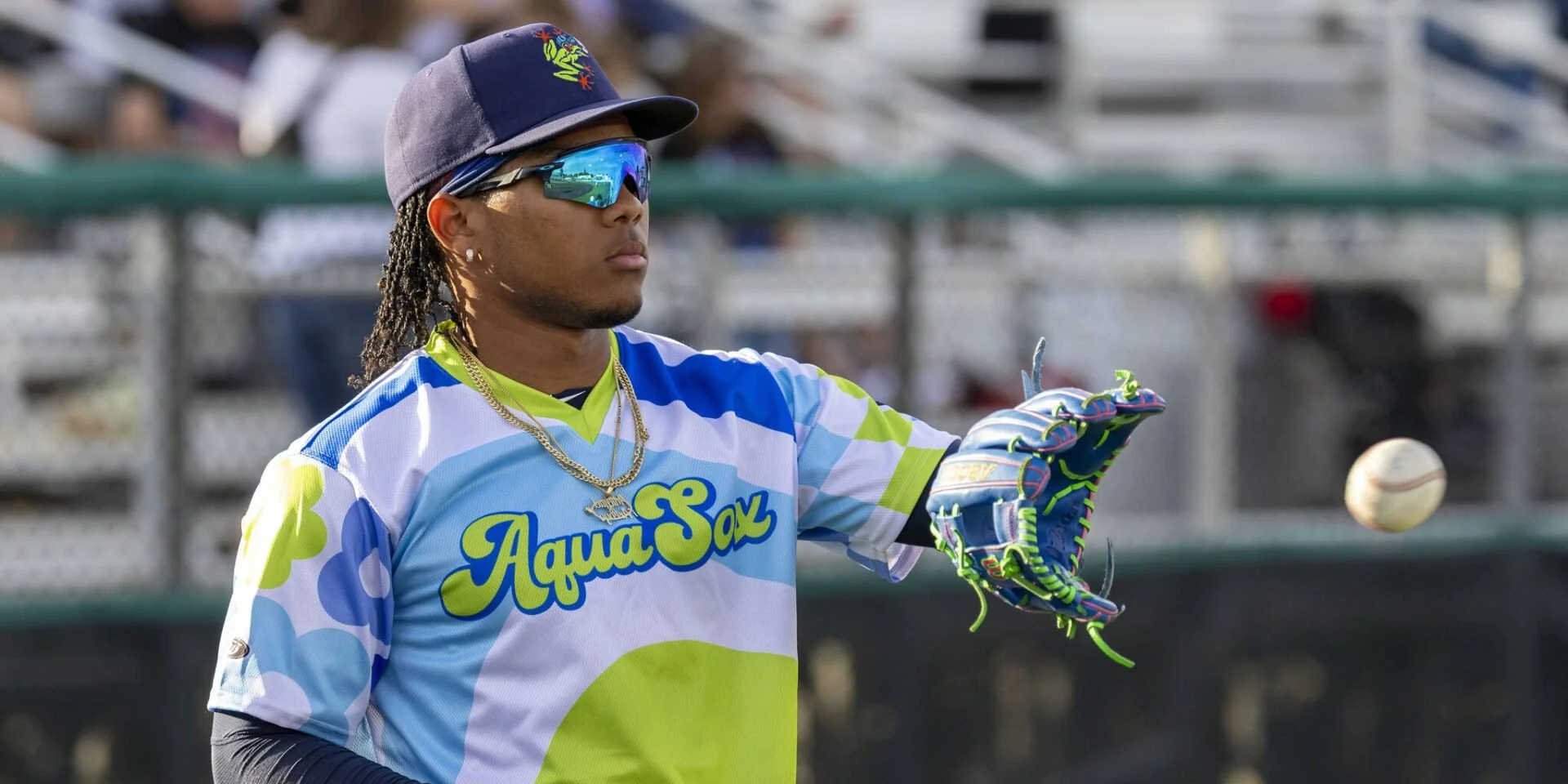
Credit: Evan Morud/Everett AquaSox
Introduction
Before diving in, this section focuses on the final two teams that have reportedly shown strong interest in players like Brendan Donovan and JoJo Romero. I’ll break down the prospects and major-league players within those organizations that the Cardinals should either inquire about or keep on their radar this offseason. While nothing here guarantees that a deal will be completed, there is a realistic path for a trade to materialize. With that in mind, here’s part two of ten prospects and players I believe the Cardinals should target during their selling spree.
Seattle Mariners
INF Michael Arroyo
Arroyo, the Mariners’ No. 5 prospect, is 21 years old and listed at 5-foot-10, 160 pounds. Primarily a second baseman who has begun logging reps in the outfield, he checks many of the boxes the Cardinals’ front office typically values.
The Cardinals are in need of another consistent right-handed bat, and Arroyo fits that profile well. During his 2025 campaign, he hit .262 with a .405/.433/.838 slash line across 121 games split between High-A and Double-A. More importantly, Arroyo has demonstrated advanced swing decisions, rarely expanding the zone. In 2025, he walked at an impressive 12.4% clip while striking out just 18.7%. Across 353 career minor league games, he owns a 20.1% strikeout rate and a 12.6% walk rate - strong indicators of a disciplined, mature approach at the plate.
While his hit tool stands out, Arroyo also offers meaningful power. In 2025, he hit 17 home runs and drove in 54 runs, backed by a 139 wRC+, coming one year after setting career highs in both homers and RBIs in 2024, when he launched 23 homers and collected 89 RBIs.
Defensively, Arroyo has adequate arm strength but could improve his fielding, which may explain why he’s getting reps in the outfield during the winter league. If he does transition to the outfield, his skill set projects best to a corner spot, given his average speed.
RHP/LHP Jurrangelo Cijntje
Cijntje entered the 2024 draft as one of the more intriguing names on the board - not only because of his standout season at Mississippi State, but also due to his rare ability to pitch effectively from both the right and left side. The Mariners selected Cijntje 15th overall, adding yet another high-upside arm to a farm system already rich in pitching talent. Fast-forward to now, and his name has begun to surface in trade conversations involving the Cardinals.
As mentioned earlier, Cijntje is ambidextrous, meaning he can pitch with both arms. However, it’s possible he transitions into a full-time right-handed pitcher in the near future. His fastball is significantly more effective from the right side, featuring improved shape and added velocity - jumping from the low 90s as a left-hander to the high 90s as a right-hander. While his slider may be slightly better from the left side, it still grades as a plus pitch when thrown right-handed. His changeup remains consistent and equally effective regardless of which arm he uses.
Jurrangelo displayed a significant platoon split in 2025, performing far more effectively against right-handed hitters than against left-handed ones. Over 66.2 innings against righties, he struck out 76 batters while issuing just 12 walks and allowing only six home runs. Against left-handed hitters, his results were markedly worse, as he recorded 44 strikeouts against 39 walks and surrendered nine home runs across 40.1 innings pitched.
While I don’t have specific data breaking down which arm was more effective against right or left-handed hitters, video from this past season provides some insight. Jurrangelo’s success against right-handed hitters clearly came from his right arm, while he utilized both arms when facing left-handed hitters. It’s difficult to determine which arm was more effective against lefties, but based on observation, his right arm appeared to have the greater success.
Breaking the fourth wall for a moment - after writing up my observations from the many videos I watched, Redbird Farmhands (who you should follow on X) was able to locate the data I was looking for. I’m happy to report that it confirmed my initial assessment and that the information shared in the paragraph above was accurate - closing the fourth wall.
While the 90th overall prospect in baseball possesses electric stuff, command remains the primary concern for Cijntje. In his first professional season, he walked 11.1% of the batters he faced across 108.1 innings - a rate that would have placed him in the 11th percentile at the MLB level. If he ultimately transitions to a full-time right-handed role, it will be worth monitoring whether his control improves or remains consistent with what he showed during his college career and in 2025.
OF Korbyn Dickerson
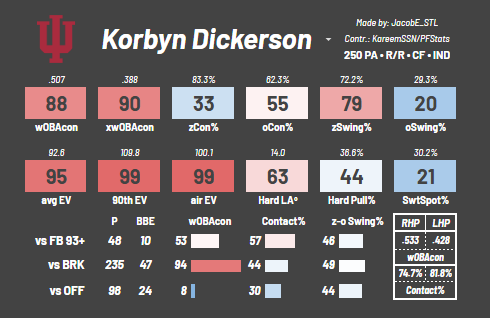
Dickerson was a draft prospect who caught my attention last year and could be a realistic trade target. Selected in the fifth round of the 2025 draft after a strong season with the Indiana Hoosiers, he offers an intriguing blend of upside and risk. There is plenty to like about Dickerson’s game, though it does come with some concerns. Given the Cardinals’ renewed commitment to player development, he represents the type of upside play worth taking a chance on.
Dickerson began his professional career ranked as the Mariners’ 16th-best prospect and was assigned to Low-A, where he appeared in just two games and showed some success - but the sample size is too small to draw meaningful conclusions. His college season provides a much clearer picture: in 271 plate appearances, he batted .314 with an impressive .381/.632/1.014 slash line. As a right-handed hitting outfielder with notable power, Dickerson is a player who fits well within the Cardinals’ system.
While Dickerson’s stat line and 19 home runs are impressive, his swing decisions reveal areas for improvement. He struggled to make contact against quality fastballs over 93 mph, connecting on just 57% of swings. Overall, his zone contact rate (zCon%) sits at a concerning 83.3%, ranking in the 33rd percentile in college baseball, and he chased pitches outside the zone 30% of the time, placing him in the 20th percentile. Despite these challenges, Dickerson’s raw power is evident, with an average exit velocity of 92.6 mph and a 90th percentile exit velocity of 109.8 mph.
Despite some concerns with his hitting, Dickerson’s speed and defense make him an intriguing prospect. MLB Pipeline grades his speed at 60, making him an above-average runner, and combined with solid defensive skills, he projects as a potential center fielder. While his arm is average, his range and speed more than compensate for the lack of arm strength. If properly developed, he has the upside to become a 20/20 player.
Tampa Bay Rays
OF Brendan Summerhill
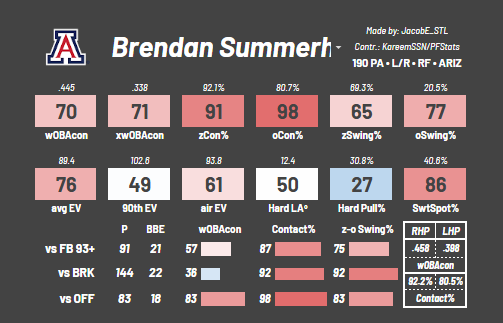
While Dickerson caught my attention, Summerhill was by far my favorite position player in the draft. Selected by the Rays with the 42nd overall pick, he quickly established himself as one of their Top 10 prospects, though he was recently bumped down to 12th following the Shane Baz trade. I believe he could return to the Top 10 in 2026, but if traded to the Cardinals, he would instantly become their second-best outfield prospect and would likely rank inside my personal Top 10.
During his 2025 season at the University of Arizona, Summerhill finished the year batting .343 with an impressive .459 on-base percentage and a .556 slugging percentage. Even more notable was his plate discipline, as he walked more often than he struck out, posting a 17.4% walk rate compared to an 11.6% strikeout rate. That approach carried over into Low-A, where through ten games he walked 14.3% of the time while striking out just 11.9%.
In addition to his excellent swing decisions, Summerhill consistently produces quality contact and does damage on balls in play. He generates strong exit velocities for a hitter whose game is built primarily around contact and shows a natural feel for driving the ball gap to gap. Paired with above-average speed, he profiles as a player capable of producing a high volume of extra-base hits. He also shows clear leadoff-hitter tendencies, a role the Cardinals have been working to solidify for quite some time. While MLB Pipeline grades his hit tool as a 55 - likely due to his lower swing rate - I personally grade it as a 60.
While he’s primarily known for his contact ability, there is some juice in his bat. Currently, he projects as a 10-home-run hitter annually, but with the right development, he has the potential to reach the 15–20 home run range. Most of his power has come to the pull side so far, making it interesting to see how that aspect of his game continues to develop.
While there’s plenty to like offensively, he also has the tools to be impactful on the defensive side. With above-average speed, arm strength, and fielding ability, he has the potential to handle center field at a high rate, even though he primarily played right field in college.
RHP Jose Urbina
Jose Urbina is the Rays number 17 prospect and honestly, he along with Summerhill is underrated. Urbina - who turned 20 in November – signed with the Rays back in 2023 out of Venezuela and has all the raw talent to be a promising prospect. If you really liked Keyner Martinez from the Giants – mentioned in part 1 – you might like Urbina more.
Urbina features a plus-plus fastball that sits in the mid-to-high 90s with excellent run. He shows advanced feel for the pitch, consistently locating it to all four quadrants of the zone. He pairs it with a mid-80s gyro slider that also grades as a plus offering and has generated strong results. Urbina also mixes in a changeup that remains a work in progress, but given the Cardinals’ track record of developing changeups, there is a clear pathway for him to elevate his arsenal and reach an elite level.
In 2025, Urbina posted a 7–2 record with a 2.15 ERA across 96.1 innings pitched in 20 games between Low-A and High-A. During his 19 starts at Low-A, he recorded a 26.4% strikeout rate and an 8.2% walk rate, marking significant developmental progress after previously struggling with higher walk totals and lower strikeout numbers. He also demonstrated an ability to miss bats, highlighted by a 24.3% whiff rate.
Continued development of his changeup will be key to further increasing those whiff rates, particularly as he needs a reliable weapon to combat left-handed hitters. I also like the idea of Urbina adding a sweeper to his arsenal, which would allow him to better expand the zone east and west when paired with a fastball that features natural run and his gyro slider. It will be interesting to see if and how he continues to evolve his pitch mix.
Which team would I make a deal with?
While many tend to value the Mariners’ farm system, there’s something about the Rays prospects that I find even more appealing. You can acquire a strong centerpiece while also picking up reliable secondary pieces - players who, in my view, offer more overall value than what the Mariners currently have. The only question is whether the Rays are even interested - and I’m not so sure they are.