The St. Louis Cardinals’ New Pitching Philosophy
Credit: Eakin Howard-Imagn Images
Introduction
The Cardinals are quietly building their pitching staff around a new idea: targeting pitchers who naturally cut the ball. This strategy highlights how teams are rethinking pitcher development, and the two arms St. Louis recently acquired from Boston demonstrate their commitment to this approach.
Below is a link to a video by Lance Brozdowski analyzing this topic, which I will use to explain why the Cardinals are seeking pitchers with so-called “bad” fastballs.
Bad Fastballs
What is a bad fastball? The “bad” fastball we are discussing today is one that has cut. This occurs when a pitcher throws the fastball more on the side of the ball rather than fully behind it. Unlike the typical “run” that many pitchers generate on their fastball, this pitch moves with cut instead.
As Lance mentions in his video, teams are increasingly targeting pitchers with bad fastballs, or cut fastballs. Why is this the case? Why should organizations pursue these types of pitchers? Now more than ever, having a pitch mix of five to six pitches is crucial for success, as it allows pitchers to deploy different weapons against both left-handed and right-handed hitters. A deeper arsenal forces batters to make more swing decisions during an at-bat. Pitchers with natural cut on their fastballs often have a greater ability to develop more advanced pitch mixes.
So how can teams identify these pitchers? There are two primary indicators. The most obvious is pitchers who visibly cut their fastballs. Another method is identifying pitchers with lower spin efficiency on their fastballs. Both traits can signal the potential to develop multiple pitch types, which we will discuss in more detail later. The Boston Red Sox have been a catalyst for this shift in pitching development, and that is one of the main reasons the Cardinals have frequently traded with them — they consistently develop quality pitching.
Below are the pitch plots from Baseball Savant for the two pitchers acquired from the Red Sox: one from the Wilson Contreras trade and one from the Sonny Gray trade. These plots highlight the arsenals of Richard Fitts and Hunter Dobbins.
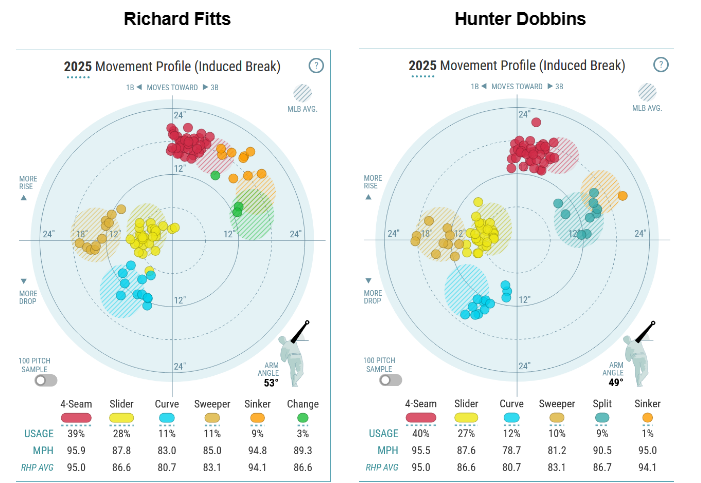
In these movement charts, each colored dot represents a pitch type. The horizontal axis shows side-to-side movement; therefore, pitches closer to the center (near the 0 line) do not move much left or right. Pitches in this area display the cut action that teams covet, and both Dobbins and Fitts fit this philosophy. While their heaters are not special in a vaccum, this trait allows them to develop more advanced pitch mixes. You can also see the MLB average, which appears to the right of both pitchers, indicating where the typical fastball usually plays.
The second way to identify a pitcher who throws a cut fastball is through spin efficiency, which measures how much of a pitch’s spin contributes to its movement. If you are familiar with spin rate, spin efficiency simply reflects how much true spin is translating into movement on the baseball. Sliders typically have lower spin efficiency, usually below 40%. Fastballs, on the other hand, generally exceed 90% spin efficiency. Pitchers with cut fastballs tend to fall closer to the 75% range, as described in the Lance Brozdowski video. Among the Cardinals’ acquisitions, Hunter Dobbins has a spin efficiency of 77%, while Richard Fitts sits at 86%. All of this data is publicly available on Baseball Savant.
Although past scouting philosophies may have penalized pitchers for these traits, modern pitching development views them as positives. Pitchers who naturally cut the ball often have the feel necessary to add new pitches to their arsenal. While these two pitchers are not flashy, their profiles suggest that the Cardinals are embracing new trends to maximize and expand pitching arsenals.
In the Sonny Gray trade, the Cardinals acquired Brandon Clarke and Richard Fitts. Clarke received more attention due to his higher upside, but Fitts provides inexpensive, controllable back-end rotation stability, similar to Hunter Dobbins. This stability allows the organization to take risks on pitchers like Clarke, who possess what Kyle Reis coined (@kyler416 on X) as “reliever fallback.” I like this term because it is not about fearing pitchers becoming relievers, but rather acknowledging that they have multiple viable paths to the major leagues.
Future Outlook
The Cardinals’ pitching philosophy represents a fundamental shift in how the organization evaluates and develops arms. By targeting pitchers with naturally cutting fastballs and lower spin efficiency, they are building a pipeline of pitchers with pitch-development upside and role flexibility. Richard Fitts and Hunter Dobbins currently provide solid rotation depth and stability, which in turn allows pitchers such as Brandon Clarke, Tanner Franklin, Liam Doyle, and others to offer high upside with built-in “reliever fallback” insurance.
By developing arsenals centered around cut fastballs, the Cardinals can cultivate a group of pitchers capable of navigating lineups with deeper pitch mixes. This approach helps limit spending on veteran starters used primarily as stopgaps. Rather than signing pitchers like Lance Lynn or Kyle Gibson, the organization can consolidate those resources into one premier acquisition while maintaining internal options through “reliever fallback” arms and reliable depth pieces like Dobbins and Fitts.
This strategy may not generate headlines in the short term, but it creates sustainable pitching depth and preserves roster flexibility. It also provides space for high-upside pitchers with multiple paths to the majors — exactly the type of structure contending teams rely on.