10 Players the Cardinals Should Target in the 2026 MLB Draft
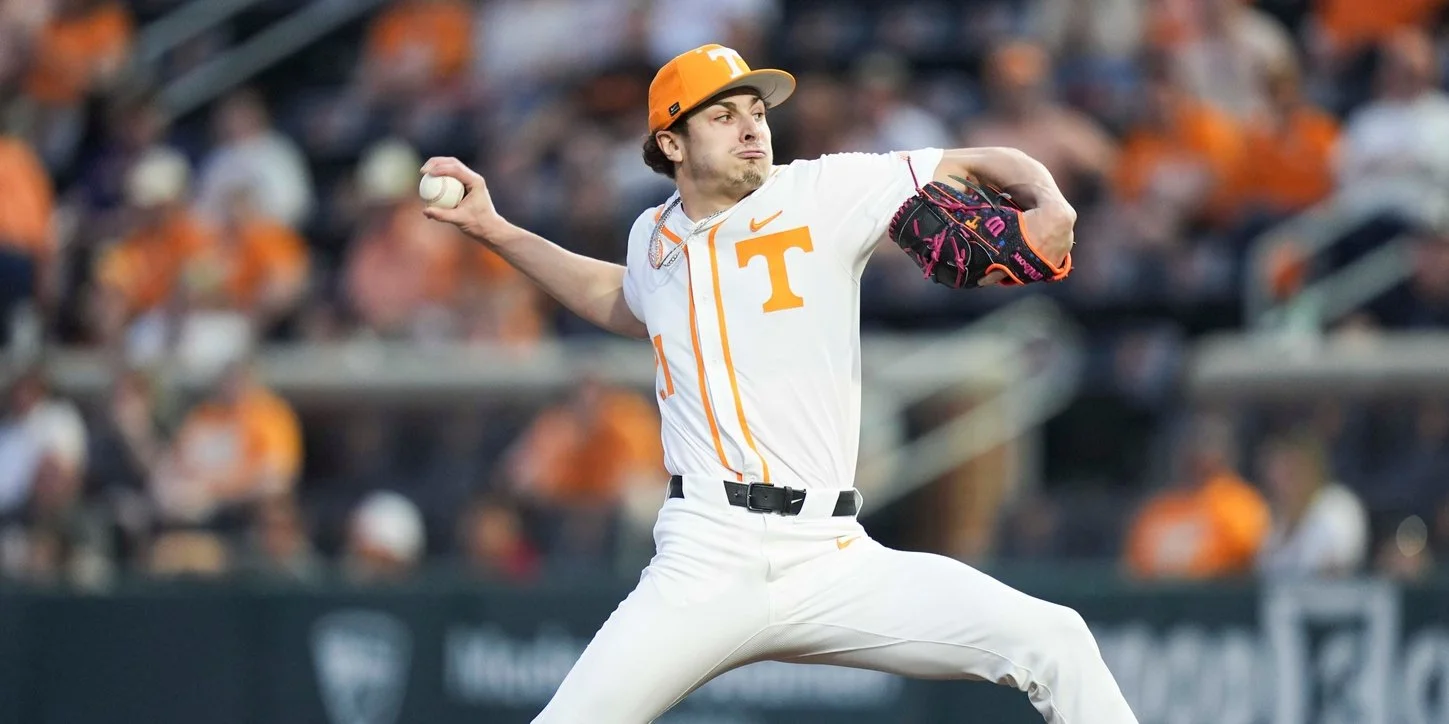
Credit: Caitie McMekin/News Sentinel / USA TODAY NETWORK via Imagn Images
The college baseball season is underway, and it has shown us that this draft class is deep. Each of the following players could impact the Cardinals’ farm system from day one. With the Cardinals holding the 13th pick, here are some names I think we could hear on draft day.
Aiden Robbins - OF, Texas (6’2”, 205 lbs.)
Robbins was at Seton Hall for two years before transferring to Texas this year. In his final season at Seton Hall, he slashed .422/.537/.652 with 20 SB, 44 BB, and 32 Ks. While he hit only six home runs in 53 games, that has changed. He has already hit nine home runs in just 22 games. He has tapped into more power, with a max EV of 112.4, and continues to have success.
Now in the SEC, he is thriving with a slash line of .375/.450/.750, along with 12 BB, 21 SO, and seven SB. He is an above-average fielder, but it is not certain how long he will stick in center field. He profiles as a better power/speed combo in left or right field. Robbins has raked at every stop and is only going to keep getting better. What stands out most is his ability to adjust and perform at every level he has played. He’s truly a gamer.
Robbins does not have an MLB Pipeline overall grade, but he carries a 55 Hit, 55 Power, 50 Field, 55 Run, and 45 Arm.
Teegan Kuhns - RHP, Tennessee (6’3”, 193 lbs.)
Kuhns is a competitor and the current ace for Tennessee. He is armed with an electric arsenal, and through 27 IP he has a 30.4% K rate, 3.5% BB rate, and a 0.98 WHIP.
From the right-hand side, he throws his fastball 56% of the time, and for good reason: it is his best pitch. It sits at 95 mph and tops out at 99, with 20 inches of IVB from a low release point (5’3”) and a -4 VAA. He generates a 36% whiff rate on the pitch. He also throws a gyro slider around 83 mph, generating a 38% chase rate and a 30% whiff rate. His changeup could get even better. It currently sits around 84 mph with 8 IVB and 15 HB, producing a 33% chase rate and a 41% whiff rate.
The changeup in particular has the makings of a true put-away pitch if it continues to develop. Kuhns has been dialed in for Tennessee, and I hope to see him keep performing at this level. He has No. 2 starter upside with an arsenal built to do damage at the major league level.
Per MLB Pipeline, he has a 60 Fastball, 60 Curveball, 45 Slider, 45 Cutter, 45 Changeup, 45 Control, and an Overall 50.
Liam Peterson - RHP, Florida (6’5”, 225 lbs.)
Peterson was a standout player in high school and walked away from a lot of money to play in college. He has been a competitor on the mound for Florida. In 24.2 IP this season, he has a 43.6% K rate, 13.9% BB rate, and a 1.05 WHIP.
He has a premium fastball that sits 94-96 and tops out at 99. He gets 21 inches of IVB from a 6’7” release height, and the pitch has a 25% whiff rate. His best pitch is his slider. It sits 84-86 and touches 89, generating a gaudy 67.3% whiff rate. That slider is one of the best individual pitches in the entire college class.
He had a disappointing season debut against UAB, where he gave up five walks in three innings, but he has been dominant since. The walk rate is the one thing to watch going forward, but the pure stuff is undeniable. If he is available this summer, the Cardinals should consider grabbing him.
Per MLB Pipeline, he has a 60 Fastball, 55 Slider, 55 Curveball, 50 Changeup, 50 Control, and an Overall 55.
Chris Hacopian - SS/3B, Texas A&M (6’1”, 205 lbs.)
I originally wrote about Chris Hacopian in my December article about who we could see called at No. 13. Once again, landing Hacopian would add a great bat to a Cardinals farm system that lacks hitting depth outside of the big three.
Hacopian has been injured to start the season, but when he is healthy, man, is he fun to watch. He brings the best hit tool in the class. He is a complete hitter with a max EV of 114 and an EV90 of 107.8. He also runs a 14% whiff rate, 18.4% chase rate, and a 9.7% zone-whiff rate. Those swing-decision numbers are elite for this class and project well to professional pitching.
Hacopian is not the fastest and provides average defense at third base and second base, but the bat is legit and would be one of the best in the system once JJ graduates.
Per MLB Pipeline, he has a 60 Hit, 50 Power, 40 Run, 50 Arm, 45 Field, and an Overall 55.
Ace Reese - 3B/OF, Mississippi State (6’3”, 205 lbs.)
Like Hacopian, Reese has an excellent hit tool and power projection. He has been a strong performer throughout his career and is ultra-efficient at elevating the ball to his pull side. He has a max EV of 110 and an EV90 of 107.5, and is currently running a 66% hard-hit rate on the year.
While he has had some chase issues this year, the profile is built to do damage consistently. The raw power plays to all fields, but his pull-side damage is where the impact shows up the most. On the defensive side, he has bounced around between the outfield and third base and could stick at a corner outfield spot, according to some scouts.
Per MLB Pipeline, Reese has a 50 Hit, 60 Power, 40 Run, 50 Arm, 45 Field, and an Overall 55.
Jacob Lombard - SS, HS (6’3”, 185 lbs.)
Thank you to Taylor Crews (@TaylorCrews1991) for putting me on to him. I was not the biggest Lombard believer, but over the course of more research and film, I have bought into the hype. While he could be gone by No. 13, he deserves a spot on this list.
Lombard has one of the highest ceilings in the draft, with some of the best potential tools available: 70-grade power, 70-grade run, and 70-grade field potential. The hit tool is the question mark. In the past, high school hitters with hit-tool question marks have panned out. Roman Anthony had a 45 graded hit tool per MLB Pipeline, and he became the No. 1 prospect last year. I am not saying Lombard will follow Roman Anthony’s path, but you can never put 100% faith in a prospect write-up.
Given Lombard’s athleticism, he has a wider margin for error as the bat develops, which is exactly the kind of upside you draft in the first round.
Per MLB Pipeline, he has a 55 Hit, 60 Power, 65 Run, 50 Arm, 55 Field, and an Overall 60.
Kevin Roberts Jr. - RHP/OF/SS, HS (6’5”, 219 lbs.)
No player in the 2026 draft class has more upside. At 6’5”, he brings some of the best sprint speed, bat speed, rotational ability, and force output in the class. His hand-eye coordination for his height and age is impressive, and it is why he ran above-average contact metrics in limited data during the summer circuit.
His swing decisions show more potential than his high school stats suggest. He has also been up to 96 on the mound, but profiles as a much better hitter than pitcher. The physical projection alone makes him one of the most exciting names in this draft, and he still has room to grow into his frame.
Per MLB Pipeline, he has a 40 Hit, 55 Power, 60 Run, 50 Arm, 55 Field, and an Overall 45. I think MLB Pipeline is underrating Roberts Jr.’s abilities, and I believe he should be significantly higher on draft boards.
E.J. Booth - OF, HS (6’0”, 205 lbs.)
Eric (E.J.) Booth Jr. is a toolsy high school outfielder who could be a potential superstar at the next level. He has a somewhat choppy swing, but he creates a lot of backspin on his batted balls, which allows them to carry farther. He also has some of the best sprint speed, bat speed, and explosiveness in the entire class.
His swing decisions and bat-to-ball numbers point to an elite player. He is a tooled-up prospect with a ton of raw ability. The swing may not be textbook, but the results and the measurables speak for themselves. He is the kind of player whose tools could translate quickly once he gets into a professional development environment.
Per MLB Pipeline, he has a 55 Hit, 50 Power, 70 Run, 40 Arm, 50 Field, and an Overall 50.
Sawyer Strosnider - OF, TCU (6’2”, 200 lbs.)
Strosnider has a lot of pull-side power. He had an impressive freshman campaign. In 56 games, he posted 13 doubles, 10 triples, 11 home runs, 10 stolen bases, and 20 walks against 47 strikeouts.
So far this year, in 19 games, he already has two doubles, two triples, four home runs, and seven stolen bases. Most importantly, he already has more walks than all of last year, with 23 BB and only 15 Ks. He is being more patient and selective. His batting average has dipped from .350 to .295, but his OBP has climbed from .420 to .500, which is a sign of real growth in his approach.
I think, given some time, his batting average will increase, but he is already making strides at the plate. The improved plate discipline combined with his existing power makes him a really exciting development profile. His exit velocities are impressive, with a 110 EV90 and 115.5 max EV. He runs a 24% chase rate, a 27% whiff rate, and a strong 86.4% zone-contact rate.
Per MLB Pipeline, Strosnider has a 50 Hit, 60 Power, 60 Run, 55 Arm, 55 Field, and an Overall 55.
Vahn Lackey - C, Georgia Tech (6’2”, 200 lbs.)
No one has been hotter to start the season than Lackey. How does .479/.602/.972 with 20 BB, 10 Ks, 7 SB, and 9 HR sound? If you are thinking he is a catcher and the Cardinals do not need more catchers, well, Lackey is extremely athletic. He was able to play eight positions in one game while finishing a single shy of the cycle.
There will be room for his bat if the Cardinals are able to select him. He very well could play himself into a top-eight draft selection, but you never know what is going to happen on draft day. He has a max EV of 111, an EV90 of 108, and a 62% hard-hit rate. His plate discipline is elite, with a 12% chase rate, 10.7% whiff rate, and a ridiculous 93% zone-contact rate. That zone-contact number is the best on this entire list and shows a hitter who does not miss when he decides to swing.
Per MLB Pipeline, Lackey has a 55 Hit, 45 Power, 50 Run, 60 Arm, 55 Field, and an Overall 55.
Players for later rounds
Jack Radel - P, Notre Dame
Logan Hughes - OF, Texas Tech
Alex Hernandez - OF/2B, Georgia Tech
Ryan Peterson - P, Sam Houston
Colin McKinney - P, Arizona
Temo Becerra - IF, Texas
Cal Randall - P, UCLA
Ty Horn - P, Nebraska
Ruger Riojas - P, Texas
Kollin Ritchie - OF, Oklahoma State
Josh McDevitt - P, Missouri