4 Cardinals Prospects To Watch In 2026
Credit: Angelina Alcantar/News Sentinel / USA TODAY NETWORK via Imagn Images
The St. Louis Cardinals head into the 2026 season with a revamped farm system after dealing key contributors like Sonny Gray and Willson Contreras. With the organization continuing to embrace a draft-and-develop approach, the spotlight turns to its emerging talent, from young players already contributing in the majors to prospects steadily climbing the minor league ladder in pursuit of their opportunity. Here are four Cardinals prospects I’ll be watching closely in 2026, all of whom have the potential to take a significant step forward.
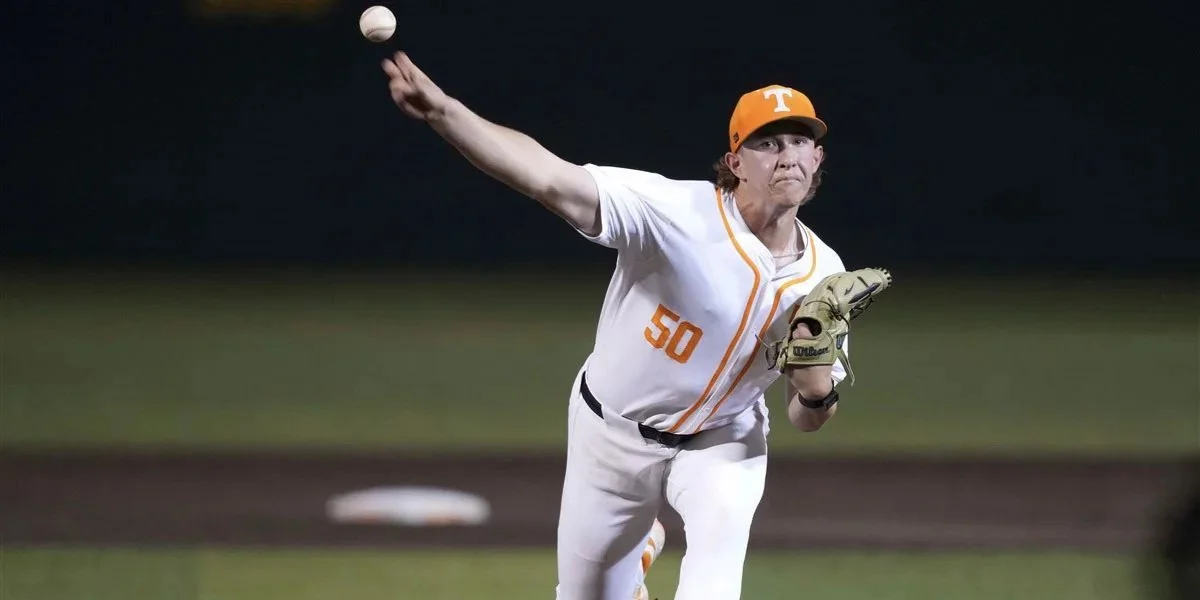
RHP Tanner Franklin
After being selected 72nd overall out of the University of Tennessee in 2025 as a reliever, the Cardinals quickly recognized something special in Tanner Franklin and committed to developing him as a starter. Although his minor league sample size is extremely limited, Franklin has already shown flashes of his potential, making 2026 a season worth watching closely.
While the regular season has yet to begin, Franklin opened his 2026 campaign in the Cardinals’ Spring Breakout game, where he impressed once again. The right-hander tossed three innings, allowing five hits but inducing plenty of weak contact. He struck out three batters, including last year’s first overall pick, Eli Willits, and gave up just one run. His arsenal was exciting throughout the outing, highlighted by the debut of his new sweeper.
His fastball was electric, as usual, sitting in the upper 90s with strong command. As the outing progressed, Franklin began to generate more carry on the pitch, likely adjusting to the major league ball. His cutter remained sharp, featuring a unique shape with more rise than a typical cutter.
The sweeper stood out as a key development. It showed excellent glove-side movement, paired with some downward action, giving it the potential to be effective against both right- and left-handed hitters.
Franklin also mixed in a single changeup, a pitch that still needs refinement. There’s room for improvement in creating better vertical separation, but if he’s able to use the sweeper effectively against lefties, it should give him more flexibility to develop the changeup over time.
It’s only fitting that he’s the first one on this list, since I’m a Tanner Franklin truther, but beyond that, his early flashes, evolving arsenal, and starter upside give him a real chance to break out in 2026.
RHP Jacob Odle
Tyler — AKA Redbird Farmhands — recently highlighted four pitchers he’s excited to watch in 2026, with Jacob Odle leading the list. If you haven’t checked out his article yet, it’s absolutely worth the read. I’ll echo Tyler here: Odle is someone I believe is poised for a big year, and if you don’t know his name yet, you will soon.
Tyler and I also had the chance to talk with Jacob on Redbirds On The Arch, where he discussed his offseason training and goals for 2026 — definitely worth a listen. Without giving too much away, he focused on refining key areas of his game that should help elevate his effectiveness this season.
Odle’s raw stuff is impressive across the board. His curveball stands out as a true plus-plus pitch, featuring sharp, downward vertical movement that generates a swing-and-miss rate north of 60%. It’s his go-to breaking ball and a weapon he can rely on against both righties and lefties.
His fastball continues to trend upward and is developing into a plus offering itself. He’s added velocity, now touching the high 90s and sitting comfortably in the mid-90s, while also improving the pitch’s carry. Already strong in generating whiffs and chase, it has the potential to take another step forward.
He also leans on a cut fastball, similar to Tanner Franklin’s, with a bit more vertical shape than the traditional cutter — a growing trend in today’s game. Sitting in the upper 80s, it’s another pitch that produces strong whiff numbers and plays an important role in how he attacks left-handed hitters.
Lastly, Odle has been working on a changeup. While it’s still developing, the pitch shows promising traits, and as he grows more comfortable with it, it could become another valuable weapon in his arsenal.
I’ll say it again: if you aren’t familiar with his name yet, you will be at some point during this 2026 season.
SS Yairo Padilla
There’s a lot to like about what Padilla has shown so far, especially considering he’s just 18 years old, but there’s still plenty of development ahead. The first thing that jumps out is his plus speed — he stole 24 bases in just 38 games in the complex league last year after swiping 22 bags in 2024.
At the plate, Padilla showed encouraging signs of a more mature approach, improving his strikeout rate, walk rate, and overall contact percentage from 2024 to 2025. While in-game power hasn’t fully translated yet, largely due to a high 52.7% ground-ball rate, he still posted a 102 mph 90th-percentile exit velocity, which points to real underlying raw power.
I’m not expecting a jump to 20-home run production this year, but there’s a clear path to more impact. If he can start lifting the ball more and tap into more gap-to-gap power, his slugging should take a noticeable step forward. With his contact skills and strength, that kind of development would mark a very successful season at this stage of his career.
LHP Michael Watson
Watson is coming off an impressive 2025 campaign in which he posted a 3.14 ERA over 66 innings, generating a 26.1% whiff rate and striking out 27.8% of hitters across Low-A, High- A, and Double-A. The biggest blemish on his performance was his control, as he walked 13.2% of batters. Even so, after breaking out last year, he’s poised to become a much more recognizable name in 2026. With limited left-handed depth in the bullpen, it wouldn’t be surprising to see him make his debut at some point this season.
While his velocity won’t jump off the page, Watson’s profile is built on deception and pitch characteristics. His low release height, extension, and movement traits allow his arsenal to play up, making him an effective left-handed reliever. His fastball sits in the low 90s, but it plays better than the raw velocity suggests thanks to its carry and his roughly 4’9” release height.
He complements the fastball with a sweeping breaking ball that features significant vertical drop, making it especially tough on left-handed hitters. It consistently generates strong whiff rates and serves as his primary chase pitch. He also mixes in a changeup in the low- to-mid 80s that shows promising traits, even if it’s used sparingly. His ability to kill spin on the pitch stands out, giving it the potential to develop into another reliable weapon, especially against right-handed hitters.