College Draft Prospects to Watch: Part 2
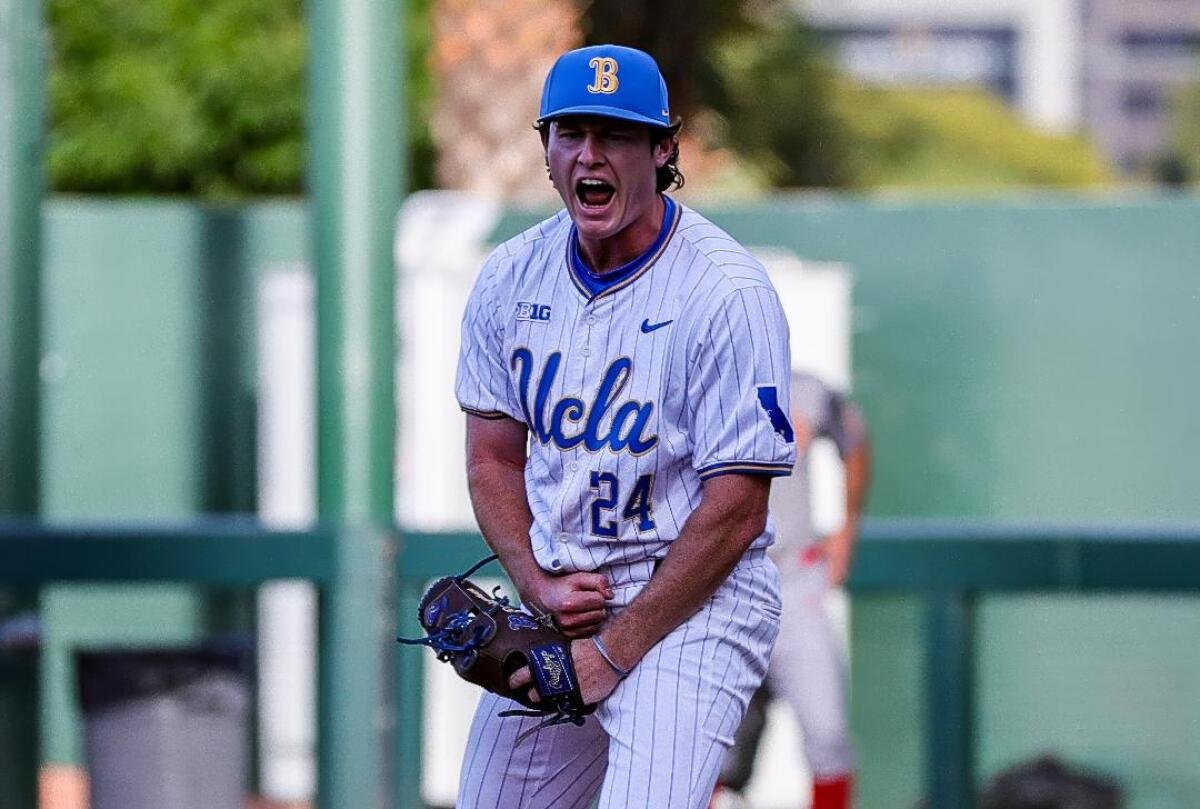
Credit- California Times
College baseball is now in full swing, with non-conference play in the books and conference matchups bringing fun matchups and new names emerging for this July’s upcoming MLB Draft. Myself (Tyler Gettinger) and Aidan Gray decided it was time to dip back into some more draft writing, as a few names have risen up boards and emerged as interesting and intriguing prospects for this year’s draft.
Unlike our first article before the season began, where we focused on names at the top of the draft board, the four names in this article are likely to be spread out a bit more, with some projected to go in the first round while others will likely be good value picks in the 2nd-5th round range.
RHP Logan Reddemann (UCLA)
Reddemann, a junior out of UCLA, is putting together an outstanding 2026 campaign. Through 10 games, he’s a perfect 8–0 with a 2.87 ERA across 59.2 innings. While he has consistently limited walks throughout his college career, the most notable jump this season has been in his ability to miss bats, with a clear uptick in strikeout rate. Improvements to both the velocity and shape of his fastball have elevated the effectiveness of his entire arsenal.
At 6’2”, 185 pounds, Reddemann has a well-proportioned frame with solid lower-half strength. He shows the durability to work deep into outings and maintain his velocity throughout. He operates from a repeatable, fluid three-quarter arm slot and has made strides with his extension this year, now averaging around six feet with a 5’9” release height.
He features a four-pitch mix anchored by a fastball that sits 94-96 mph and has reached as high as 98.6. The pitch has shown improved ride this season, averaging 17.2 inches of induced vertical break, leading to more swing-and-miss and chase above the zone. His changeup, thrown at 83-85 mph, relies more on velocity separation than movement. While the shape is below average and lacks significant vertical separation off the fastball, it remains effective, particularly against left-handed hitters, with occasional use versus righties.
Reddemann’s primary breaking ball is a gyro slider he’s comfortable throwing to both sides of the plate, though it can occasionally blend into a cutter shape, pointing to a need for greater consistency. He also mixes in a curveball with more depth, used more frequently against left-handed hitters, and it shows solid tunneling off the fastball.
Overall, Reddemann projects as a potential No. 2 or No. 3 starter at the next level. His fastball velocity and improved shape provide a strong foundation, and continued refinement of his slider consistency — along with greater vertical separation between the fastball and changeup — could elevate his profile and solidify him as a dependable No. 2 option.
SS Tyson LeBlanc (Kansas)
LeBlanc, a 21-year-old junior out of the University of Kansas, is emerging as a notable name in this year’s draft class. He’s hitting .323 with a strong .415/.677 slash line, good for a 1.092 OPS. LeBlanc has totaled 24 extra-base hits, including 15 home runs, ranking tied for seventh in slugging percentage and fifth in home runs within the Big 12 Conference.
At 6’0”, LeBlanc brings impressive power for his size, paired with solid bat-to-ball skills. He features a subtle bat wiggle with minimal front-foot movement in his stance, helping him stay balanced and controlled before his load. His timing mechanism consists of a small leg kick/toe tap, and he does a good job keeping his hands quiet through the load. The swing is clean and efficient, supported by good bat speed that allows his power to play.
Defensively, he’s started every game at shortstop this season. He shows reliable hands and works well through ground balls, presenting the glove early and handling both forehand and backhand plays with confidence, including balls he has to charge. There are some concerns with the arm, however — throws can get erratic on the move, and overall arm strength appears fringy at times.
Offensively, LeBlanc profiles as a power-oriented hitter with strong contact ability. He controls the zone well, posting a low chase rate (19.5%) while maintaining a solid walk-to-strikeout balance (12.7% walks to 16.8% strikeouts). His in-zone contact rate is strong, and the power is legitimate, highlighted by a 104.1 mph EV90. He shows the ability to drive the ball to all fields, further supporting his offensive versatility.
Overall, LeBlanc projects as a potential everyday second baseman at the next level, with the flexibility to slide over to shortstop when needed. His combination of contact skills and power should translate into consistent offensive production, with the upside for double-digit home run output annually.
RHP Cade Townsend (Ole Miss)
A black belt in Taekwondo, Cade Townsend is one of the top draft-eligible sophomores in this year’s draft. With a 6’1”, 185-pound frame, Townsend made the full-time transition into the Rebels’ rotation this season, emerging as the Rebels’ top weekend starter and turning into one of the SEC’s best pitchers so far this season. He has posted a 1.73 ERA across 41.2 innings, striking out 61. This comes with a major improvement in command, with Townsend cutting his walk rate from 13.1% to 6.0% between 2025 and 2026, which has also allowed him to limit damage to a .181 opponent batting average.
Townsend features a smooth but explosive delivery, which starts with him stepping his plant foot toward the first-base side before swinging the front leg through to a waist-high leg kick and exploding down the mound. He utilizes a high ¾ arm slot with slightly below-average extension (5.7-5.9 ft) and around a 6 ft release height. From the stretch, Townsend ditches the initial step and leg swing, going straight into a waist-high leg lift before striding down the mound.
Townsend is one of the most complete starters in the 2026 draft, featuring a diverse five-pitch mix that includes a fastball, cutter, slider, curveball, and splitter. The fastball has ticked up from his freshman year, averaging in the mid-90s and touching 98 mph with 20 inches of vertical break. Townsend has good command of the pitch, with a 73.9% zone rate and a solid 23.1% whiff rate. While Townsend has a solid fastball, his go-to offering has been his low-90s cutter, which he has used 28.5% of the time. The pitch has produced a 38.6% whiff rate, an equally impressive 23% swinging-strike rate, and a zone rate of 78.4%, making it a clear 60+ grade pitch. Townsend combines these two fastball variations with a trio of interesting off-speed offerings, including a high-80s slider, which has produced a 41.5% whiff rate; a low-80s curveball, which has 15 inches of vertical drop and a 41.7% whiff rate; and a high-80s splitter, which generates a 44.8% whiff rate. One of the things that makes Townsend a safer pick is the fact that he zones his off-speed well, with four out of his five pitches being zoned above 63.5%, while his curveball sits slightly below 60%.
Townsend has played himself into looking like a lock to go inside the top 40 picks in this year’s upcoming draft, barring injury. He did have a small injury earlier this season vs. Texas. His mix of a complete arsenal and a stuff uptick makes him appear as one of the safer pitching options in this year’s upcoming draft. While Townsend might not have the top-end ability of a pitcher like Jackson Flora, his ability to throw strikes consistently with a deep arsenal almost guarantees that he will stick as at least a strikeout-oriented backend starter, with a solid chance to become a mid-rotation arm, making him a potentially intriguing pick at #13 or #32 if he makes it that far.
OF Andrew Williamson (UCF)
A three-year starter at UCF, Andrew Williamson has been one of the most consistent college and summer ball performers over the past two seasons, posting WRC+ marks of 147 and 133 the past two seasons at UCF while batting over .300 with 10 or more homers in both seasons. In his two summer ball campaigns, he has posted OPS marks of 1.452 and .904 between the Cal Ripken and Cape Cod Leagues. With a 6’0”, 180-pound frame, Williamson has solid size for what projects to be a potential up-the-middle player.
Williamson features a quick leg lift and jab from the left side of the plate. This leg lift allows Williamson to get on time with his extremely whippy hands, which is where much of the outfielder’s power is generated. His bat starts on his back shoulder before he starts his swing, and then he lifts his back elbow, causing his bat to almost point toward the pitcher, before whipping his strong wrists to explode through the zone. Williamson has posted good exit velocities at UCF this year, averaging 92.8 mph with a max exit velocity of 118.8 mph. From a discipline standpoint, Williamson has posted a 16.9 K% to a 15.8% BB rate this season, which is relatively in line with the 13.8% K rate and 13.0% BB rate he posted in 2025. Williamson is middle of the pack in most contact% stats, posting a 76.3% contact rate and a 25.5% chase rate, both of which are around average for a college hitter. Williamson is a very good fastball hitter, with an 88.5% contact rate vs. fastballs, though he struggles a bit vs. off-speed pitches in terms of contact%. The good sign is that his chase rates vs. off-speed pitches are more average than bad, making me bullish he could eventually hit them more consistently.
A twitchy athlete, Williamson played center field most of his freshman year with the Golden Knights, though he transitioned to RF when the Knights brought in DeAmez Ross from Florida State to play center. Even with the move to right field, I believe Williamson still has the athleticism to play center, which has been shown in the few midweek games he’s gotten to play there this spring, as well as by not getting caught in 13 steal attempts last season. While I haven’t seen many clips of his arm, reports say that it will work if he ends up in a corner outfield spot and may even be above average if given the chance to play center field.
Williamson is a good athlete with plus power from a very whippy swing and good enough contact ability and approach to maximize the profile, especially with his gamer mentality. Williamson is likely to find himself in the 2nd-4th round range, and with the Cardinals having six picks in the top 84, don’t be surprised if Williamson finds his way to St. Louis come July.