Early Draft Reviews: College Prospects to Watch
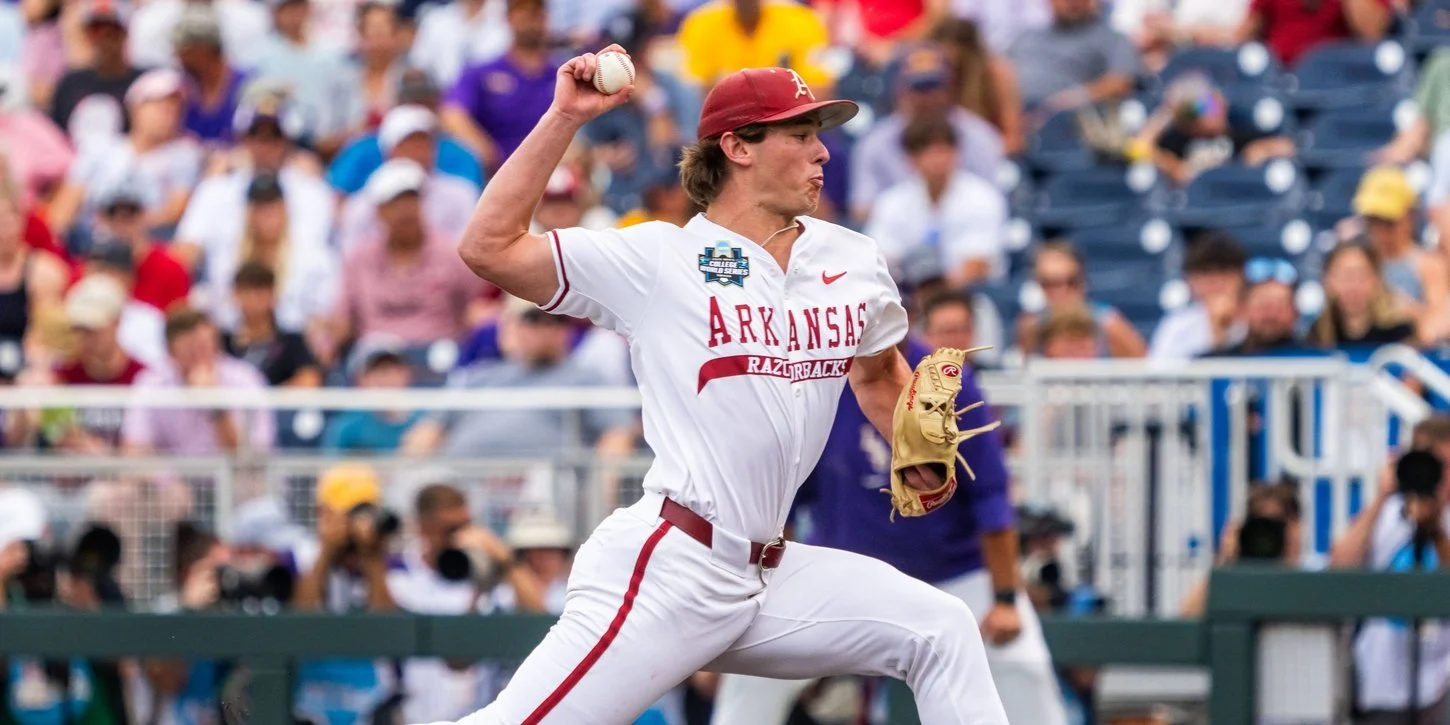
Credit: Dylan Widger-Imagn Images
First, I want to thank Tyler Gettinger (aka RedbirdFarmhand) for taking the time to co-write this article with me (Aidan Gray). He did outstanding work, and I know you’ll enjoy his reports as much as I did!
In this piece, we break down eight players currently projected as first-round selections in the 2026 MLB Draft, highlighting some of our favorite prospects to watch throughout the upcoming college and high school seasons. That said, with the draft still more than six months away, plenty can change - player stock is always on the move.
With that in mind, we hope you enjoy the article and keep an eye on these names as the season unfolds.
Tyler’s Prospects to Watch
3B/OF Ace Reese (Mississippi State)
Reese is one of the better pure hitters in college baseball coming into the 2026 season, last season as a sophomore Reese slashed .352/.422/.718 for a 1.140 OPS against very tough competition in the SEC. He got a plethora of awards in 2025 including being a SEC Player of the Week, All-SEC First Team, SEC Newcomer of the Year, and was a Dick Howser Semifinalist (Best Player in the Country). Reese’s calling card is his top-end power as he hit 21 homers, which was top 15 in the country, and his .718 SLG was top 35 among all D1 players. Another thing that intrigues me when it comes to Reese is the fact that when he played SEC competition he was even better with a .402 average and a 1.344 OPS with 15 of 21 homers coming against SEC teams. Reese also had a brief stint in the Cape Cod League and destroyed the baseball slashing .303/.361/.485 with 2 homers and 7 RBIs in 8 games. Reese balanced power with strikeouts well posting a 19.8% K rate with a .366 ISO and a 139 WRC+, also walked 9.9% of the time this past season.
Now that I got the stats part out of the way I want to get into what I see on video, Reese has a leg kick which allows him to not only stay on time, but also helps him generate torque which allows him to get into his plus-plus power. From the video I watch Reese has good bat control and can get to almost anything in or out of the zone, but does have some chase tendencies, though MLB Pipeline notes that his approach got better from his first year at Houston. The thing that really stood out to me when watching Reese is his ability to hit the ball for power and loft to all fields, and the fact that he handles both right-handed and left-handed pitchers well, according to MLB Pipeline. The one downside to Reese’s game is that he may not stick at the hot corner, being just an average performer their last season, some evaluators believe he may end up in a corner outfield or at 1B, some preparation for this has already taken place as 6 out his 8 games in the Cape he played LF. Even if he eventually turns into a full-time 1B, his projected 25-30 home power should work at the position.
SS Eric Becker (Virginia)
Eric Becker has been one of the most consistent performers in all of college baseball since stepping on campus in 2024, a two-year starter Becker has posted a batting average north of .360 and an OPS of 1.070 or above both of his first two seasons in Charlottesville. In 2025, the sophomore slashed .368/.453/.617 for a 1.070 OPS and while he only had 9 homers, he had 21 doubles (Top 3 in ACC) and 31 XBH overall. An RBI machine Becker drove in 52 runs in 50 games last season for Virgina, leading the team in batting average, RBIS, doubles, and total bases. The hit tool is the calling card for Becker as he has excellent bat-to-ball skills while limiting chase, according to MLB Pipeline. While not necessarily a plus power player right now he did play for Team USA over the summer with other top college talent and was 97th percentile in barrel% and his 90th percentile EV was a very solid 106 mph. Known for being a leader for Virginia, Becker will look to continue to be one of the most consistent players in college baseball in 2026.
When doing my initial research for the 2026 college baseball season, the thing that stood out to me when watching Becker was how simple and projectable his left-handed swing is. He uses a slight leg raise or toe tap for timing and then uses a fluid stroke that looks like the Braves Matt Olson to make hard line drive contact to all fields. Olson for his career has been a doubles machine, and I could see Becker being similar though I don’t see Becker getting to the 30+ homer potential that Olson has. On the defensive side Becker is a bit slower than the usual shortstop, though he has an excellent internal clock which helps him make plays despite his lack of above average speed. He played mainly 3B over the summer for Team USA, and that position or 2B could be his future home where his speed and arm should play better. A mature hitter I wouldn’t be too concerned about the fact that Becker doesn’t walk all that much; he doesn’t chase and knows what pitches he can do damage on and attacks them. One of the higher floors coming into the 2026 college and draft season, I’m excited to see if Becker can take it to the next level.
RHP Liam Peterson (Florida)
Peterson is considered one of the top college arms in the country going into the 2026 season as the 6’5 Junior will be the Friday night starter for the Gators this upcoming season. In 2025 Peterson posted a 4.28 ERA in 16 games striking out 96 in only 69.1 innings. Peterson did have a bit of a walk issue with 32 walks which came out to a 10.5% walk rate. The thing that makes Peterson a top prospect is obviously the swing and miss he struck out 31.5% of batters, while generating a 26.4% chase rate and a 32.7% whiff rate. He ranked 5th in the SEC in terms of K/9, and his 3.0 K/BB ratio was 20th nationally. Despite the great stuff he did get give up more hits than expected with an opponent batting average of .250 and a wOBA of .328.
When looking at Peterson’s arsenal, it is a traditional four pitch mix including a fastball, changeup, slider, and curveball. The fastball is the most used pitch against both RHH and LHH being around 50% against both sides; the pitch averages around 96-97 mph topping 99.3 mph with good carry at slightly above 20 inches of induced vertical break. The changeup is a pitch that is still a work in progress with its velocity being the 85-87 mph range and while the movement profile isn’t anything crazy, he did get a whiff rate north of 40% on the pitch in 2025, and the pitch made progress throughout the 2025 season. The slider is Peterson’s best secondary as the pitch averages around 85 mph with 5 inches of glove-side movement while getting very little vertical break; the pitch maxed out at 89.4 mph with a 42.5% whiff rate and only a .174 xWOBA. He rarely used his curveball at only 4.6%, but in that small sample size the pitch did a very impressive 58.3% whiff rate according to Zack McKeown, and it could become a more prominent part of his arsenal if he finds more feel for the pitch. One thing that surprised me was that Peterson only gets between 5.6 and 6.1 feet of extension despite being 6’5. While not a major concern given his stuff, if the velocity drops a bit in pro-ball, he may need to find some more extension to be effective.
LHP Cole Carlon (Arizona State)
Cole Carlon isn’t as highly rated as some of the other college arms in this article, but he could play himself into a similar position that Liam Doyle did last season if he can prove to maintain a starters’ workload. Carlon pitched 54 innings out of the Arizona State bullpen last season to a 3.33 ERA and 86 strikeouts with a 1.06 WHIP, though like Peterson walks were an issue with a 11.3% BB rate being less than ideal. What Carlon does extremely well is miss bats with an overall whiff rate of 41% which was one of the top marks in all of college baseball, his 38.7% K rate ranked 4th among all D1 pitchers, and he also got a solid amount of chase at 27%. Carlon backed up this performance with a stint in the Cape Cod League where he posted a 1.42 ERA in 6.1 innings with 8 strikeouts against some of the best college competition in the country. Carlon is expected to make the jump into the Sun Devils rotation in 2026 and could be a top draft pick if these numbers translate to that role.
Carlon has four pitches in a fastball, slider, changeup, and curveball though he rarely uses the latter two, and mainly focuses on his use of the fastball and slider. The fastball is a decent pitch sitting at 94-95 mph with the ability to get up to 98 mph with 18 inches of IVB, but it isn’t much of a bat missing pitch and is mainly used to set up his wipeout slider (43.2% FB usage). Carlon easily has the best slider of any prospect going into the 2026 draft as the pitch sits in the high 80s and is a pure bullet shape and nobody in college baseball could touch it in 2025 as the pitch had a ridiculous 73.9% whiff rate, while it won’t maintain that in pro-ball it is a clear 70-80 grade pitch going into next July’s draft if it maintains the results in 2026. As I mentioned, curveball and changeup were rarely used but will become more of his arsenal in 2026 as he transitions to a starter role. The changeup isn’t bad averaging in the mid-80s and getting decent separation off the fastball, and the curveball has the potential to be at least average, though it was mainly used to keep guys off the slider in 2025. Despite having little extension from his 6’5 frame, Carlon’s more over the top arm angle allows him to get close to 7 feet at release, which makes it difficult for hitters to pick up his very good fastball/slider combo. Carlon is someone I will certainly have my eye on as he transitions to a starting role and could have a great year for ASU.
Aidan’s Prospects to Watch
RHP Gabe Gaeckle (Arkansas)
Gaeckle enters his junior year at the University of Arkansas as a key piece of the Razorbacks’ pitching staff and is expected to take on a leading role in 2026. He was effective out of the bullpen during the 2025 season while also making several appearances as a starter. That split role likely explains why he currently ranks 24th on MLB Pipeline’s draft board, but I expect him to rise throughout the year. Gaeckle possesses the raw stuff and athleticism to profile as a full-time starter at the next level.
As a sophomore in 2025, Gaeckle finished 3-2 with a 4.42 ERA across 71.1 innings pitched. The underlying metrics are encouraging, particularly his ability to miss bats. He struck out 29.9% of opposing hitters while walking 10.1%, a rate that remains workable as he continues to refine his command. He was especially effective against right-handed hitters, and the primary area for improvement entering 2026 is limiting damage against left-handed bats. Despite strong strikeout rates and swing-and-miss numbers on both sides of the plate, his inability to consistently land his changeup for strikes against left-handed hitters put added pressure on his fastball, resulting in weaker overall outcomes against that side.
From a pure stuff standpoint, there is plenty to be excited about heading into the 2026 season. Gaeckle’s fastball sits in the mid-90s with above-average spin and can reach the upper-90s when he reaches back, touching a max velocity of 98.5 mph last season. The pitch shows above-average carry relative to his release height, allowing it to play effectively in the zone. His best secondary offering is a high-80s slider with tight, glove-side break that generated excellent results. He also features a low-80s knuckle curveball with sharp depth and clear potential, though consistency remains an issue. Similar to his changeup, he needs to throw the pitch for more strikes, and when it does find the zone, he tends to leave in the upper-half of the plate. His changeup sits in the high-80s and features notable horizontal movement with enough vertical separation to induce swings and misses, giving him a legitimate weapon against left-handed hitters if he can improve strike consistency.
RHP Jackson Flora (UC Santa Barbara)
Flora is a 6-foot-5 right-hander entering his junior year at UC Santa Barbara and is projected to be a first-round pick - following in the footsteps of teammate Tyler Bremner, who was selected second overall just one year ago. Flora offers immense upside, and with another strong season, he profiles as a future top-of-the-rotation starter.
In 2025, Flora put together an impressive campaign, going 6-3 with a 3.60 ERA across 75 innings. Opponents hit just .209 against him, as he struck out 27.8% of batters while issuing walks at an excellent 5.5% clip. His underlying metrics further highlight his dominance, including a strong 31% whiff rate paired with a 27.1% chase rate. Like Gaeckle, Flora is strongly effective against right-handed hitters but shows more pronounced struggles versus lefties. Against left-handed batters, his strikeout rate dipped significantly to 11.8%, and they posted a .279 average against him. Continued development of his changeup will be critical in neutralizing left-handed hitters and unlocking his full potential at the next level.
Flora features a four-pitch arsenal, headlined by a power fastball–slider combination that produces strong results. His four-seam fastball shows excellent carry, generating nearly 18 inches of induced vertical break, paired with subtle arm-side run - enough movement to miss barrels without sacrificing command. The pitch plays at an elite velocity, sitting in the upper 90s and touching triple digits at times, and he consistently throws it for strikes. That combination of velocity, ride, and control makes it difficult to make contact with, as evidenced by a strong 27.1% whiff rate. Flora complements the fastball with two breaking balls. His primary secondary is a sharp mid-80s slider that he relies on heavily. The pitch features strong spin and tight break, and he shows advanced feel for locating it. Hitters struggle to make contact, whiffing on 44.4% of swings and chasing it 32.5% of the time, while it produces very low in-play rates. His sweeper, while less effective from a results standpoint, shows promise due to its movement profile. Thrown in the upper 70s and occasionally touching the low 80s, the pitch features good glove-side break. An uptick in velocity could help it play more effectively off his fastball and slider, potentially turning it into a more consistent weapon. Flora also mixes in a changeup in the high 80s to low 90s, primarily against left-handed hitters. While the pitch remains a work in progress, it flashes quality movement at times. It does not currently generate much swing-and-miss, but hitters chase it roughly 25% of the time. Continued development of the changeup will be key to improving his effectiveness against left-handed bats.
OF Zion Rose (Louisville)
After a strong freshman campaign, Rose saw his role and playing time expand even further during his sophomore season, and his production remained remarkably consistent. He hit .310 with a .396 on-base percentage and a .552 slugging percentage, good for a .948 OPS that mirrored the impact he made as a freshman. What makes Rose especially appealing is his advanced bat-to-ball skill set and approach at the plate, highlighted by a low 12.0% strikeout rate and a strong 10.3% walk rate. He whiffs just 16.7% of the time, and while continued refinement of his swing decisions outside the zone (26.5% chase rate) could elevate his game even more, he makes quality decisions and frequent contact on pitches in the strike zone. In 2025, Rose totaled 32 extra-base hits, including 16 doubles and 13 home runs, and his above-average speed showed up not only in three triples but also on the bases, where he swiped 31 bags and added another dimension to his offensive profile. While he tends to hit right-handed pitching more effectively, he still produces strong numbers against left-handers, making him a reliable offensive option regardless of the handedness of the opposing pitcher.
Rose uses a big leg kick as his primary timing mechanism while keeping his weight back to generate power. During his load, his hands remain quiet - calm and controlled -which allows the barrel to get to the ball efficiently without unnecessary movement. This simplicity in his hand action should help him handle higher velocity as he transitions to professional baseball, though he has had limited exposure to pitches consistently above 95 mph or faster.
Defensively, he profiles best in a corner outfield role due to average instincts and an average arm. While his speed gives him a chance to handle center field, that projection hinges on significant improvement in his defensive reads and routes.
OF AJ Gracia (Virginia)
After Duke’s head coach departed for Virginia, it made sense that he brought Gracia with him. In 2025, Gracia hit .293 with a .449/.558/1.007 slash line and finished the season with 15 home runs. He showed elite plate discipline, striking out just 12.6% of the time while posting a strong 20.0% walk rate. That patient approach translated into quality contact across all pitch types, as he whiffed on only 13.6% of swings and chased pitches outside the zone at a mere 16.8%. An important note is Gracia’s success against both right- and left-handed pitching. As a left-handed hitter, he still produced strong contact metrics and positive results versus southpaws. Gracia is well regarded among draft evaluators and is widely expected to be selected near the top of the first round.
Gracia uses an upright batting stance with his hands set high. For Cardinals fans, think of an Alec Burleson - style stance from the 2023 season. He incorporates a small leg kick that has greatly improved his timing at the plate. Gracia features an uppercut swing that allows him to elevate the baseball, and he does an excellent job controlling the barrel through the strike zone.
While he receives most of the praise for his bat, Gracia is also a solid defender. He takes efficient routes and shows a good feel for the glove, but his lack of speed limits his overall defensive ceiling. Gracia profiles best in a corner outfield role, with left field being the most natural fit due to his below-average arm strength. MLB Pipeline notes that despite his limited speed, some scouts are willing to give him a look in center field, though it’s unlikely he remains there long-term unless the speed improves.