8 Rule 5 Draft Targets for the Cardinals
Credit: MLB.com
Kareem’s Rule 5 Targets
RHP Griff McGarry (AA/AAA, Phillies)
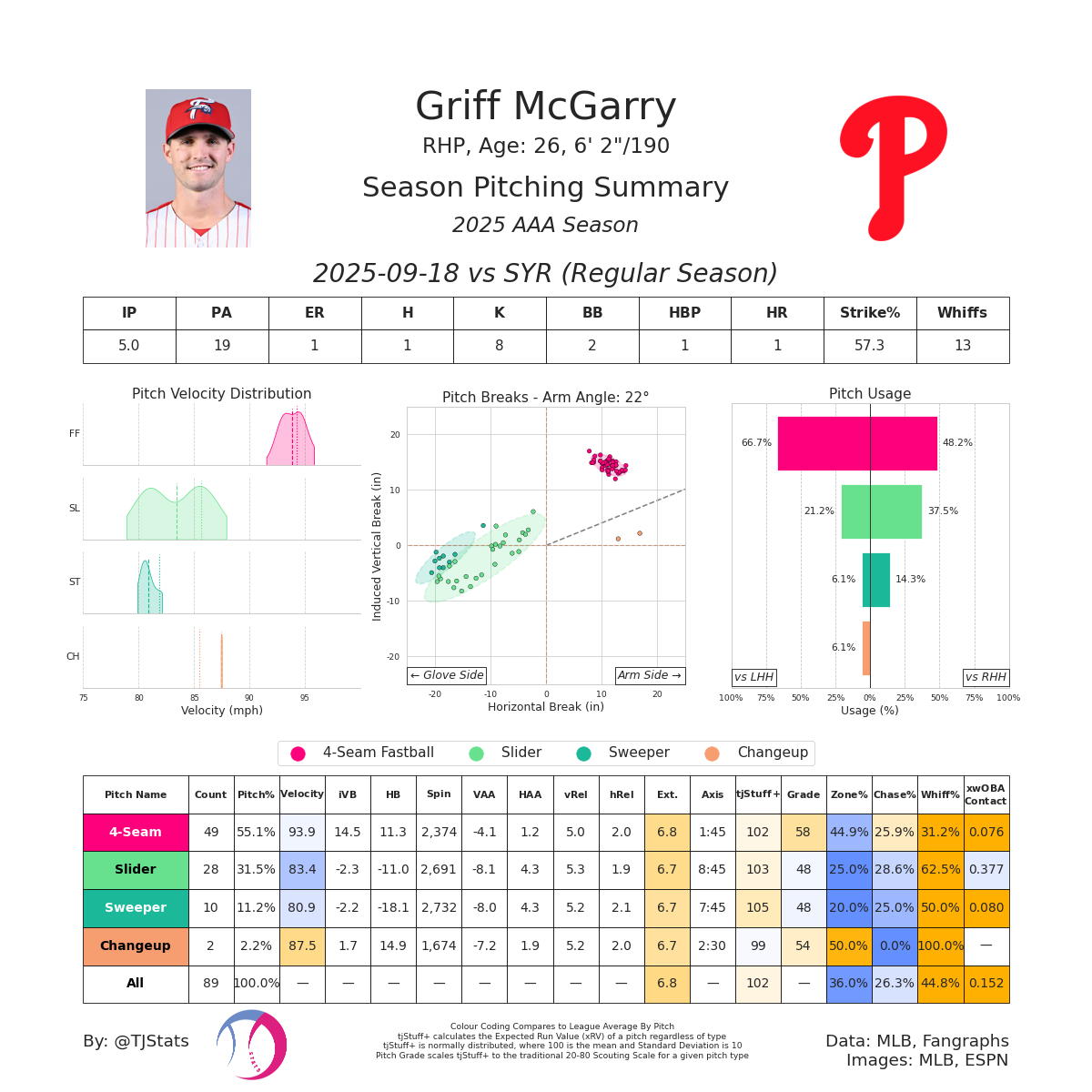
There might not be a starting pitching prospect with better stuff available in the Rule 5 draft than Griff McGarry. McGarry was a former 5th-round pick out of Virginia in 2021, and he’s someone who has been an interest of mine for a long time. He was left exposed in last year’s Rule 5 draft and was not selected, but I think this year might be different. McGarry was exclusively used out of relief in 2024 and was clearly not comfortable in that role. He pitched to a 4.55 ERA in 30 innings, and his walk rate, already an issue, ballooned to an egregious 24%.
McGarry was back in the role he was accustomed to for his whole career and had a phenomenal season. In 83.2 innings between Double-A and Triple-A, McGarry posted a 3.44 ERA with an elite 35.1% strikeout rate while getting the walks down to a manageable 13.9%. His arsenal is headlined by a low-launch heater that generates above-average carry for his 5-foot vertical release height, creating a very flat approach angle, and he has two strong breakers: a two-plane shape in the mid-80s and a bigger sweeper at around 80 MPH, both of which he spins extremely well.
I think McGarry is someone who would compete for a starting rotation spot in spring, and if it doesn’t end up working out, there’s no harm, no foul. There’s no question McGarry has the stuff to be an impact pitcher in the big leagues, but whether his command gains in 2025 were real remains to be seen.
RHP Zach McCambley (AA/AAA, Marlins)
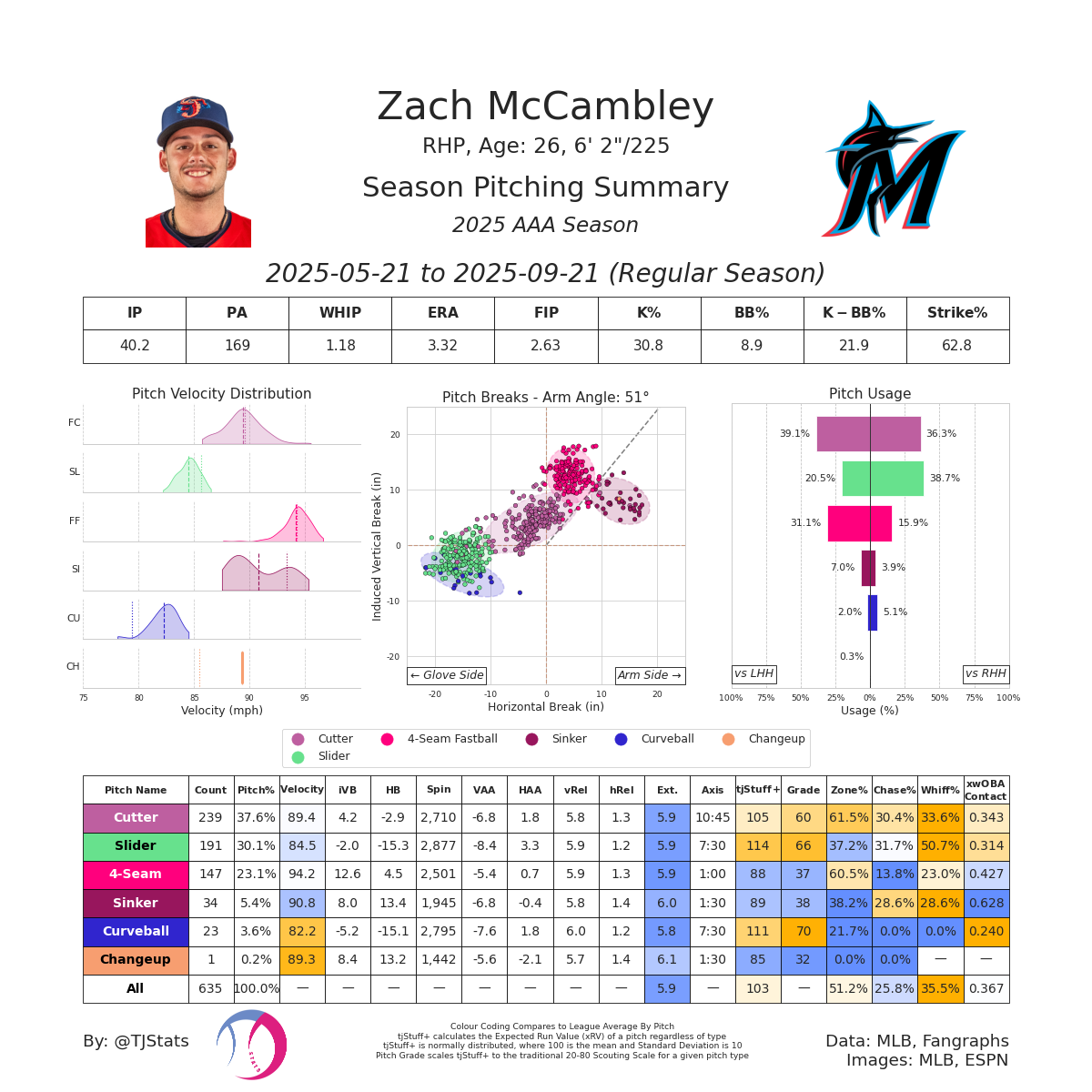
If the Cardinals opt for a pure relief pitcher who has a somewhat safe floor to be an effective middle-relief type, I think Zach McCambley might be their guy. The Marlins drafted McCambley in the 3rd round out of Coastal Carolina, and he was used as a starter in his first two years as a professional. He moved to the pen in 2023 and hasn’t looked back since. McCambley has posted a 3.20 ERA in 129.1 innings since his transition to the bullpen. He generates strikeouts at an above-average rate and effectively limits damage. His walk rate might be a little higher than you’d want at 11.9% during that stretch, but this year he brought that number down to just 8.8%.
McCambley’s primary offering is an 89 MPH cutter, which honestly acts like more of a gyro slider with 4” of IVB and 3” of glove-side movement. He works his best offering, an 84.5 MPH sweeper with 15” of sweep, wonderfully off the cutter, and the pitch had elite results this year with a 50.7% whiff rate. McCambley’s fastball does leave something to be desired. It sits 94 MPH with a cut-ride shape, but it only generates 13” IVB and hasn’t performed well. He’ll also occasionally mix in a changeup, though the pitch needs work.
I do think McCambley will find immediate success in a big-league bullpen on the back of his cutter and sweeper, but his fastball, which already struggled in Triple-A, might face even greater issues against MLB competition.
RHP Jose Rodriguez (AA/AAA, Dodgers)
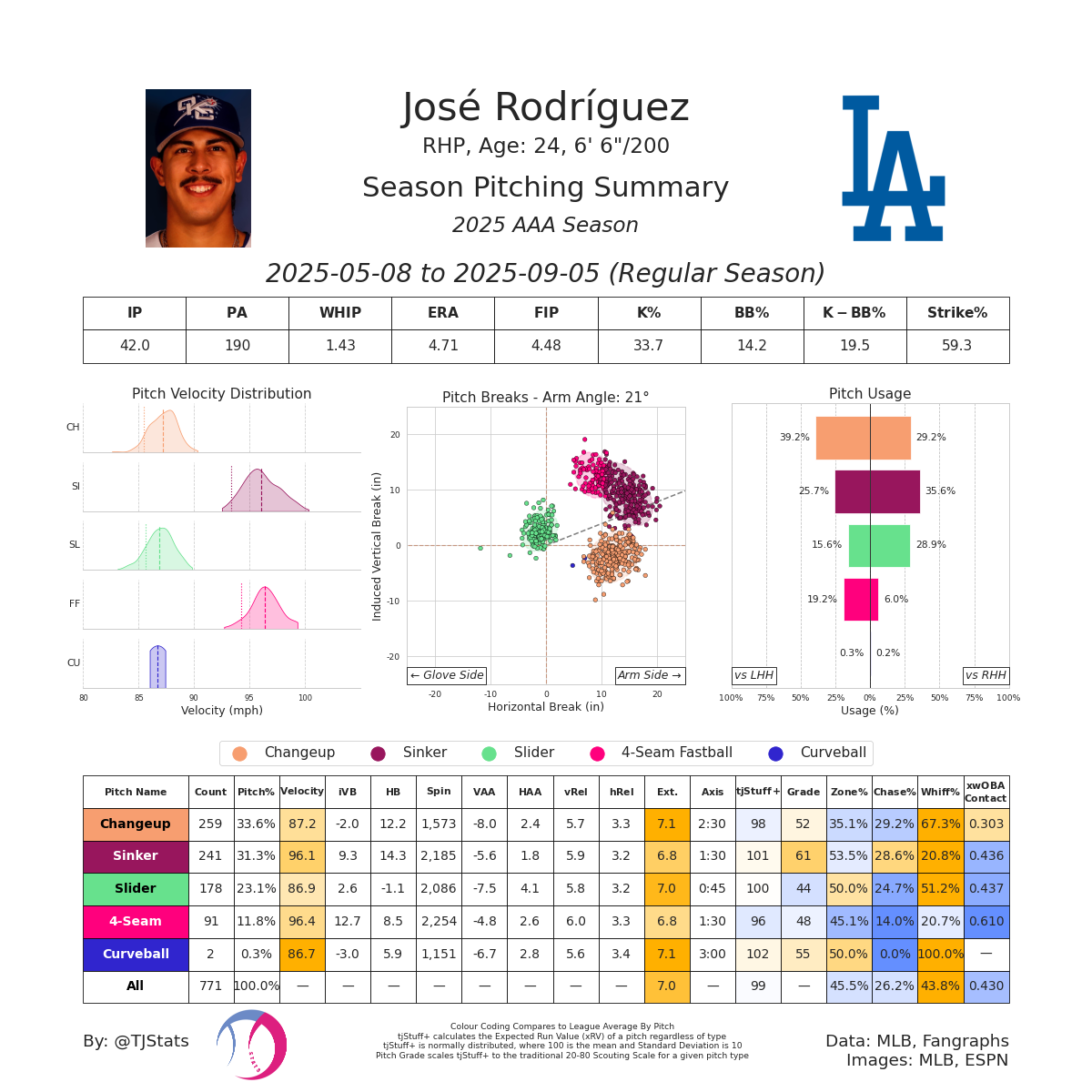
The Cardinals farm system has an abundance of elite changeups in the organization, headlined by Luis Gastelum, who might honestly have the best changeup in all of minor league baseball, but Rodriguez rivals his and he touches 100 MPH. Why didn’t the Dodgers protect this guy? After a stellar 2024 season in which he posted a 3.38 ERA between A and A+, striking out 126 batters in 90.2 innings, Rodriguez ran into trouble in 2025, posting a 5.50 ERA between Double-A and Triple-A. His most glaring issue was contact suppression, as opponents posted a .431 slugging percentage against him.
Without a track record of success in the upper levels, it would make sense why teams would be reluctant to pick him, especially those in need of immediate impact in the pen. There’s a chance Rodriguez completely flounders at the big-league level, but it’s tough to bet against the stuff he possesses. His changeup generates -2” IVB and 12” of run at 87 MPH and registered a 67.3% whiff rate. I think there’s still some low-hanging fruit in his usage, as he’d benefit from throwing his changeup and slider more.
Speaking of his slider, it’s another plus pitch at 87 MPH with a pure bullet shape, and he posted a 51.2% whiff rate with that offering. Despite his four-seam and sinker sitting 96 MPH and touching 100, the offerings clearly aren’t his strong suit. Reducing their usage from 43% down to the 25-30% range would be beneficial for him. Rodriguez’s release characteristics are pretty wild too, as he generates seven inches of extension while launching from a wide 3.3-foot vertical release.
While there’s certainly some volatility with a pitcher who hasn’t found much success in the upper levels, Rodriguez has the kind of stuff teams should bet on.
RHP Ben Peoples (AAA, White Sox)
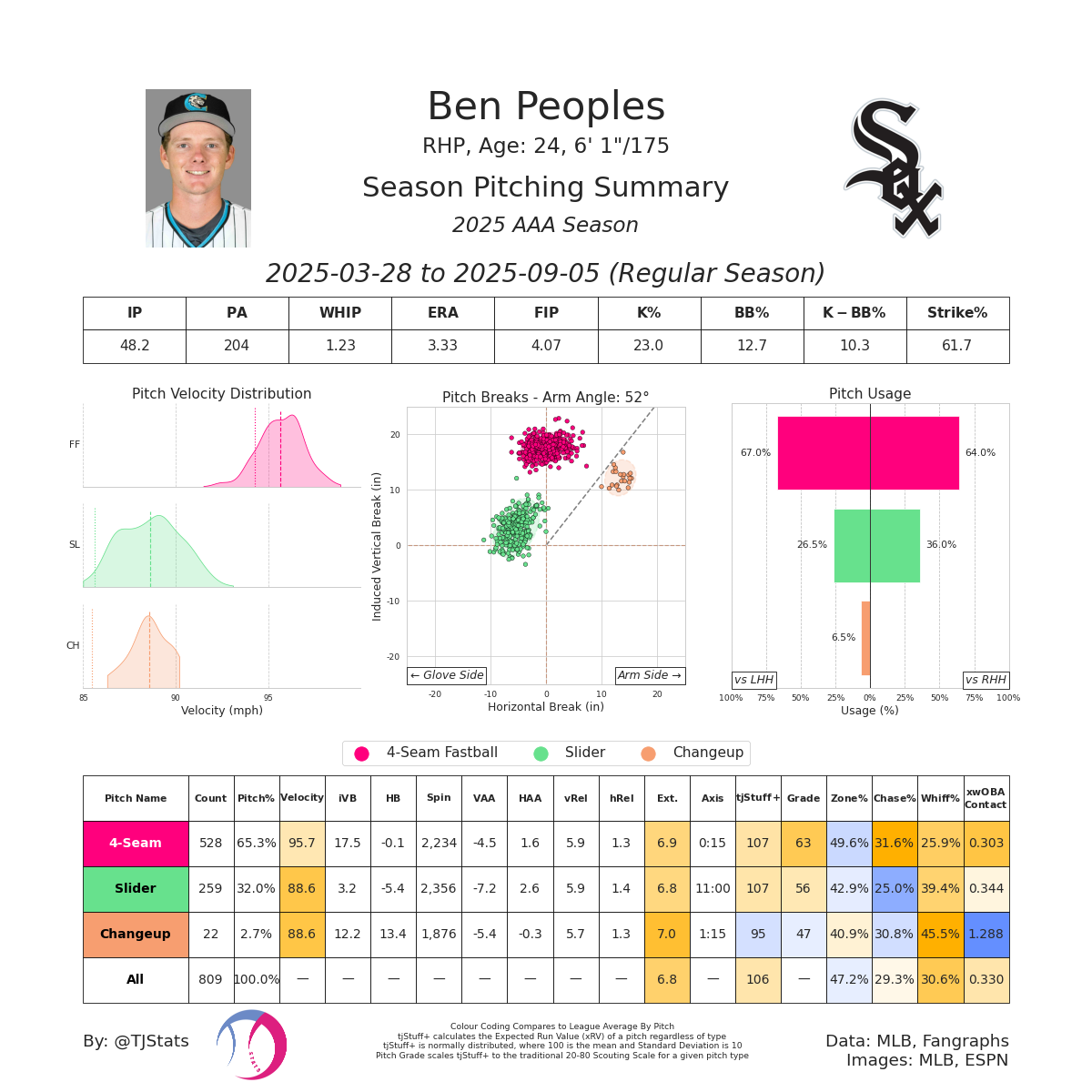
The White Sox acquired Peoples in the trade that sent Adrian Houser to the Rays at this year’s trade deadline. After a stellar start to his 2025 season in the Rays organization with a 2.65 ERA in 37.1 innings, Peoples ran into issues in his 11.1 innings with the White Sox. They left him unprotected for the Rule 5 draft, but I still think he’s someone worth keeping an eye on. Despite the rough end to his season, he’s still coming off a strong 48.2 innings at the Triple-A level. This was also his first year being used in relief, and I think it’s a much better role for him long term.
He’s essentially a two-pitch guy with a 96 MPH cut-ride heater as his primary offering, generating 17.5” of carry from a 5.9-foot vertical release. He pairs the fastball with a hard 88.6 MPH slider that generates 5” of glove-side movement. He seldom used a changeup against lefties, but the pitch is a clear work in progress at this stage. I think Peoples’ fastball-slider combo has the chance to work well in a big-league bullpen.
Despite the high-level stuff, his strikeout rate this year was only 23%, which leaves something to be desired, but he managed contact well enough to negate that red flag. Though it’s typically uncommon to see a pitcher’s strikeout rate go up in the big leagues, I wouldn’t be surprised to see Peoples’ number rise once he finds better execution with his slider. Peoples’ walk rate at 12.7% is a bit high, but he’s never let that number get to a dangerous enough level for it to be a big issue.
I think Peoples could immediately hold his own as one of the lower options in a bullpen while having the potential to become a high-level middle-relief type.
Tyler’s Rule 5 Targets
RHP RJ Petit (AA/AAA, Tigers)
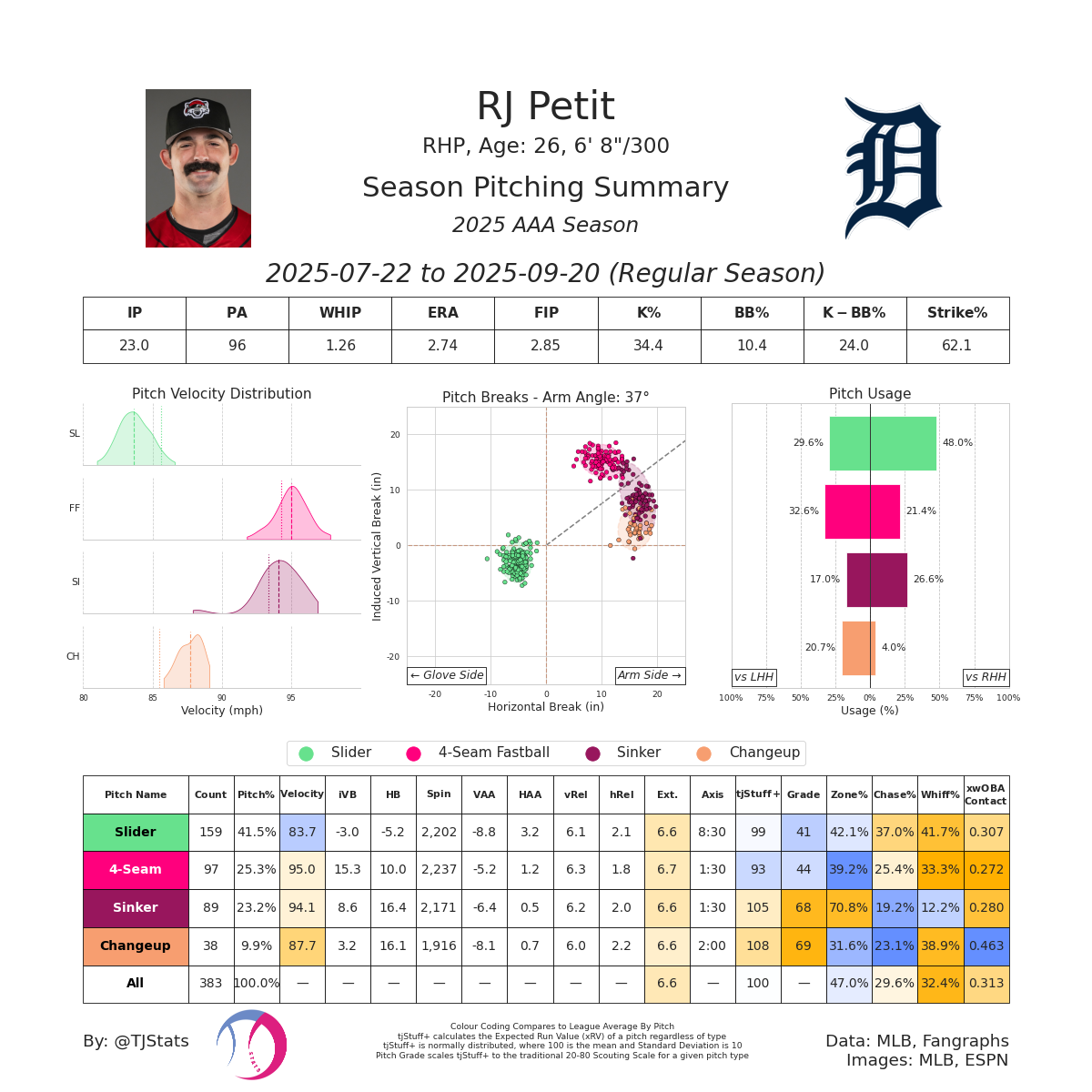
Petit was one of the top relief prospects for the Tigers this year, finding his way to Triple-A, where he posted a 2.74 ERA in 23 innings with the Toledo Mud Hens. Petit posted impressive underlying numbers, ranking above average in almost every major category except for barrel percentage, where he fell into the 47th percentile. His 92nd-percentile 34.4% strikeout rate, along with his 94th-percentile 23.4% hard-hit rate, is why he will almost certainly get selected in the Rule 5 draft.
Petit relied heavily on his 83 MPH slider this season, using it 41.5% of the time, and for good reason, as it produced a 41.7% whiff rate at Triple-A while allowing just an 11.76% hard-hit rate. Petit’s second-most-used pitch is his 95 MPH four-seam fastball, which he used 25.3% of the time at Triple-A, producing a 33.3% whiff rate despite middle-of-the-road movement characteristics. He also has a sinker, which he mainly uses against right-handers, and a changeup, which he uses against lefties to round out his arsenal.
Petit hides the ball well behind his 6-foot-8, 300-pound frame, making it difficult for hitters to pick up the ball early, particularly lefties, who hit just .183 against him in 2025.
RHP Tyler Cleveland (A+/AA, Mariners)
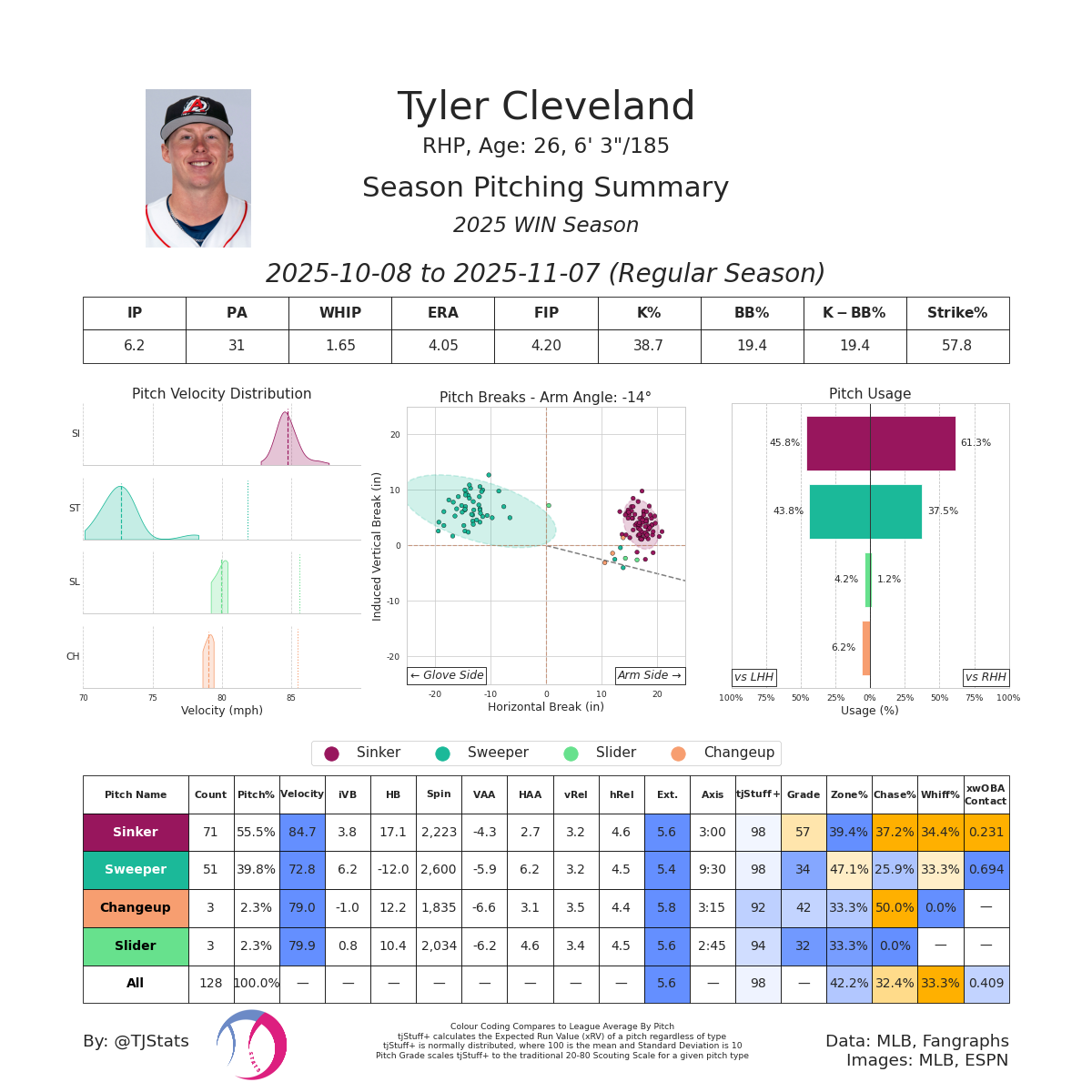
To be a quality MLB reliever, you either have to possess one or two above-average pitches or be very unique, and Cleveland fits almost exclusively into that second category. While his fastball tops out at only 89 MPH, he throws from a submarine arm slot, which makes the pitch nearly impossible to hit for power. Cleveland allowed just one extra-base hit all season between High-A and Double-A, including zero home runs.
He pairs this mid-80s fastball with a low-70s rising slider, which gives right-handed hitters fits, especially considering it generated a 33.3% whiff rate in the Arizona Fall League. Using the AFL ball, Cleveland showed that his pitches can play against higher-level talent, as he led the league in average exit velocity at 80 MPH and ranked in the 97th percentile in hard-hit rate and the 95th percentile in strikeout rate.
I think the unique arm slot and sinker/sweeper combo could be effective against right-handed hitters immediately at the big-league level, given its overwhelming success in the minors in 2025. The reason Cleveland likely won’t get selected is that teams may be concerned about whether he can command the ball well enough to stick, as he walked 19% of batters in the AFL. That said, his 8.7% walk rate during the regular season makes me think he has better command than what he showed in Arizona. I think Cleveland would be a fun pick to try, and I think it would be a success.
RHP Alex Pham (AA/AAA, Orioles)
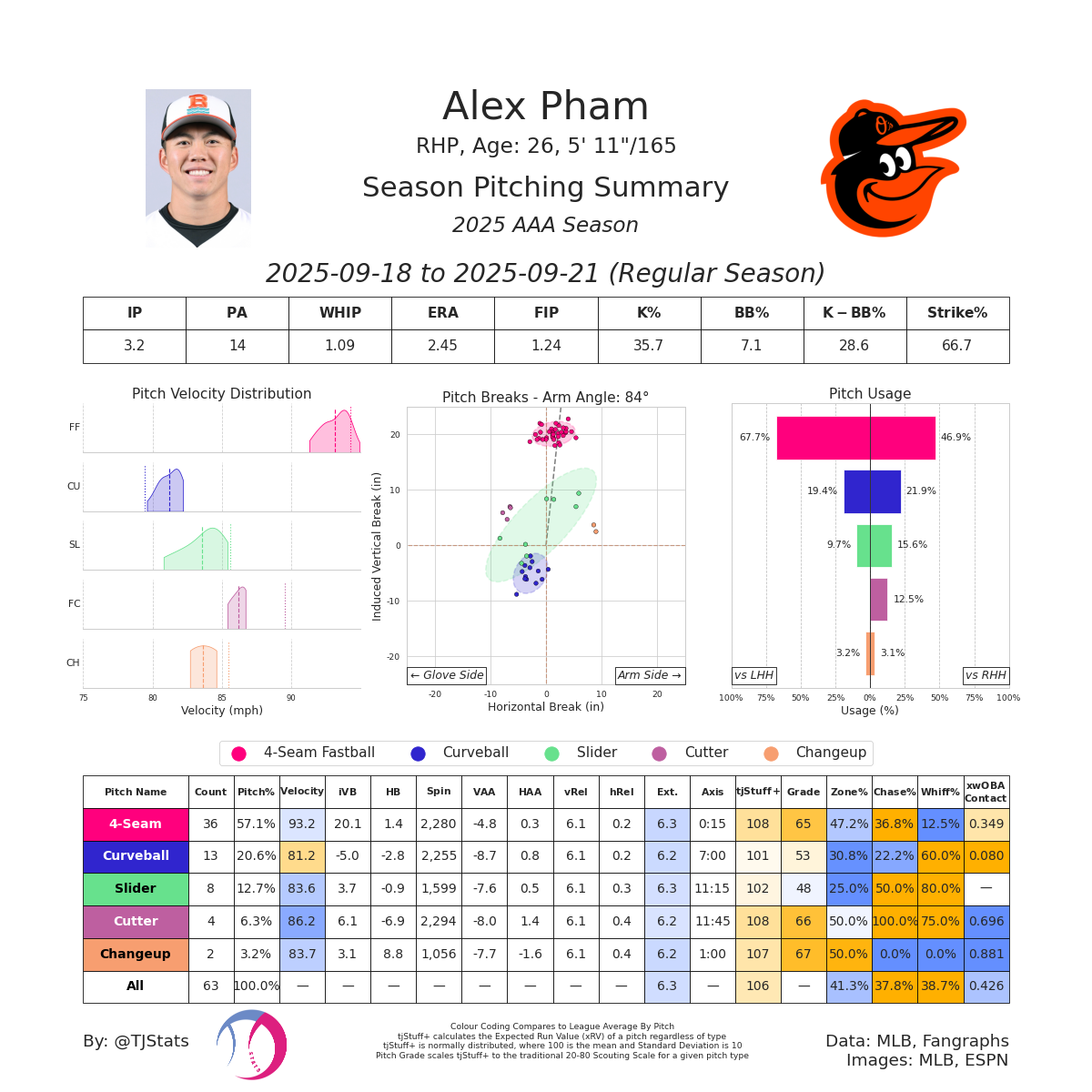
From one of the lowest arm slots in the minors with Cleveland to one of the highest with Alex Pham, he has an arm angle that is nearly vertical, sitting in the 78–85 degree range. Much like Cleveland’s low slot, this creates a tough visual for hitters. Pham’s extremely high arm slot allows him to generate a ton of vertical movement on his fastball, averaging around 20 inches of induced vertical break at 92–93 MPH.
He pairs the heater with four secondary pitches, including a curveball, cutter, slider, and changeup/splitter. The curveball was his most-used pitch in limited Triple-A action, used 20.6% of the time with strong results, generating a 60% whiff rate. Pham also uses the curveball in tandem with his cutter, which may be his best pitch against lefties, posting a whiff rate north of 50%.
Pham developed a new “death ball” slider toward the end of 2024, and it has become one of his primary weapons against right-handed hitters. He uses the changeup/splitter sparingly, and it is currently his weakest secondary, but I like the pitch from a metrics standpoint, and it could play a bigger role if a savvy development staff decides to take a chance on him. Overall, Pham posted a very solid 31.2% whiff rate and walked only 8.3% of batters in 2025. His 21% K-BB% ranked top 15 across all of minor league baseball.
I think Pham gets selected in the Rule 5 draft; the question is whether he makes it to the Cardinals.
RHP Peyton Pallette (AA/AAA, White Sox)
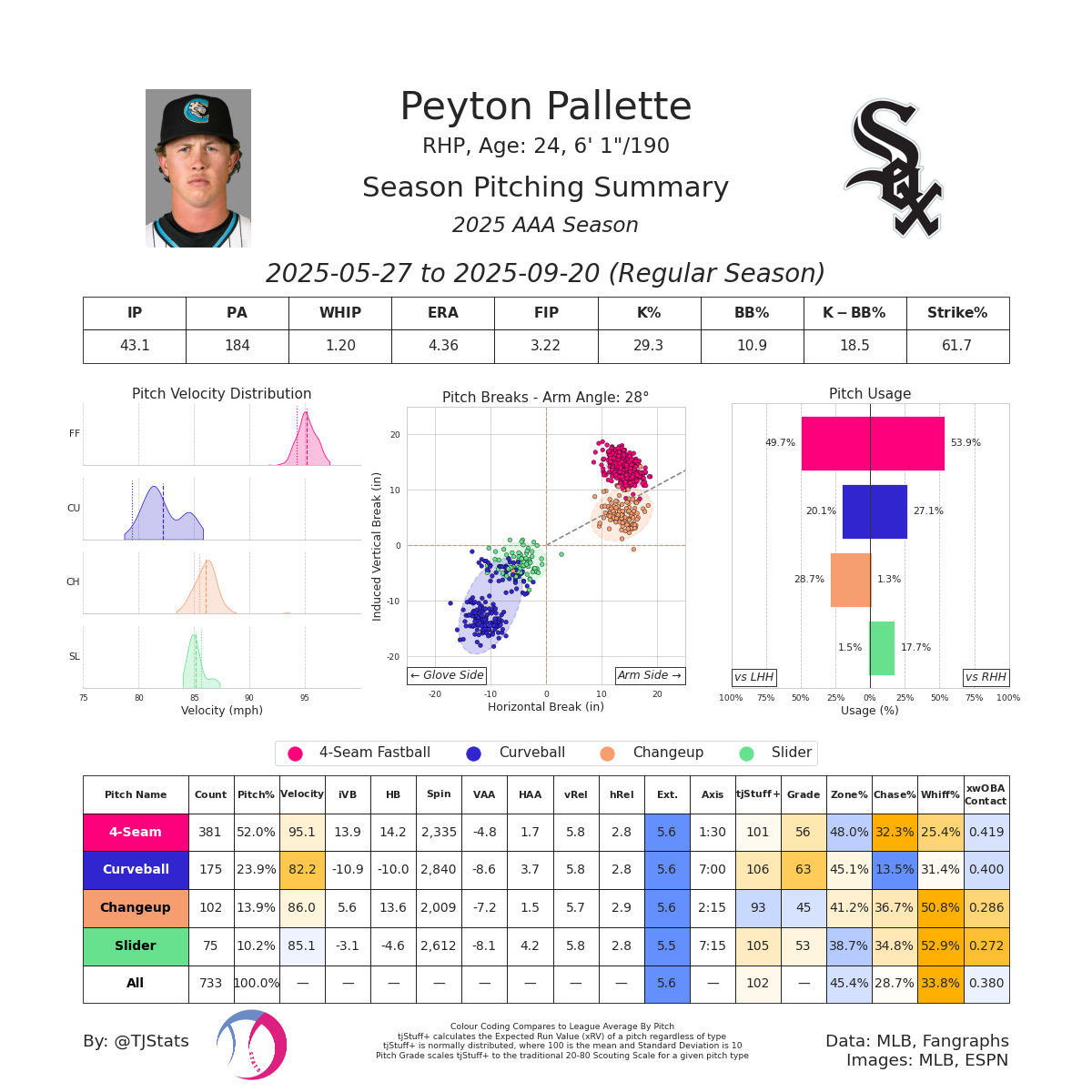
Pallette not being added to the White Sox 40-man roster came as a shock to most in the industry, myself included, as he was ranked No. 14 in the system by MLB Pipeline. Pallette will almost certainly be selected near the top of the Rule 5 draft, as his arsenal is largely MLB-ready, featuring a solid fastball and three average-or-better secondary offerings that play well off it.
Pallette struck out batters at a 29.7% rate, which ranked in the 81st percentile among all Triple-A pitchers, and his 34.1% whiff rate placed him in the 85th percentile. His 11% walk rate is a bit high, but not high enough to deter teams from taking a chance on a 24-year-old with this level of stuff.
His fastball doesn’t stand out from a metrics standpoint, but he throws it 95+ MPH from a sub-30-degree arm slot, which helps compensate for the lack of premium movement. The curveball is his go-to secondary, used 23.9% of the time, and it features a strong shape, generating a 31.4% whiff rate at Triple-A, with the potential to be even better in a larger sample size.
His changeup is heavily featured against left-handed hitters, with a 28.7% usage rate, and it produced excellent results, posting a 50.8% whiff rate. His slider is his least-used pitch at just 10.2% usage, but it was effective in limited action, generating a 52.9% whiff rate almost exclusively against right-handed hitters. I’m not sure it would maintain that level of success over a larger sample, but it rounds out his arsenal well.
I don’t expect Pallette to make it to the Cardinals, as I think he’ll go in the top five of the Rule 5 draft, but if he does, I could absolutely see them selecting him.
Shoutout to @TJStats on X for all the pitcher summary cards!