6 Players the Cardinals Should Target With Their Competitive Balance Round B Picks
Credit: Eddie Kelly / ProLook Photos
The thing that makes this year’s draft so intriguing for Cardinals fans is the fact that the Cardinals acquired both of these picks during the Brendan Donovan trade to go along with Jurrangelo Cijntje, Tai Peete, and Colton Ledbetter from the Mariners and Rays. With these picks, the Cardinals also added a million or more in bonus pool money, which they can allocate throughout the draft. With the Cardinals having so many picks and money early in the draft, it could be around this area where we see them maybe get aggressive with larger risk-reward high school players or college guys with talent who may be younger and have some incentive to return to campus.
Aidan’s Picks
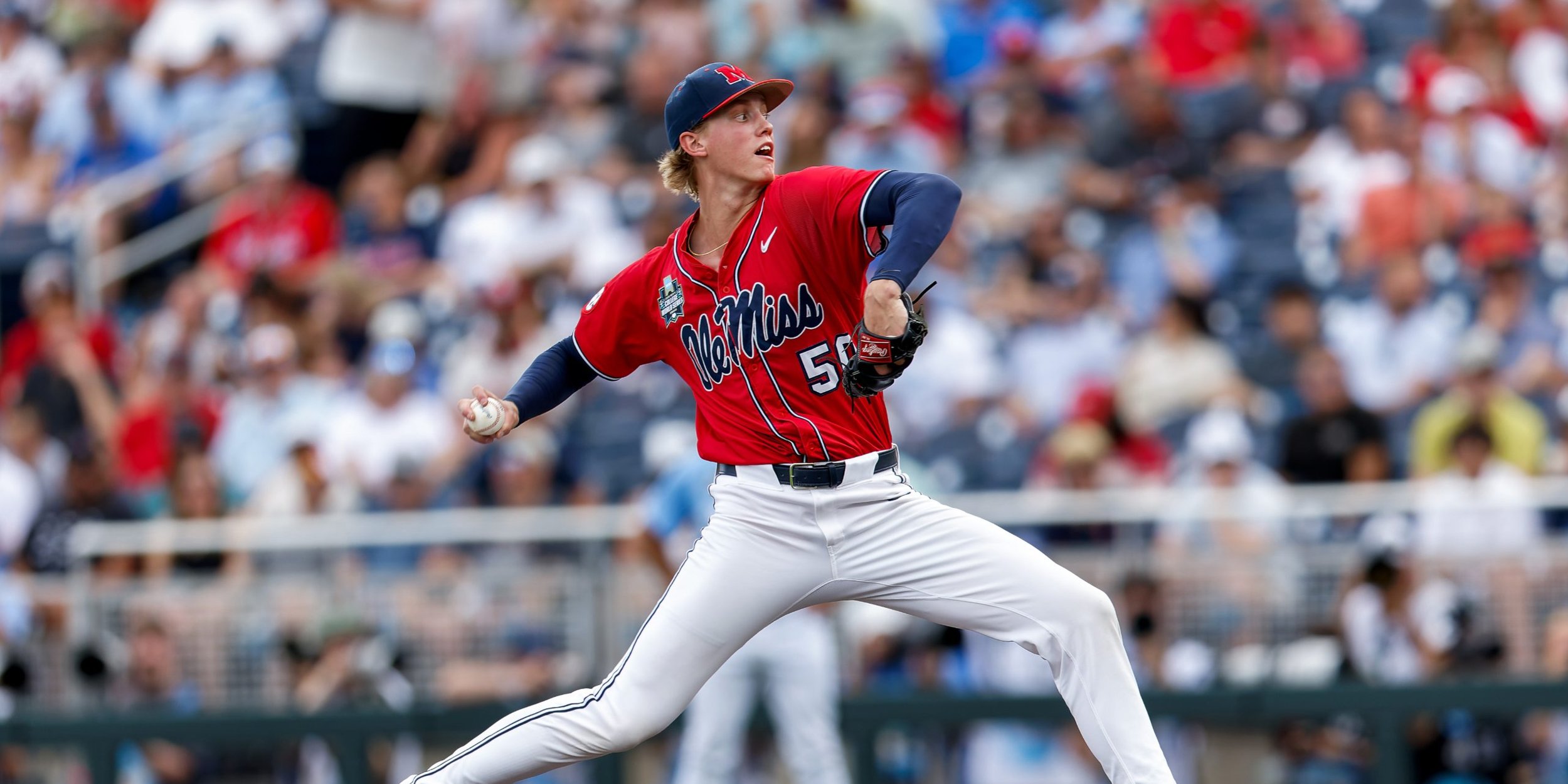
RHP Taylor Rabe (Ole Miss)
After logging just 16.1 innings for the Rebels in 2025, Rabe has taken a significant step forward and elevated his stock for the 2026 MLB Draft. He opened the season in the bullpen, where he proved to be an effective reliever before earning a move into the starting rotation. Across both roles, Rabe has compiled a 5–3 record with a 3.71 ERA over 70.1 innings pitched. The biggest driver of his success has been the jump in his swing-and-miss stuff, as he has generated strikeouts at a much higher rate while continuing to miss bats consistently throughout the season.
The 21-year-old possesses a projectable 6-foot-5, 200-pound frame with room to add strength. Rabe already shows solid arm strength, working in the mid-90s with his fastball, and there could be additional velocity in the tank as he continues to fill out physically. He utilizes a high leg kick in his delivery and generates roughly average MLB extension down the mound. The right-hander also does a good job of creating deception, hiding the ball well and releasing it from a higher slot, with a release height of approximately 74 inches.
Rabe is a five-pitch mix pitcher who headlines his arsenal with a mid-90s fastball that has touched 99 mph. He shows good feel for the pitch, generating strong spin and consistently landing it in the strike zone. The primary drawback is the shape, as the fastball produces below-average induced vertical break relative to his release height. He also features a sinker that offers a more favorable movement profile for his release characteristics. While the shape still has room for improvement, the pitch shows promising velocity and a high spin rate.
His most frequently used secondary pitch is a high-80s cutter, though its movement profile more closely resembles a gyro slider. It generates plenty of swing-and-miss and chase, and he is comfortable using it against hitters from both sides of the plate. He complements it with a low-80s slider that can resemble a smaller curveball at times. Primarily used against right-handed hitters, the pitch has been an effective weapon. The main concern with both breaking balls is that he does not generate much spin. Rounding out the arsenal is a changeup that he uses sparingly. The pitch has a serviceable shape but remains a work in progress. He has yet to develop a consistent feel for the offering, as evidenced by a 54.4% strike rate.
There is still plenty of development ahead for Rabe, but the upside makes him an intriguing draft target. His physical frame suggests there could be additional velocity to unlock, adding even more value to a fastball that already touches 99 mph. While his pitch shapes are not currently standout offerings, his ability to command the baseball gives him a strong foundation. He consistently throws strikes, avoids leaving pitches in the heart of the zone, and demonstrates advanced control for a power arm. Another encouraging indicator is his ability to generate high spin on his fastballs. That trait suggests the raw spin characteristics are present, even if they have not yet translated to his breaking ball arsenal. With further development—potentially through grip adjustments or pitch design work—there may be room to improve the shape and effectiveness of his cutter and slider.
Given his combination of size, velocity, strike-throwing ability, and untapped pitch-design potential, Rabe offers significant projection and could develop into a much more complete pitcher at the next level.
LHP Wes Mendes (Florida State)
After a difficult 2025 season at Florida State, Mendes emerged as a reliable Friday night starter for the Seminoles in 2026. He significantly improved upon his 5.42 ERA from the previous year, posting a 2.90 ERA while taking a major step forward in both command and bat-missing ability. Mendes increased his strikeout rate from 26.3% to 32.6% and cut his walk rate from 11.4% to just 6.5%, key factors behind his breakout campaign.
The junior left-hander stands 6-foot-1 and 195 pounds. He features solid, repeatable mechanics, though there is still room for refinement. Additional physical development could help him unlock more velocity. Mendes repeats his arm action well and releases the ball from a 5-foot-9 vertical release height. He generates limited extension down the mound.
Mendes operates with a five-pitch mix led by a low-90s fastball that serves as his primary offering. While the velocity is lower, he has reached as high as 96 mph, suggesting there may still be more velocity to tap into. The fastball features average shape for his release profile but plays well at the top of the strike zone thanks to a solid vertical approach angle. After reducing its usage compared to 2025, the pitch became more effective in 2026. He also introduced a new cutter in the upper 80s that shows quality shape and strong underlying results. While it currently functions more as a bridge pitch within his arsenal, it gives hitters another look and helps set up his secondary offerings.
His changeup is the standout pitch and grades as a plus offering. Typically thrown in the upper 70s to low 80s, it tunnels exceptionally well off the fastball and features significant arm-side fade. The pitch consistently generates both whiffs and weak contact, particularly against right-handed hitters. Mendes primarily deploys it versus righties, where it has produced an impressive 54.1% whiff rate while also generating plenty of chase outside the strike zone.
The slider shows promise as another swing-and-miss weapon. It features good shape but is not thrown particularly hard, typically sitting in the low 80s and occasionally reaching the mid-80s. Mendes relies on it primarily against left-handed hitters, where it generates strong chase and whiff rates. He also demonstrates the ability to back-foot the pitch effectively against right-handed batters.
Rounding out the arsenal is a curveball in the upper 70s. Mendes uses it primarily as a strike-stealing pitch early in counts. While he can land it below the zone, it does not generate significant chase and currently profiles more as a count-management offering than a put-away pitch.
There is a strong chance Mendes is selected well before the Competitive Balance Round B range. However, if he were to still be available, the combination of present performance and future projection would make him an intriguing value. The ingredients are there for him to develop into a reliable major league starter, particularly if he can add another tick or two of velocity and consistently work in the 94–96 mph range. Increased fastball velocity would not only improve the effectiveness of the pitch itself but also further enhance the separation and deception of his plus changeup and promising slider. With an already established plus offering and a deep five-pitch mix, Mendes provides a solid foundation for player development staffs to build upon.
OF Noah Wilson (McCallie School - TN)
Selecting Wilson in this range carries considerable risk, but the upside makes him one of the more intriguing prep prospects available. Wilson is known for his rare combination of power and speed, earning 55-grade power and 70-grade run tools from MLB Pipeline. He consistently produces impressive exit velocities and generates quality bat speed, giving evaluators plenty to dream on. The primary concern is his hit tool, which struggled against high-level competition on the 2025 summer showcase circuit.
The 6-foot-2, 195-pound outfielder features a quiet setup at the plate with minimal pre-swing movement. His load incorporates a small leg kick, helping him gather into his swing without creating excessive timing challenges. Wilson starts with his back elbow in a lower position before raising it as he begins his swing sequence. He employs an uphill, left-handed swing path that naturally creates loft and allows him to drive the ball in the air. While that approach contributes to his power potential, it is also a key reason for his elevated swing-and-miss rates.
Wilson's athleticism and speed project well in center field, where he has the tools to remain long term, though there is still defensive refinement needed for him to reach his full potential at the position. Despite possessing plus athleticism, his reads, routes, and overall defensive instincts remain a work in progress. His arm strength currently grades below average, but that is less of a concern in center field than it would be in a corner-outfield role. There may also be room for additional arm strength as he continues to physically mature, which could further improve his defensive profile.
Tyler’s Picks
RHP Jacob Dudan (NC State)
Jacob Dudan came into the season as the Saturday starter for the North Carolina State Wolfpack and quickly established himself as one of the more intriguing arms in the country, pitching to a 3.60 ERA across 50.0 innings with 62 strikeouts to only 12 walks. Dudan was likely to continue rising draft boards into the first-round conversation until his elbow blew out during a start vs. Notre Dame, causing him to undergo Tommy John surgery in late April. He missed the majority of conference play, where his stock could have risen considerably.
Standing at 6-foot-2 and 191 pounds, Dudan doesn’t get great extension down the mound, but the 5.95 feet of extension on his fastball allows him to get down the mound enough to create a lower 5-foot-5 release height, making both his fastball and secondaries, which have even lower release heights, extremely effective. Dudan features a waist-high leg lift before moving down the mound and allowing his low three-quarters arm slot to create both deception and an elite VAA on his fastball.
Speaking of Dudan’s fastball, the pitch averaged an impressive 96.8 mph on the season, which was one of the top marks in all of college baseball, and the pitch can get up to the 99 mph range. While the pitch doesn’t have great IVB, its -4.48 vertical approach angle makes it extremely tough on hitters and has allowed it to generate an elite 30.5% whiff rate in its limited sample size. While Dudan has a really solid fastball, he actually uses his sinker more, with 33% usage. The pitch averaged 95.6 mph with almost 18 inches of horizontal break, and while it only produced a 12.9% whiff rate, it did a good job of producing ground balls with a .321 xwOBA.
While both of Dudan’s fastball offerings are solid pitches, the gyro slider is the clear standout pitch of the arsenal, and Dudan relies on it a lot, with 40.1% usage. The pitch averaged 86.8 mph with around 2600 RPMs in spin, and it gets ample swing and miss. A 51.2% whiff rate on the pitch ranks among the 96th percentile in all of college baseball, with its even more impressive 44.6% chase rate being among the 99th percentile. The pitch is a clear 65-70 grade offering and will be the pillar of his arsenal in either a starter or reliever role.
There are some questions with Dudan, the first and most obvious of them being health. Dudan missed half of the season this year with the aforementioned Tommy John surgery and won’t be on the mound again until 2027. He’s also never thrown above 50 innings in any college season, so whether his body can handle a starter’s workload is a mystery. He is also only a three-pitch pitcher currently, with two of those pitches being fastball variants, making his current approach vs. lefties somewhat in question.
Even with these questions, the arm talent and stuff are undeniable, and that has firmly supplanted him in this range of the draft, even with the injuries. With the Cardinals having so many picks in the first four rounds of the draft, it could be worthwhile to take a big risk on a high-upside arm like Dudan at one of these picks.
OF Jake Brown (LSU)
From a pitcher who was rising up boards early to a position player who was rising up boards before injury, Jake Brown was having a very strong year at LSU before going down with a broken hamate bone in April. Before the injury, Brown was slashing .309/.404/.642 with 16 homers and seven doubles through 42 games for the Tigers. He also sported a solid 16.5% strikeout rate combined with an 11.9% walk rate. There was a likely chance that if Brown didn’t get injured, he would have played himself into backend first-round or early second-round conversations.
Standing at 6-foot-2 and 194 pounds, Brown starts with an open stance from the left side of the plate with his hands and bat at head level. He then implements a small leg lift as a timing mechanism before swinging. Overall, it is a very balanced swing with not a lot of moving parts, and Brown has shown the ability to get into his legs well to generate power while staying on time consistently.
One of my favorite things about Jake Brown when I was scouting him is that, while he might not have as many standout traits as others in this draft, he doesn’t really do anything poorly enough to warrant any concern from me. On the contact side, he had an 83.9% zone-contact rate, which is solid for a college player. He combines that with another solid 62% out-of-zone contact rate while only chasing 17.6% of the time, which ranks in the 87th percentile. His 22.5% whiff rate ranks exactly in the 50th percentile among all college hitters. His 7.7% in-zone whiff rate vs. spin is very good, and he can hit velocity as well, with only a 4.8% whiff rate vs. 94+ mph pitches, which ranks in the 63rd percentile.
With 16 homers on the season, it is no surprise that Brown’s power metrics are also good, with an 89.7 mph average exit velocity and a 104.7 mph 90th-percentile EV. Brown maximizes these by having good launch angle metrics, with a 40.7% hard-hit pull percentage combined with only a 32.6% ground-ball rate and a 23.7% line-drive rate, both of which are in the 66th percentile or higher. His 49.3% overall hard-hit rate ranks in the 88th percentile among all D1 college players.
Brown mainly manned right field for the Tigers this spring, with likely top-15 pick Derek Curiel flanking him in center, though Brown has plus speed and whichever team drafts him will likely give him a chance to play center field, where he could profile as an average defender with a plus arm. Brown stole nine bases this season in his 42-game sample, though he stole 11 last season, and has the ability to get to around 20 with more reps and training on the basepaths.
Overall, I don’t see many holes in Brown’s game. While he isn’t great against lefties, with more time and reps, he could become comfortable enough to handle them at an average level. Besides that, he has solid power and contact metrics and is more of a safe college pick than one with huge upside, but he is someone I believe will rise fast through whichever organization decides to pick him.
OF Martin Shelar (Marist HS - GA)
As Aidan mentioned, it is always a bit tricky and risky to take high school players in this range, but Mississippi State commit Martin Shelar is as impressive as they come. The outfielder made a mockery of Georgia 4A baseball in the Atlanta area, which is impressive considering the Atlanta area consists of some of the best prep talent in the country. Shelar hit 20 homers, which led the Peach State, while hitting over .500 with 25 walks to eight strikeouts.
Shelar has an unorthodox swing, standing upright to start before doing a short toe tap into a longer stride. While the swing does have some scouts concerned about his future production, the results are undeniable. This spring, Shelar has consistently hit balls over 100 mph, with the ability to reach the 109-110 mph range. After the untraditional load, the hands and hip movement are as explosive as I’ve seen from a high schooler in this class.
There are some question marks about his ability to play center field, though he has posted plus home-to-first and home-to-third times in the past. I believe there is enough athleticism to at least give him the chance to play center field in the lower minors. If not, the bat, if it is as good as the spring and circuit metrics suggest, should be just fine in a corner-outfield spot.
I have Shelar as a borderline top-five high schooler in this draft class, and while I think he should go much higher than this ranking, this is where most of the outlets have him ranked, so I’m including him in this article.