5 Players the Cardinals Should Target With Their 3rd Round Pick (#86 Overall)
Credit: MLB
Another draft, and another set of preview articles for this year’s draft, and while it was fun last year for me ( Tyler) to do them by myself, I invited Aidan Gray to join me for this year’s preview article as we break down and share some of the players we like that are currently ranked in the area of each of the Cardinals’ top 6 picks. As I am typing this, the college baseball postseason is in full swing, and we are just over a month away from one of the most fun couple of days of the year. Without further ado, let’s break down five players that could be available for the Cardinals in the 3rd round of the upcoming draft.
Aidan’s Picks
RHP Ruger Riojas (Texas)
Riojas, the 22-year-old senior, is one of the older players in this year’s draft class, but he’s put together a strong season for the Longhorns. The right-hander is 5–2 with a 4.02 ERA across 65 innings pitched. Ruger has taken a clear step forward in his college career, posting a career-best 37.3% strikeout rate in 2026 against SEC competition after never eclipsing 30% in previous seasons. Even more encouraging, the jump in strikeouts hasn’t come at the expense of command -- he’s maintained strong control, walking just 5.2% of opposing hitters.
Ruger has a smaller frame at 6’0”, 192 pounds, but shows simple, repeatable mechanics. His ability to maintain velocity and avoid a significant velocity drop as his pitch count increases is impressive. Riojas works from a higher arm slot with a release height around 5’10”, and because of his smaller frame, he doesn’t generate much extension down the mound.
He features a four-pitch mix headlined by a four-seam fastball that sits 94–96 mph and has reached as high as 97.7 mph. The pitch averages just under 19 inches of IVB and shows strong characteristics for playing effectively at the top of the zone with its flatter approach angle. His fastball has generated a 32% Whiff% and has been effective against both right-handed and left-handed hitters. He pairs it with a plus splitter that sits 81–84 mph and tunnels exceptionally well off the fastball. The splitter has produced a 54.5% Whiff%, driven largely by the 14+ inches of vertical separation from the fastball. It has also proven effective against hitters from both sides of the plate. Together, the fastball and splitter create an ideal north-south combination.
His cutter is his most-used secondary pitch and serves as an ideal bridge between the fastball and splitter. It’s a traditional cutter with minimal vertical movement that sits 86–88 mph. He uses it more as an east-west offering, running it in on left-handed hitters and away from right-handed hitters. He rounds out the arsenal with a curveball that sits 77–80 mph, primarily using it to keep hitters off balance. The pitch shows more of a 12–6 shape, though it lacks the true vertical depth typically associated with a traditional 12–6 curveball.
Riojas has an intriguing profile and the traits to develop into a big-league starter. There are elements in his game that hint at middle-of-the-rotation upside, though a back-end starter role appears to be the more realistic projection at this stage. If he can maintain the shape of his fastball while adding more velocity, he has the potential to outperform expectations and surprise a lot of people.
OF Kollin Ritchie (Oklahoma State)
Ritchie, a 21-year-old junior at Oklahoma State, has showcased tremendous power throughout the 2026 season. In 56 games, he is hitting .335 with a .478 on-base percentage and an eye-popping .828 slugging percentage. He currently has 29 home runs, ranking third in Division I baseball behind Louisville’s Tague Davis, who leads the nation with 34, and FDU’s Hunter Ray, who sits second with 32.
The 6’2” outfielder features a quiet setup at the plate with minimal hand movement in his stance. The left-handed hitter uses a small leg kick/toe tap as a timing mechanism. Ritchie’s uphill swing path helps him get underneath the baseball and create lift, while his strong bat speed allows him to generate quality exit velocities.
Ritchie profiles as a clear power-first bat, though that power comes with some swing-and-miss concerns, as evidenced by his 71.8% overall contact rate. While the contact numbers may raise some questions, he compensates with the quality of contact he produces when he does connect. His 107.9 mph EV90 ranks in the 96th percentile, but even more impressive are his air-pull metrics. He carries a 73.8% air-pull rate, placing him in the 99th percentile and highlighting his ability to consistently get the ball in the air to his pull side. Ritchie will expand the zone at times, but he also shows a disciplined approach by drawing walks at a 16.4% rate while striking out 23.9% of the time. He has also demonstrated the ability to handle both left and right-handed pitching, posting an OPS of 1.280 or better against hitters from either side.
The outfielder has primarily played center field for the Cowboys and has shown solid instincts with good reads and efficient routes to the baseball. He has committed a couple of errors this season, including a dropped fly ball and a ground ball that caught the heel of his glove. While there is some speed in Ritchie’s game, it likely isn’t enough for him to remain in center field long term. Combined with average arm strength, left field projects as a more natural defensive fit at the next level.
Ritchie has the tools to develop into an everyday big leaguer in left field. If he can maintain consistent power production, he projects as a productive offensive player with defense capable of holding its own. However, there is risk attached to the profile because of the swing-and-miss concerns. That issue alone could ultimately determine how far he advances through a system and whether the offensive impact is enough to offset the contact questions.
Tyler’s Picks
RHP Ryan Peterson (Sam Houston)
One of the top non-power conference pitchers, Ryan Peterson, had an excellent season for the Bearkats, posting a 3.38 ERA across 88 innings, striking out 105 batters while only walking 23. While the Bearkats didn’t play the toughest schedule, Peterson shined against some of the toughest competition, including an 11-strikeout performance against Oklahoma State, where he gave up just a single run on three hits.
Peterson uses his 6’3 to get down the mound well, getting over 6’5 feet of extension on his fastball, changeup, and over 6 feet on his curveball and slider. He utilizes a leg lift that comes up to his midsection before straightening his leg to get down the mound to create that elite extension. He utilizes a lower ¾ arm slot along with the extension to create a very low vertical release height of 5’1 feet on his fastball, creating one of the best vertical approach angles in all of college baseball at -4.11 degrees, which makes the ball appear to rise as it enters the top of the zone.
Peterson’s fastball sits in the 92-94 mph range, touching 96, though it plays well above its velocity because of the release characteristics and deception that Peterson employs, allowing the pitch to get a 19% whiff rate. This is why he went to the pitch 43.2% of the time in 2026. What makes Peterson intriguing is that his fastball might be just his third-best pitch, as he also employs an elite hammer curveball and an intriguing baby sweeper. The curveball is one of the best in all of college baseball, sitting in the low 80s. The pitch gets over 3100 RPM of spin on average, allowing the pitch to get 10 inches of vertical drop, combined with 17 inches of sweep. The pitch registered a 41.8% whiff rate this season in a 21% usage clip this season. He also spins his sweeper well, averaging around 2900 RPM with 9.8 inches of horizontal break while sitting in the low 80s. The slider also generated a very impressive 35.4% whiff rate.
The changeup needs a lot of work, and he rarely used the pitch in 2026, with only a 5.3% usage. He doesn’t kill spin well on the pitch at all, with the pitch averaging over 2000 RPM, getting 3.4 inches of IVB while having 13 inches of horizontal break. With the Cardinals’ recent ability to develop kick-changeups, I think they could figure out a way to help him develop this pitch into a usable offering.
Peterson has three average to above offerings by almost every metric. Combine that with good command, and it makes him a high-floor pick that likely profiles as a backend starter at the next level, with the ability to be more than that if he can get into the mid 90s more consistently with his fastball. His feel for spin also makes me confident in his ability to create new pitch shapes, and I think it would be a very solid pick in this range.
1B Mulivai Levu (UCLA)
One of the key pieces of the Bruins’ run as the top-ranked team all season, Mulivai Levu had one of the best seasons of any 1B in the country, slashing .350/.446/.663 with 17 homers and 62 RBIs. While most power hitters of Levu’s status have some swing and miss in their game, Levu has been able to balance his power with good contact, running an 11.2% strikeout rate to a 9.7% walk rate this season, posting a 147 WRC+.
Levu, standing at 6’1 and 215 pounds, starts with a balanced setup, his hands just behind his head. He then employs a small leg lift to get into hitting position before allowing his hands to whip through the zone until contact. On outside and middle pitches, he seems to get extended well, which allows him to create more loft. In contrast, on inside pitches, he seems to cut the bat around the waist more, though he seems to still get solid swings and contact numbers despite a slightly more unconventional inside pitch swing.
Levu posted very solid exit velocity numbers with a 105.4 mph 90th exit velocity and a 111.6 mph max exit velocity. He also posted a 47.2% hard-hit rate, which ranked in the 84th percentile among all college hitters. The thing that makes me intrigued by Levu, though, is how he combines this with his contact ability. Levu posted an 89.4% in-zone contact rate, which ranked in the 81st percentile, and an OOZ of 69.4%, which also ranked in the 80th percentile, which is why he was able to keep his strikeout rate so low despite the power. The big question mark with Levu will come down to how he refines his approach in pro-ball, as he posted a 29.8% chase rate this season, which ranked in the 13th percentile. This chase causes him to make contact with less-than-ideal pitches at points, limiting his damage during certain stretches.
Defensively, he is solid at 1B, making good plays and having a solid arm. He has more athleticism than your typical 1B and could get a shot at 3B or even a corner outfield in pro-ball, especially with a team that is confident in their ability to help develop defense. He’s not the best runner, and he profiles to be below-average to maybe average on the basepaths.
I could see Levu developing into an Alec Burleson or Blaze Jordan-esque hitter who makes a lot of contact, showing solid power, and if he can refine his approach and swing as Burleson did, I think there is a solid major league contributor in this profile with 20 HR power and high average at the 1B position.
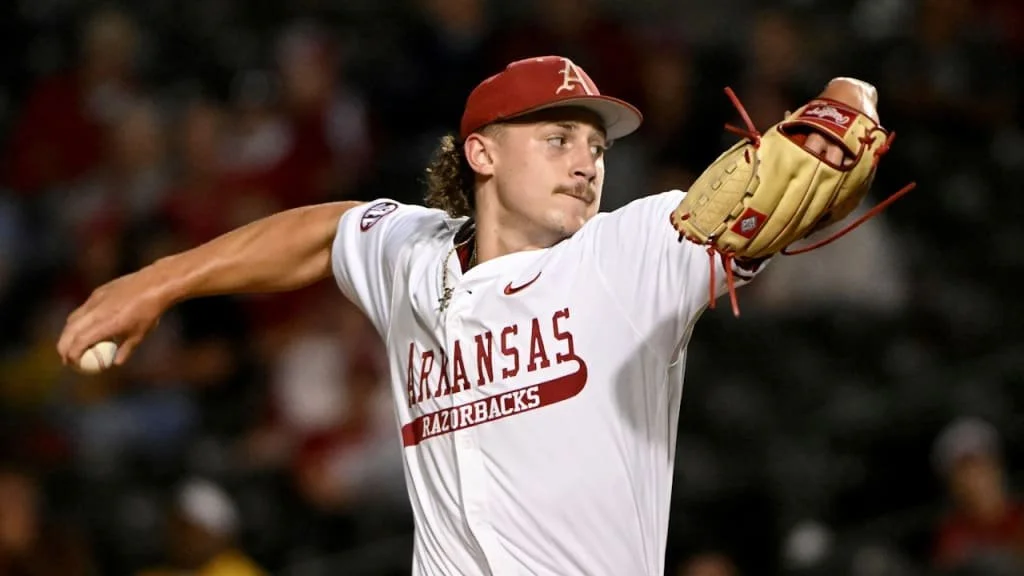
RHP Carson Wiggins (Arkansas)
Arguably, no player in this likely pick range has the upside of Carson Wiggins, but with this upside comes a high-level of risk because Wiggins has not, and doesn’t plan to, pitch this season for the Razorbacks after having an elbow surgery sideline him. Even with this extreme risk, Wiggins is a top 100 draft prospect this year for a good reason: the arm (when healthy) is one of the best pitchers in the country with an ability to get strikeouts in bunches. He also has family pedigree on his side, as his brother is the Cubs’ top pitching prospect and currently in AAA.
Standing at a towering 6’5 Wiggins employs a waist-high leg kick into a simple stride down the mound and then whips his arm through the zone, utilizing a ¾ arm slot to create a flat approach angle with his fastball. While he did have a 15.3% walk rate in his small 14-inning sample size, I feel like the delivery doesn’t have too many moving parts and could easily see him developing solid command as he gets more innings under his belt.
Wiggins’ arsenal consists primarily of two pitches: a fastball and a slider. The fastball sits in the high-90s, touching 102 when healthy, with the ability to touch and potentially sit north of the 100 mph mark, especially in a reliever role. The pitch also has solid movement of 18 inches IVB from a flatter approach angle. He combines this fastball with a slider, which sits in the upper 80s with spin rates north of 2700 RPM, allowing the pitch to generate great depth with a more downward shape. Wiggins also mixes in a developing changeup, which has been inconsistent but has shown flashes of being a good pitch and could develop into a plus pitch with pro development.
A draft-eligible sophomore Wiggins could be a harder sign than most 3rd round picks, though a team with a larger bonus pool and many picks (like the Cardinals) could have both the money and the willingness to take a shot on arm like Wiggins given the height of his upside, if a team does pick him, they will almost certainly try him as starting pitcher (at least to start his career) as if it all comes together for him, he easily has #2 to potential ace potential as a starter. It is a risky pick, but one that comes with tremendous upside if developed correctly.