4 Later-Round Draft Prospects the Cardinals Should Target
Credit: Santa Clara University Athletics
The MLB Draft is in less than two months, and the Cardinals will have a very interesting class to handle. This year’s crop of draft-eligible college players may lack the truly elite-level talent that existed in some prior classes, but it more than makes up for that with the numerous prospects with intriguing traits scattered throughout different conferences and teams with varying draft stock.
This year, the Cardinals are loaded with early picks that give them better chances at selecting impact players, as they hold six picks within the top 100 at #13, #32, #50, #68, #72, and #86. These picks obviously take up much of the attention regarding draft discourse, but for an organization with four players in their top seven of total FanGraphs WAR since 2016 who were drafted later than the 100th pick, including a certain legendary catcher, the importance of late-round picks can never be ignored.
In this article, I’ll highlight four draft-eligible college players unlikely to go in the first three rounds who I believe possess the ability to outperform their draft position in the future.
Wake Forest RHP: Duncan Marsten
Coming off his first year with the Demon Deacons, Duncan Marsten was a name who some people in the draft sphere identified as a potential breakout candidate who would rise up 2026 draft boards with a good second year. Everything has not quite come together for Marsten, evidenced by his 4.74 ERA over 57 innings pitched, but he still holds the same premium traits that put him on the radar of draft analysts.
Marsten is a premium mover down the mound. Throwing from a ¾ release, the 6'3" righty is able to generate premium extension at roughly 6.6 feet from a smooth, repeatable delivery that helps quell some possible concerns of him becoming a reliever at the next level.
The four-seam fastball has been Marsten’s primary fastball this year, as he’s shifted away from the sinker-heavy approach he adopted in his freshman season, and it sits in the 95–96 MPH region but has peaked as high as 99. The movement profile on the offering is not great at 15.3 IVB and 13.8 HB, but Marsten has seen success with it, holding a 20.4% Zone Whiff rate on the year. His sinker shape is also relatively uninspiring, but it has also been able to perform well due to its + velocity, missing bats at a 20% clip in zone. Marsten’s main secondary has been a mid-80s gyro, and the offering looks the part of a potential + breaker with a little refinement. He also mixes in a high-80s changeup that kills spin, although his feel for the offering has been rough and he’s struggled to land it for strikes.
Marsten will need some arsenal tweaking and command growth to reach his ceiling, but his frame, velocity, present capacity for swing and miss, and + release traits give him the potential to become an impactful Major League starter at a spot later than those types of prospects usually go.
Oklahoma State OF: Alex Conover
With a .357/.476/.625 slash line, Alex Conover has had a breakout year for the 19th-ranked Cowboys and made his draft stock a lot more intriguing in the process.
The Oklahoma State outfielder grabbed some attention for his above-average exit velocities last year, and with a 90th-percentile exit velocity of 107.6 and a hard-hit rate above 68%, it's easy to see why. While the raw power was evidently there, he struggled immensely in his sophomore season as a result of his poor hit tool. Conover struck out 28.2% of the time, and with a chase rate of 25.4%, he did not nearly possess the plate discipline to offset his swing-and-miss issues.
In his draft-eligible year, however, Conover has shifted his approach to become far more selective at the plate. He’s running much lower swing rates, and as a result, he cut down his chase rate to 19.4% and bumped his walk rate up to 15.4%, although it does come at the cost of him being less aggressive with pitches in the strike zone. The improvements he’s seen in plate discipline in just one year are incredible, but surprisingly, his general bat-to-ball skills have seen an even bigger improvement than his swing decisions have. It’s clear that during the year, Conover has prioritized putting the ball in play at the highest rate he can. He’s running an 89.6% zone contact rate as opposed to 82.9% a year prior and has cut his fly-ball rate significantly in favor of more line drives.
The power generation has certainly taken a hit from Conover’s new contact-heavy process, but it's probably not as much as you’d imagine. He’s still running a well-above-average 90th-percentile exit velocity of 105.7, and the same is true of his hard-hit rate of 52.5%. His game power might have dropped a good bit, but when the contact quality is still impressive and his hit tool has gone from a large negative on his profile to a legitimate + trait, it has looked like a worthy trade-off as he’s matured into a very well-rounded hitter. Taking his slim 6'4", 202 lb. frame into account, there might be more projection coming that could potentially nullify a bit of the power concerns as well.
Conover is a solid enough runner who has shown the ability to handle a corner outfield spot well, even if he does not project as a + defender there, rounding out his profile well. While he definitely does have some odd traits, like his extreme opposite-field spray tendency, Alex Conover is an advanced hitter with a relatively high chance of contributing in the big leagues at some point.
UCLA RHP: Cal Randall
Cal Randall had an incredible year in the bullpen for UCLA with a 3.19 ERA and 43.5% K rate, and the Bruins relief ace holds some of the top raw stuff in this year's pitching class.
It’s pretty safe to say that Randall’s fastball is the best pitch in all of college baseball. It may sound crazy, but the offering is completely worthy of an 80-grade marking. The pitch sits ~97 MPH, and Randall has run it up as high as 100 on multiple occasions. The offering is perceived as being even faster due to Randall getting great extension down the mound. The overpowering velocity is already enough to get the pitch by batters, but the real outlier nature of the offering comes from its movement profile. Randall throws from an extremely low 5.2-foot release height but still gets incredible ride and run on his heater at 18.5 IVB and 11.6 HB, and the pitch comes in looking incredibly flat with a VAA of -4.0°. To put the metrics into context, there have been 140 fastballs thrown in MLB from a release height ≤5.3 feet, with ≥18 inches of IVB, ≥10 inches of HB, and at ≥96 MPH over the last four seasons. Cal Randall threw more than 190 of them this year alone. The shape will see some downgrades with the transition to the Major League ball, but it is still an unbelievably special fastball, all things considered.
Randall relies on the offering more than 85% of the time, but it’s seen no drop in effectiveness, as hitters are whiffing 35.5% of the time against it. When he’s not relying on the fastball, Randall will mix in an 88 MPH slider as well as an 89 MPH changeup with almost no vertical separation from his heater, but neither of the two looks the part of an effective offering.
There is obviously some pretty resounding risk with Randall’s profile. He struggles mightily with command, as he’s walked 16% of batters faced this year, and he lacks any form of a truly viable secondary offering. When these two red flags are combined, it’s incredibly unlikely he’s ever even attempted to stretch into a starting role, and they could even lead to him failing in a bullpen role without the right development. Even in a relief role, Randall will certainly need to find a way to develop an effective secondary and cut down on his fastball usage in order to find success. The red flags may be there, but Randall’s raw stuff gives him the ceiling of a truly elite reliever, and if the Cardinals organization feels confident in their ability to develop him, I would love it if they ended up being the team to take a reach and select him earlier than one might think.
Santa Clara RHP: Max Bayles
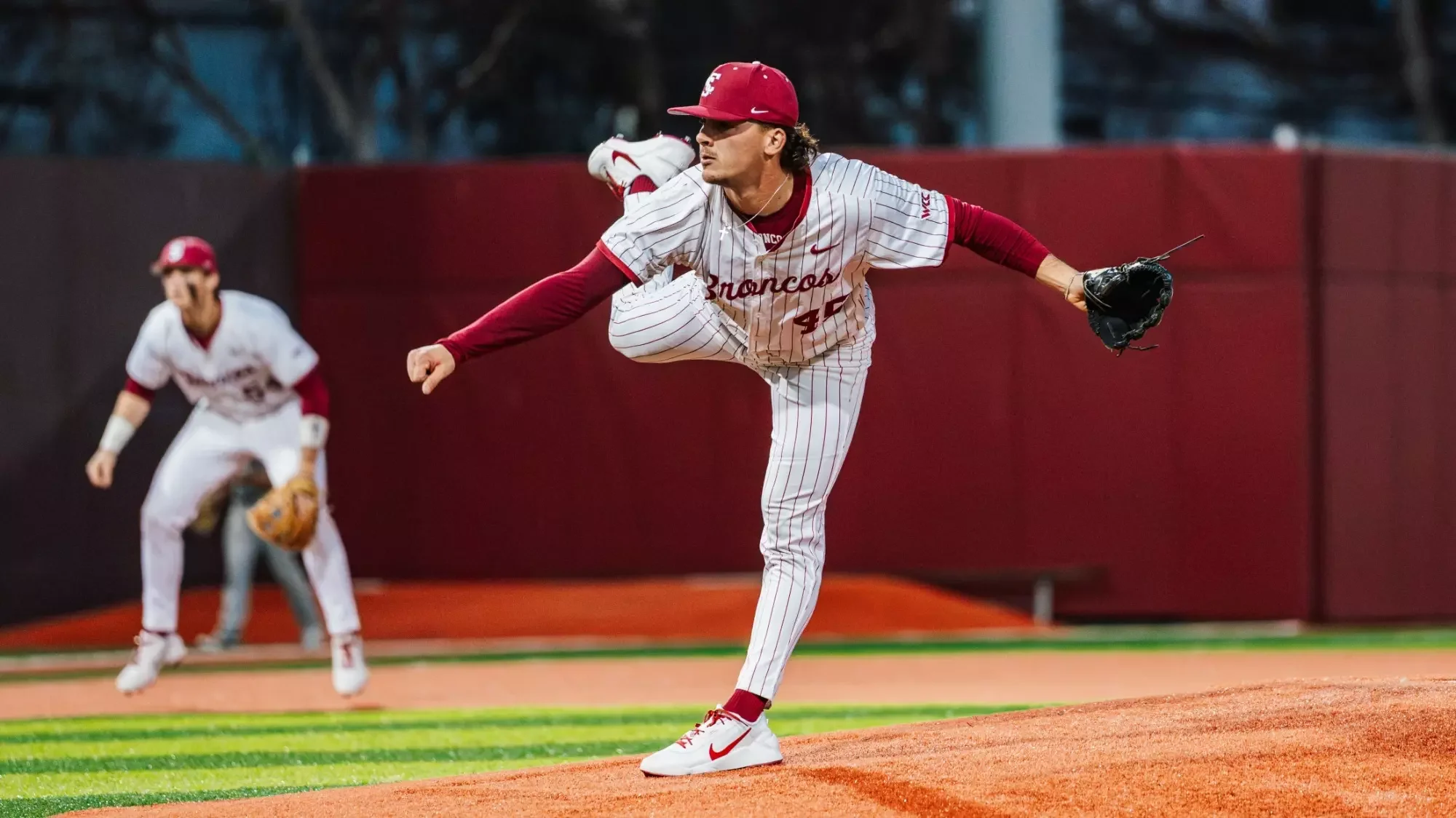
It’s been seven years since the University of Santa Clara has had a player selected within the MLB Draft, when RHP Keegan McCarville went to the Milwaukee Brewers at pick #1093. The years-long streak will come to an end this year when Max Bayles receives a call from an MLB organization. Bayles has had a great year for the Broncos with a 2.54 ERA and 34.6% K rate, and he offers the potential to be a legitimate diamond in the rough in this year's class.
Bayles extends very well down the mound, getting ~6.5 feet of extension from his 6'3" stature. At the moment, his primary offering, his four-seam fastball, is pretty rough. The pitch averages 91 MPH with a heavy cut-ride profile at 18.5 inches of IVB and 1.6 inches of HB. The general movement profile seems impressive until Bayles’ release traits are factored in, with the pitch’s IVB becoming much more plain when thrown from Bayles’ 6.6-foot release height. The pitch predictably has not performed well at all, with an 8.5% Zone Whiff rate and 42.5% hard-hit rate, and whatever organization selects Bayles will certainly be banking on him being able to gain velocity on the pitch in some way and cutting down on its usage as much as possible.
Banking on a WCC pitcher with a poor fastball and 13.6% BB rate may seem like a poor idea, but his slider is more than good enough to justify a look. The pitch sits 81.5 MPH with -5.1 inches of HB and wipeout depth at -5.7 inches of IVB, grabbing as high as -10 on occasion. Coming off of Bayles’ incredibly high release, the pitch topples over and looks incredibly steep to hitters with a VAA ~ -9.5°. The incredible angles and deception created by the release cause opposing batters to have some of their ugliest swings on pitches out of the zone, leading to the pitch holding a 36.2% chase rate and 52.1% whiff rate.
Bayles spins his breaker exceptionally well at ~2750 RPM, and with his advanced feel for spin, he very well could be able to develop an above-average second breaker to pair with it. He does throw a changeup that has flashed some promising results, but at 13.4 inches of IVB and 12.5 inches of HB, the pitch doesn’t get enough vertical separation from his fastball for me to be convinced it will transfer in its current state.
Bayles, like any other mid-round pitching prospect, is not without his risks. He evidently has not faced the same level of competition as many of his peers have, and he’s shown immense struggles landing his pitches for strikes. I’m not attempting to ignore the fact that the odds are certainly against Bayles sticking as a starter, but with his immense spin capacities and the wipeout slider he’s already demonstrated, I’d certainly be willing to take a risk on him in what’s likely a later spot than any other prospect I mentioned. He’s the exact type of blank-slate prospect that could be a fun way to test the strength of the newly revamped development system.