
Cardinals Prospects 2026 Mock Draft 1.0
Credit: LSU
We are less than two months away from the 2026 MLB Draft, and the Cardinals have an opportunity to add a franchise-altering group of talent to a farm system already viewed as one of the strongest in MLB. They are slated to pick six times inside the top 86, something they haven’t done since the 2012 Draft — a class headlined by Michael Wacha.
As the Draft gets closer, I thought it would be fun to put together a mock draft for the Cardinals’ first six selections. The Cardinals Prospects team and I have worked through several mocks over the past few weeks, but this article will focus on my personal mock.
Without further ado, here is my first mock draft for the 2026 MLB Draft.
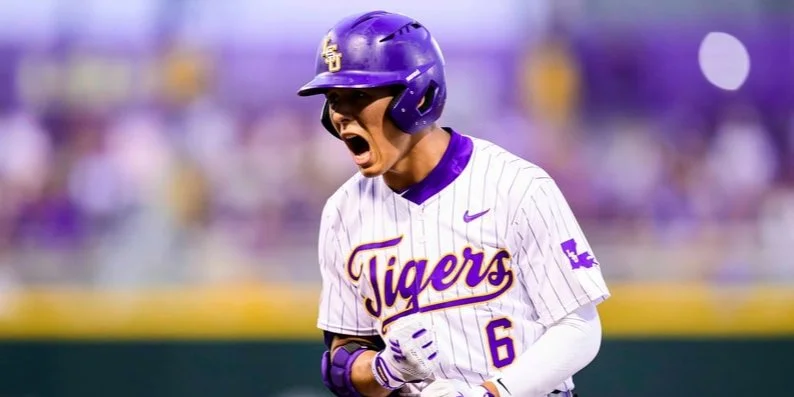
No. 13 (1): Derek Curiel, OF, LSU
Curiel was viewed as one of the top prep bats in the 2024 class, but he opted to take the college route at LSU. That decision has paid off, as the draft-eligible sophomore is now seen as a surefire first-round pick. Curiel has one of the strongest hit tools in the class. Among Power Four hitters with a hard-hit rate above 50%, his 87.8% contact rate ranks first. There is also more raw juice in the bat than you might expect, as Curiel owns a 105 mph 90th-percentile exit velocity, ranking in the 85th percentile. He has yet to fully translate that raw power into consistent in-game production, but there is still room for Curiel to fill out his 6-foot-2 frame, and he is one of the youngest college prospects in the class. He began his collegiate career as LSU’s left fielder, but he has the tools to handle center field and has made a seamless transition there thanks to his 70-grade speed.
No. 32 (CB-A): Ben Blair, RHP, Liberty
Blair fits the mold of the low-release, flat-approach-angle pitchers the Cardinals have targeted in recent years. The Liberty right-hander owns a 3.87 ERA across 81.1 innings this season while walking a minuscule 3.6% of hitters. His calling card is a fastball that sits a tick over 94 mph and has reached as high as 98.2. The pitch only gets around 10 inches of induced vertical break, but it comes from a low 4.8-foot vertical release height. The fastball is a flat-VAA monster, coming in at -4.5 degrees, and it plays even flatter when he is able to locate it in the upper third of the zone. Blair gets elite extension down the mound, effectively adding 1-2 ticks of perceived velocity to his pitches. He rounds out the arsenal with an 83 mph sweeper that gets 12 inches of glove-side movement and a high-vert cutter at 86 that helps bridge the east-west profile. He has tinkered with a changeup in college, and I envision him developing a viable one in pro ball.
No. 50 (2): Beau Peterson, 3B, Mill Valley HS
Peterson showed off his powerful left-handed swing at the 2025 Prep Baseball All-Star Game Home Run Derby, where he recorded exit velocities up to 109 mph. He carried that production into games against strong competition, posting a .921 OPS in showcases and tournaments, per Overslot. Peterson posted an in-zone contact rate in the 96th percentile during the 2025 summer circuit, giving him an intriguing blend of bat-to-ball ability and power potential. The batted-ball profile on the circuit was more modest, but he has made some swing adjustments this spring, showing a smoother, more controlled bat path without sacrificing his plus bat speed. Peterson is also an interesting pitching prospect, and his strong arm should fit nicely at third base, where he projects long term.
No. 68 (CB-B): Caden Ferraro, OF, Texas Tech
Ferraro is one of the premier data-darling hitting prospects in the 2026 class. He is one of only two college hitters with a 90th-percentile exit velocity above 109 mph, a contact rate above 80%, and a chase rate below 20%, with the other being potential 2027 first-overall pick Brendan Lawson. There’s a strong case that Ferraro is the single best college hitter in the class. If I’m being nitpicky, the one area that could unlock even more of his offensive ceiling is getting to more of his power to the pull side. He has played the majority of the season at DH, and likely does not profile as more than a fringy defender in a corner, but the bat will certainly play. The defensive profile creates some questions, but Ferraro’s offensive upside makes him easy to buy into.
No. 72 (CB-B): Carson Kerce, INF, Georgia Tech
Georgia Tech has two potential top-ten picks in Drew Burress and Vahn Lackey, but Carson Kerce’s underlying data is right there with both of them. There are only three college hitters age 22 or younger with a 90th-percentile exit velocity of at least 106 mph, a chase rate of 20% or lower, and an in-zone contact rate of at least 90%: Christopher Hacopian, Caden Ferraro, and Carson Kerce. Among that group, Kerce owns both the highest average exit velocity at 94.6 mph and the highest hard-hit rate at 62.2%. Kerce is an exceptional gap-to-gap hitter and recently set Georgia Tech’s single-season doubles record. He’s playing shortstop for the Yellow Jackets and has the instincts to stay there as a pro, but he also showed his versatility on the Cape by playing second, third, left, and short.
No. 86 (3): Clayton Freshcorn, RHP, Texas A&M
Freshcorn has had a dominant season as Texas A&M’s closer, but he also checks a lot of the boxes you look for in a potential starter conversion. He’s a low-launch right-hander who sits around 93 mph with his fastball and gets an extremely flat -4.36 VAA, which ranks in the 98th percentile. He’s an athletic mover on the mound and generates above-average extension for his stature. Freshcorn pairs the fastball with two distinct breaking balls: an 86 mph slutter and an 83 mph sweeper with 14 inches of glove-side movement. He has also sparingly thrown a changeup that has produced strong results in a limited sample, with the ability to effectively kill spin around 1,200 rpm. Freshcorn has walked just five batters in 42.2 innings this season, good for a 2.7% walk rate. There is some aggression in the delivery, but the traits are there to make the conversion.
